
He Won the Golden Rooster. The Next Morning, He Was Just Another Guy Waiting for a Train.
Tony Leung Ka-fai spent forty years proving that being a movie star and being a working actor are two different jobs.
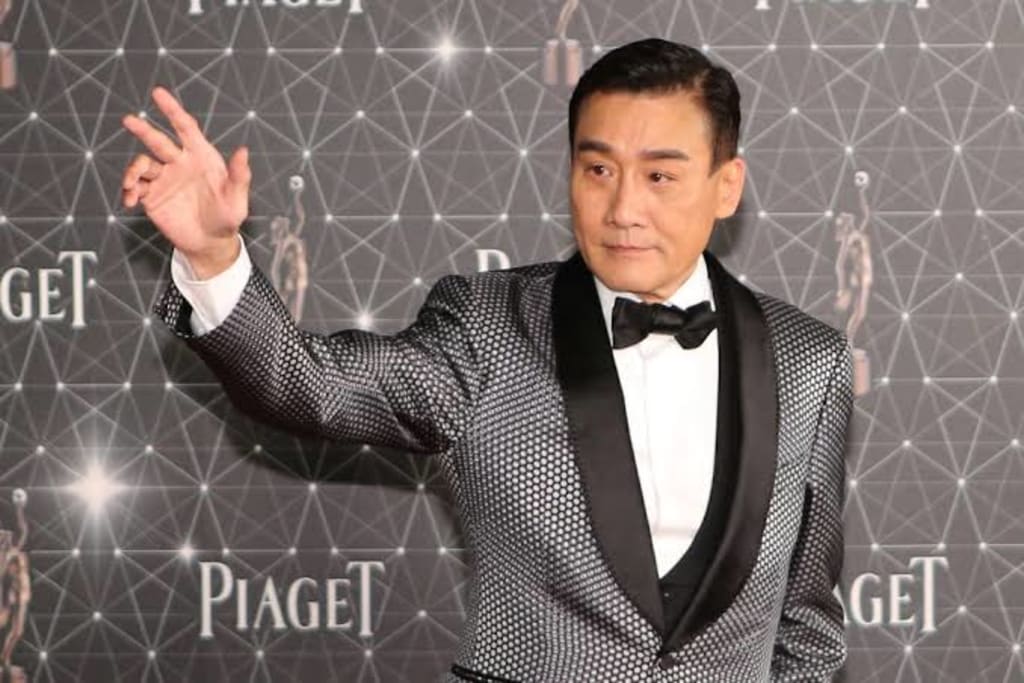
Xiamen, November 2026. The day before the Golden Rooster Awards ceremony, someone photographed Tony Leung Ka-fai at a high-speed rail station. He was sitting in a waiting-room chair, a suitcase standing by his feet, a backpack on his knees, his head lowered. He looked asleep, or like he did not want to talk. After the photo spread, the word that came up most in the comments was “surprising.” A man who, wherever he went, should have had someone to carry his suitcase. How was he taking the high-speed rail alone?
The next night he stood on the Golden Rooster stage with a Best Actor trophy in his hand. It was his first Golden Rooster nomination and his first win. He paused for more than ten seconds before speaking: “I’ve been in film for more than forty years. This is the first time I’ve been nominated for a Golden Rooster, and to have the award in my hand, it feels very strange, very dreamlike… Winning an award doesn’t mean you can knock off. Time to get to work.”
The audience laughed. He didn’t.
In 1984, the 3rd Hong Kong Film Awards gave Best Actor to a twenty-six-year-old Leung. The film was Li Han-hsiang’s Reign Behind the Curtain, in which he played Emperor Xianfeng, a timid, coughing emperor who shrank behind the curtain. He later admitted that he didn’t know how to act then. The director told him where to walk, and he walked. Told him what expression to make, and he made it. The trophy came anyway, along with a record: the youngest Best Actor in the history of the Hong Kong Film Awards, still unbroken.
Then the blacklist came. The Taiwan authorities, because he had made a mainland film, crossed him off the Hong Kong film industry. At the time, Hong Kong films depended heavily on the Taiwan market. Crossing off one person meant crossing off his film contracts and bookings together. Four years. No films.
Leung went to Causeway Bay to sell from a street stall. Leather goods: bracelets, necklaces, keychains. He bought his own stock and hawked it himself. He later said in interviews, “I made good money at that stall,” and “How could I cry when I was counting bills every night before bed?” He smiled when he said it. Not the smile of a man who had boiled his suffering down into chicken soup. The smile of a man talking about something that had ended long ago. When he counted bills, his fingers smelled of the glue from the leather goods. After closing the stall, he bought a bottle of water at a convenience store, squatted by the roadside and finished it, then walked home. Four years passed like that.
He rarely brought those days up later, but they were there. A man who had dealt with hawker-control officers on the streets of Causeway Bay was not likely to treat “Best Actor” as something that had to be held up at all times. The ease in his later acting probably had its roots there. He never held himself aloof. He never strained.
In 1992, Jean-Jacques Annaud’s The Lover took him to another scale. After its French release, the film broke a two-year box-office record in France and grossed about $45 million worldwide. The 18th César Awards gave it Best Original Music, along with nominations for Best Cinematography, Best Foreign Film, and Best Editing. The 65th Academy Awards gave it a Best Cinematography nomination. Leung himself did not win a César or an Oscar for acting for the film. A Hong Kong actor becoming a recognizable face to European audiences in a French literary film was enough.
Thirteen years later, Johnnie To’s Election made him remembered another way. Big D was arrogant and violent, and he calculated every move. Leung’s approach was to “not play arrogant.” In the cha chaan teng ordering scene, the tips of his chopsticks hover for half a second before picking up the char siu. As he chews, his jaw muscle twitches slightly. His Adam’s apple bobs three times before he swallows. The body is not performing fierceness. It is sounding an alarm left by years of trading violence for safety. The same line, when spoken to a subordinate, rises in the nose with mockery. To a rival, it lowers into a breathy voice. To an elder, it trembles slightly at the end. He does not build authority by shouting. He builds it with pace and pauses, and with the way he swallows.
Election was selected for the main competition of the 58th Cannes Film Festival. Leung walked the red carpet with Johnnie To and the cast. French fans shouted his English name. A few female fans held roses. The screaming at Cannes was loud. People who were there still laugh when they remember it.
A few months later, Leung appeared in On the Taihang Mountains, produced by the August First Film Studio, playing the one-armed Eighth Route Army regimental commander He Bingyan. No fee. Not a cent. A reporter on set asked him: You’re an international star. Why come do a cameo in such a small role? Leung looked at the reporter with surprise and shot back: “What do you mean, a cameo in a small role? I’m a regimental commander!”
To play the commander, he taped and strapped his left arm behind his back, twisted backward. That arm later hurt more than the stones thrown up by the squibs hitting his body. He refused to “show off” a military salute off camera: “How can you just show off a military salute?” Put the two things together. A man whose name was being shouted on the red carpet. A few months later, the same man running around barren hills with one arm strapped behind his back. No explanation is needed.
Fu Longsheng. The mastermind behind a gang of thieves. The kind of villain most easily played as “entering with a fierce face, every word a threat.” Leung did not play him that way. He relied on his eyes and small shifts of the body. Under the gentility, cunning. Inside paternal love, cruelty. One review said his Fu Longsheng was “more like a viper,” with “not a shred of emotion in his eyes.” His most easily overlooked skill is letting a villain go most of the film without sending threat signals while the audience knows the threat is there.
The Golden Rooster gave him Best Actor. Onstage he said, “Very strange, very dreamlike,” then added, “Winning an award doesn’t mean you can knock off. Time to get to work.” In anyone else’s mouth this might be modesty. In his, it was literal. After the ceremony, he would probably go back to Huizhou, back to the set of The Shadow’s Edge 2, trading blows with Jackie Chan, forced to exercise every day.
A few months earlier, at a Hundred Flowers Awards forum, he had said something else. Speaking about the film industries of the mainland and Hong Kong, he choked up and said: “I didn’t ‘go north.’ I returned.” In 1983, at twenty-four, Li Han-hsiang brought him to Beijing to shoot The Burning of the Old Summer Palace and Reign Behind the Curtain. In the Forbidden City he shaved his head, wore imperial robes, and learned to walk. More than forty years later, he called it “returning.” Not a line for the occasion. From Beijing to Causeway Bay to Paris to Cannes to the Taihang Mountains to Huizhou, his career maps that sentence.
After the Golden Rooster ceremony, a reporter asked him about the photo at the rail station. Leung half-jokingly said: “Actually, a lot of people came with me. They just happened to go to the convenience store, or maybe the restroom.” The reporter laughed. He laughed too.
In the photo his head is lowered, the suitcase standing by his feet. The station announcements are playing. People are lining up to have their tickets checked. Someone is squatting in a corner eating instant noodles. He sits there like a man who has just finished work, waiting for a ride home. Tomorrow he has to go to work again.
About the Creator
Jin
Writer of reamstories
https://reamstories.com/jin
Enjoyed the story? Support the Creator.
Subscribe for free to receive all their stories in your feed. You could also become a paid subscriber, letting them know you appreciate their work.
Comments
There are no comments for this story
Be the first to respond and start the conversation.