
He Told the Truth at a Meeting. The Room Buried Him.
A scene from Canglang Zhi Shui explains why office honesty becomes a group-risk problem.
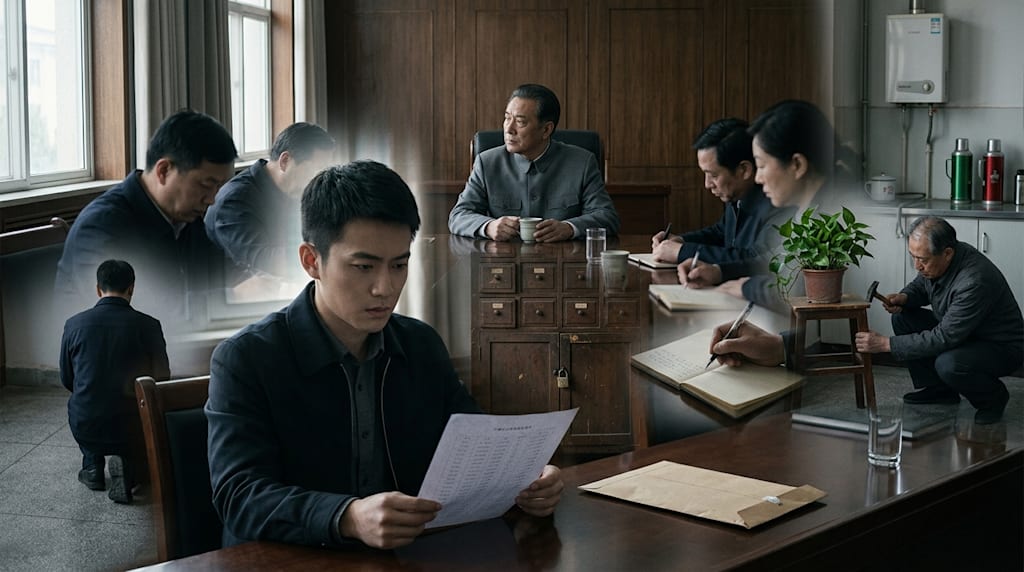
Chi Dawei sat at the long table of the branch democratic-life meeting, holding a sheet of figures he had copied from the finance office. Over three hundred thousand yuan for an imported sedan. The department’s entire annual hospitality budget was about that much. He spread the paper on the table and read item by item: the car price, customs duty, insurance, follow-up maintenance. When he finished, he added that if the money were spent on upgrading grassroots health stations, it could cover a certain number of sites. He did not look at Director Ma as he said this. His eyes stayed on the sheet of paper.
Director Ma listened, nodded, and said that speaking the truth was good. A democratic-life meeting was exactly for hearing opinions and criticism. Then he picked up his teacup, took a sip, and said, “Next.” The room went quiet for a few seconds. Someone began flipping through a notebook. Someone else looked down at a phone. When the meeting broke up, Xiao Mo walked past Chi Dawei faster than usual. That afternoon, in the corridor, Chi Dawei heard Xiao Mo say to two other people: “There’s a problem with Xiao Chi’s calculation. He only counted the cost of the car, not the protocol requirements for receiving foreign guests. It’s one-sided.” The voice was not loud, but a corridor is only so wide.
Not long afterward, the transfer order came down. Chi Dawei was sent to the Society of Traditional Chinese Medicine. The office was on the second floor of another building, with a north-facing window. In winter the radiator was only half warm. He sat behind that desk for four or five years. During those years, he occasionally ran into Xiao Mo in the canteen. Xiao Mo would nod and say, “Xiao Chi, busy lately?” Then he would carry his tray to another table.
Chi Dawei’s father had encountered something similar, only earlier, and at a greater cost. The day Zhu Daofu knelt before his father, Chi Dawei was still small, but he remembered the sound of Zhu Daofu’s knees hitting the ground, dull, like a sack of rice dropped on the floor. His father helped him up and said, “Don’t worry. I’ll say what needs to be said.” His father said it. Later, at a struggle session, Zhu Daofu stood up, pointed at his father, and said, “He has spread disgruntled remarks before.” He said it with chapter and verse, even inventing times and places. His father was labeled a rightist, expelled from the county TCM hospital, and took young Chi Dawei into the mountains. The clinic there had only three rooms. The medicine cabinet was nailed together by his father himself. The bottom shelf held arsenic and alcohol, and it was locked. When Chi Dawei was little and hungry, he stole brown sugar from the top of the cabinet and was hit across the palm with a bamboo ruler. To the end of his life, his father said he had done the right thing. Later, whenever Chi Dawei thought of the way Zhu Daofu had knelt, he felt that the sound of that sack of rice hitting the ground was louder than any words.
During the Health Department’s campaign to clean up the Chinese medicine market, Chi Dawei and Ding Xiaohuai went down to investigate for three days. Chi Dawei wrote in his notebook: at the east-city warehouse, forty-seven boxes of moldy angelica; at the south-city clinic, decoction pieces cut with Guanmutong; at the west-city pharmacy, labels that did not match the actual ingredients. When they returned to report, Chi Dawei opened his notebook and read item by item. Ding Xiaohuai sat beside him. After Chi Dawei finished reading, Ding Xiaohuai cleared his throat and said to the division chief: “Some of what Chi Dawei recorded was dampness from transport, not necessarily fake medicine. And with that batch of Guanmutong, our sampling method may have had problems. I suggest we verify it again.” The division chief glanced at Ding Xiaohuai and said, “Then verify it again.” Chi Dawei sat there, his notebook still open, his finger pressed on the line that read “forty-seven boxes.” Later he went to Yan Zhihe. Yan Zhihe was watering the pothos on the windowsill. After listening, he said only one thing: “That notebook of yours. Before you write in it, think about who’s going to read it.”
Ding Xiaohuai was promoted later. From the cold bench at the Society of Traditional Chinese Medicine, Chi Dawei watched Ding Xiaohuai go from staff member to deputy division chief, then to division chief. Once, at a department-wide meeting, Ding Xiaohuai sat in the first three rows, and Chi Dawei sat near the door. When the meeting ended and the crowd flowed out, Ding Xiaohuai walked past Chi Dawei, chatting and laughing with several people, without turning his head. Chi Dawei clutched the meeting materials in his hand. The edge of the paper was creased where he had squeezed it.
The day Shu Shaohua came to see Chi Dawei, he brought a kraft-paper envelope. Inside was a letter listing Director Ma’s “seven great crimes,” from infrastructure bidding to personnel arrangements. Behind each item were signatures from experts whose names were known in the field. Shu Shaohua spread the letter in front of Chi Dawei and said: “Dawei, you know better than anyone how Director Ma has treated you at the Society all these years. The atmosphere in the department matters now.” Chi Dawei looked at the signatures. He knew several of them. One had even taught him. His fingers moved along the edge of the envelope twice. Shu Shaohua added: “You don’t need to do anything. Just sign your name. We’ll submit it jointly, and the higher-ups will take it seriously.” Chi Dawei said, “Let me think.” As Shu Shaohua left, he left the envelope on the table and said, “Take your time.”
Chi Dawei took the envelope to Yan Zhihe. Yan Zhihe was repairing an old chair, his hammer striking the tenon, one blow after another. Chi Dawei explained what the letter said. Yan Zhihe did not look up. He asked, “If this works, where do you sit?” Chi Dawei said nothing. Yan Zhihe asked again, “If it fails, what are you?” The hammer stopped. Yan Zhihe turned the chair over, looked at the tenon, and said, “What Shu Shaohua wants is your name, not your heart. If you sign, you’re just a number on his letter. If he doesn’t get you to sign, he’ll find someone else to sign. It’s the same.” Chi Dawei put the envelope in his bag and that evening went to Director Ma’s home. Director Ma opened the door wearing slippers, a remote control in his hand. Chi Dawei told him that Shu Shaohua had come to see him, told him what the letter contained, told him who had signed. After listening, Director Ma set the remote on the shoe cabinet and said, “Dawei, sit down.” That night Chi Dawei sat at Director Ma’s home until eleven and drank three cups of tea. Later he was transferred back to the department, and later still promoted to deputy division chief.
Yan Zhihe later said something to Chi Dawei in that north-facing office at the Society of Traditional Chinese Medicine. Yan Zhihe plucked the withered leaves off the pothos and threw them into the wastebasket. He said: “After you’ve been in this circle long enough, the most reliable way to look at people and things is from the standpoint of interests. Friendship and moral vision are not dependable. Friendship in this circle is calculated, not grown. Once you’re no longer in the position, the friendship ends.” He did not look at Chi Dawei as he spoke. His eyes were on a newly sprouted pothos leaf, tender green, its edge curled. Chi Dawei did not answer. He turned a page of the document on the desk.
The time Section Chief Shen tested Chi Dawei about his relationship with Director Ma was in the water room. Section Chief Shen was filling his thermos and asked, “Dawei, did you know Director Ma before?” Chi Dawei screwed the lid onto his cup and said, “I met him once during my internship four years ago. I’ve forgotten even what he looks like.” Section Chief Shen said, “Oh,” and then, “That’s fine too.” Chi Dawei took his cup and left. He did not look back, and he did not add anything. The cup was full of freshly poured hot water. It burned his hand, so he switched hands.
Chi Dawei did not stop speaking. During his years at the Society of Traditional Chinese Medicine, he still wrote the reports that needed writing and reported the data that needed reporting. But before reporting, he would first think it through: who would see this data, and how they might use it after seeing it. Once the department needed a research document on grassroots medical sites. Chi Dawei finished it but did not submit it directly. First he made a copy and put it in his drawer. Then he submitted the original. When he handed it in, he checked the original against the copy: page numbers, signatures, dates. Only after everything matched did he put it in the envelope. The envelope was kraft paper. He glued the flap shut, then pressed it down.
The pothos on the windowsill had been repotted. Yan Zhihe had left it to him before retiring. Chi Dawei watered it once a week and picked off the dead leaves when he did. One leaf had yellowed along half its edge. He picked it off, held it in his palm for a moment, and threw it into the wastebasket. In the wastebasket there was also an old document from yesterday, bearing his handwriting from four years earlier, written with a fountain pen, the ink slightly smudged. He turned the pothos pot so that the newly sprouted leaf faced south.
About the Creator
Jin
Writer of reamstories
https://reamstories.com/jin
Enjoyed the story? Support the Creator.
Subscribe for free to receive all their stories in your feed. You could also become a paid subscriber, letting them know you appreciate their work.
Comments
There are no comments for this story
Be the first to respond and start the conversation.