
He Refused to Buy a Coffee at Starbucks. Then He Called the Police.
A seat dispute in Nanjing shows what happens when “the customer is always right” meets a customer who won’t follow the rules.
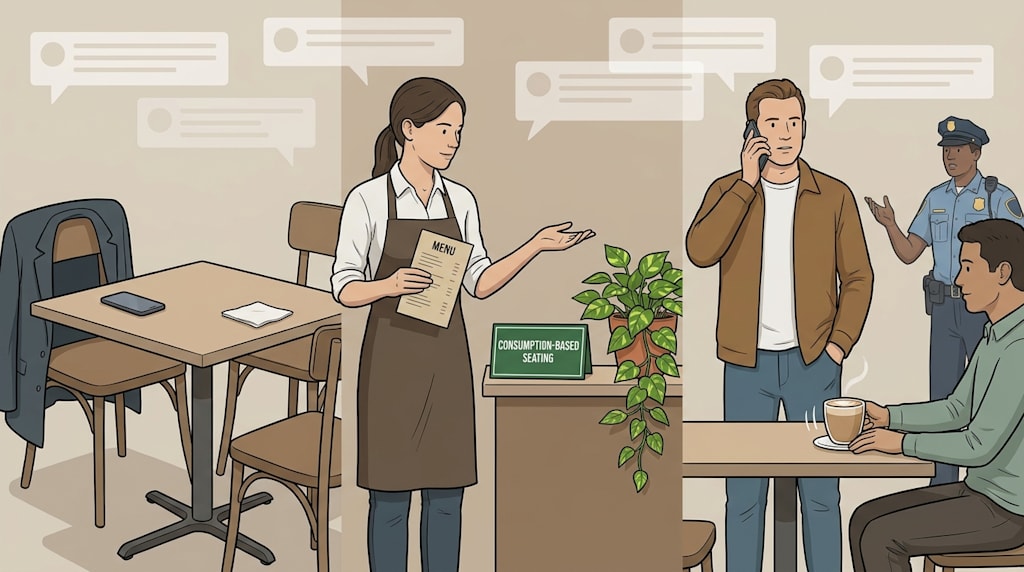
There was no cup in front of the man.
On the table were only a phone, a jacket draped over the back of the chair, and a napkin pushed to the corner. When the employee walked over for the third time, she was holding a menu. She bent down slightly, kept her voice low, and said, “Sir, these seats are for customers who make a purchase. Would you like to order something first?”
The man looked up. He looked at the menu, then at the employee, and said, “What kind of attitude is that?”
That sentence was later quoted by many people. In the store at that moment, it only made the air pause. The employee took half a step back, wiped her hand on her apron, and said, “Sorry, I was just reminding you. We have a consumption-based seating policy.”
The man did not order anything. He took out his phone and called the customer service line to file a complaint. No one nearby could hear what was said on the other end. They only saw him standing beside the seat, his jacket still over the chair, his voice rising. The complaint led nowhere, so he called the police.
By the time the police arrived, the store manager had already come out from the back room, still holding an inventory clipboard. The manager put the clipboard on the counter, said a few words to the officers, and pointed to a small sign beside the seat. The sign was not large. It stood next to a pothos plant. It read “Consumption-Based Seating” in white letters on a green background. If you were not looking carefully, you could easily miss it.
The police mediated for a few minutes. The man picked up his jacket and left. The seat emptied, and soon a person holding a latte sat down. The bottom of the cup tapped the table, very softly.
When the story spread online, some people typed out the phrase “the loudest gets the deal,” then deleted it and replaced it with something shorter: refusing to buy anything, occupying a seat, and calling the police when reminded is not defending your rights.
The comment was blunt, but the direction was right. A café seat is not a park bench. The air conditioning, the outlets, the Wi-Fi, the restroom, the paths employees walk back and forth, all of it costs money. A business opens its doors and welcomes people to sit down, but “welcome” does not mean “unconditional.” In a busy mall store, if one table sits empty all afternoon because someone is not buying anything, while paying customers walk around with cups in their hands and cannot find a place to sit, that costs the business. It also costs ordinary customers.
“Consumption-based seating” is a rule for allocating a business’s own resources. The rule is printed on a sign. The employee walks over and reminds the customer. That is already a relatively gentle way to enforce it. If a customer does not accept it, he can leave. He can go to another store. He can sit at home. But turning “please order something” into a complaint and a police call is no longer a discussion about rules. It is an attempt to rewrite the rules by volume.
The fact that the man left after police mediation says something. If the business had infringed on his rights, if the employee had been so abusive that police intervention was necessary, the matter would not have ended with him leaving the store. It looks more like a person who knew he was not on solid ground used every means he thought he had, only to find that those means did not work.
There was another sarcastic comment online. It was harsh, but its logic held: a person who would never spend money at Starbucks in the first place has only one way to boycott Starbucks. He can not go there in the future. It sounds like a “mutual departure,” but it points to a simpler fact: a stable consumer relationship is not built by making a scene. A business losing a customer who was never going to buy anything has limited impact. But if it becomes so afraid of complaints, police calls, and public opinion that it turns a blind eye to every act of seat occupation, what it loses is the trust of the customers who spend money.
That does not mean the business has “won completely.” Rules must be clear. Reminders must be polite. Enforcement must be consistent. Frontline employees must be supported. If any one of these three is missing, a small incident can become a big problem. When the employee walked over, she was holding a menu, not an eviction order. When the manager came out, he put down the clipboard before speaking. When the police arrived, the sign was right there beside the pothos plant. The rule was visible. These details determine whether the situation is “normal management” or “bullying a customer.”
When criticizing the customer, there is no need to slap on labels like “giant baby,” and even less need to aim the criticism at a particular age group. Labels feel satisfying, but they easily turn a specific issue into an emotional release. A more accurate criticism is this: a small number of customers treat the business’s courtesy as a given and normal management as a personal insult. Not buying anything is fine, but occupying a seat should have limits. Having an opinion is fine, but defending your rights cannot depend on making a scene.
This is also the dilemma of the service industry. We should emphasize the spirit of service, but the spirit of service does not mean endless concession. Employees are workers too, not emotional punching bags. When a business encounters clearly unreasonable seat occupation, troublemaking, or verbal abuse, it should have a clear process: first a polite reminder, then a clear statement of the rule, and if necessary, assistance from mall management or the police. Good service means making people who follow the rules feel comfortable and making people who do not follow the rules understand where the boundary is.
After the man left, the seat was taken by someone holding a latte. The cup tapped the table, very softly. The employee returned behind the counter, put the menu back in its place, and continued wiping cups. The sign beside the pothos plant was still there, white letters on a green background. No one brought the matter up again. The store stayed open. The seats continued to be occupied, and people continued to leave. The rule did not change because of one police call, nor did it become invalid because of one mediation. It was simply there, like the sign, not loud, but present.
What is worth remembering is what happened after the seat emptied: a normal paying customer sat down. The point of rules in public space is to make that happen smoothly, without a complaint, without a police call, without drinking a stomach full of anger before ever getting a cup of coffee.
The man left. The seat remained. The next person walked over with a cup, sat down, and took a sip. That is what it looks like when a rule works.
About the Creator
Jin
Writer of reamstories
https://reamstories.com/jin
Enjoyed the story? Support the Creator.
Subscribe for free to receive all their stories in your feed. You could also become a paid subscriber, letting them know you appreciate their work.
Comments
There are no comments for this story
Be the first to respond and start the conversation.