
He Is 180 Centimeters Tall. The Box Is 56. The Viral “Bone-Shrinking” Clip Gets the Trick Wrong.
Inside the contortion act at Macau’s House of Dancing Water, the training that makes it possible, and the small backstage details the camera misses.
One
The second the box door opened, someone in the theater gasped.
It was not loud. You could hear it from the third row. It sounded like someone setting a glass of ice water on a table. The bottom of the glass knocked against marble.
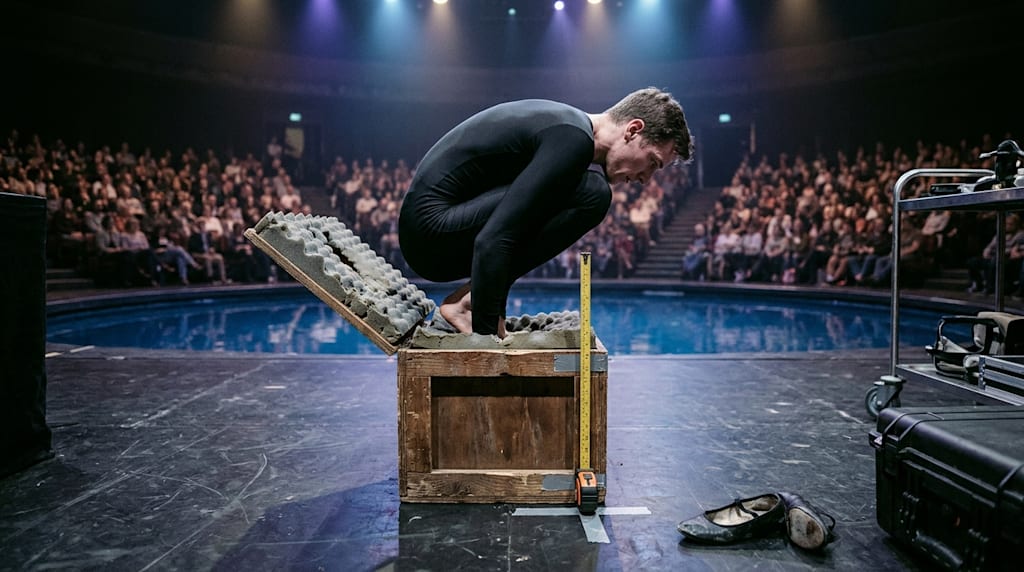
A person was curled inside the box. His knees pressed against his chest. His ankles folded under his backside. His head tilted to one side. His shoulders were wedged between the box wall and his knees. He wore a black tight suit. The muscles in his back bulged in strips, like a wrung-out towel.
He crawled out. One foot first. Then one leg. Then his whole body. He stood up. He stood straight. He reached up and touched the air above his head.
180 centimeters.
The box was 56 centimeters high, 40 centimeters deep, and 43 centimeters wide. I measured it backstage later. A staff member held a tape measure up for me. The tape stopped at 56 centimeters. When the lid closed, a corner of the black tight suit was stuffed into the gap.
The audience was quiet for two seconds. Then the applause started. It was louder than the applause after the diving segment.
https://www.douyin.com/video/7559132052982992186
Two
In short videos, people call this “bone-shrinking kung fu.”
Comments scroll past. “This is the legendary bone-shrinking kung fu.” “Can bones shrink?” “Fake, right?”
A boy in a school uniform sat next to me. He was maybe fourteen or fifteen. He turned to his mother and asked how the man got in there. His mother shook her head and said she did not know. The boy took out his phone and started searching. The screen light fell on his face. He searched “bone-shrinking kung fu principle,” scrolled through three results, locked the screen, and looked up at the stage again.
Onstage, the 180-centimeter man had already walked to the edge of the pool. He crouched. He touched the water with his fingers. He stood up, took three steps back, ran, and jumped.
He kept the splash low. He surfaced at the other end of the pool, wiped his face, and waved toward the audience.
The box was still standing at the side of the stage. Its door was open. It was empty inside. A staff member walked over, closed it, lifted it, and put it in the prop area. As the box passed in front of me, I could see its size. It was not much bigger than a carry-on suitcase.
Three
Later I looked it up. The move is not called bone-shrinking kung fu. It is called contortion.
Performers start training at six or seven. Every day they press their joints. They pull the shoulder joints, hip joints, and spine apart segment by segment. By adulthood, their joint capsules are far looser than an ordinary person’s. Their shoulder blades can slide into positions they normally cannot reach. Their hips can rotate outward so far it looks like dislocation.
But he was not dislocated. Inside the box, his knees reached his chin. His spine curved into a C. His shoulder blades drew toward the center. His ribs pressed against his thighs. His breathing was shallow, about seven or eight breaths a minute. He exchanged air with tiny movements of the diaphragm.
He does not talk about these details onstage. Onstage he does only two things. He climbs into the box and crawls out. Then he goes to dive.
The audience sees a man climbing into a small box. The audience does not see this: from the age of six, he spent two hours a day stretching. After the joint capsules were loosened, his muscles had to be trained tighter to stabilize the bones. By the time he was twenty, his shoulders had dislocated habitually three times. After each reduction, he rested two weeks and went back to training.
Four
The stage of The House of Dancing Water has a 270-degree ring-shaped auditorium. The central pool holds 17 million liters of water. That is more than five standard swimming pools. The pool can be drained in tens of seconds. The floor rises and becomes dry land. A motorcycle bursts out from the land side, flies over the pool, and lands in the water. Performers jump from a high diving platform and land in the center of the pool.
After the dive, the 180-centimeter man climbed out of the pool, changed clothes, and returned to the stage. This time he carried a bag. The box was in the bag. He set the box in the center of the stage, knelt down, and opened the door.
The audience knew what he was about to do. They still went quiet.
He put one leg in first. Then he drew the other in. His shoulders went in last. He pressed his knees toward his chest with his hands, lowered his head, and slid his whole body into the box. The door was closed from outside.
Another person stood onstage, lifted the box onto his back, took two steps, and set it down. The door opened. He crawled out. He stood straight. He reached up and touched the air above his head.
The applause came again. This time it was louder. The boy in the school uniform stood up to clap. His mother pulled him back down. Even after he sat down he kept clapping. He did not stop until he had clapped a dozen or so times.
Five
After the show, I stood at the theater entrance for a while. The audience filed out. Some discussed the diving. Some discussed the motorcycle. Some discussed the box.
A man in a suit said to his companion that the box definitely had a mechanism. His companion said there was no mechanism. He had watched it the whole time. It was an ordinary box. The man in the suit shook his head. He said it was impossible. A 180-centimeter man could not fit in there.
His companion did not argue. The two walked toward the elevator. The man in the suit looked back at the theater entrance and muttered something.
I walked to the backstage passage. Staff were collecting props. The box was on the floor. Its door was open. I crouched to look. The walls were wood, lined inside with a thin layer of foam. There were several indentations in the foam, pressed out by knees and shoulders. A small patch on the bottom was worn shiny. His heels had rubbed it.
A staff member walked over, closed the box door, lifted it, and put it into a black prop case. The box was stacked on another box. The latch clicked shut. He pushed the cart toward the storage room. The wheels rolled over the floor. The sound grew fainter.
Six
Back at the hotel, I searched for the performer’s name. I could not find it. In the cast and crew list, the contortion section said “Performer.” There was no specific name.
Then I searched for “House of Dancing Water contortion training.” A 2015 interview came up. A retired contortionist said he retired because when he got up in the morning, his knees would not bend on their own. He had to use his hands to bend them before he could get out of bed. He was smiling as he said it. The reporter laughed too. At the end of the interview, the reporter asked what he wanted to say to the audience. He said, “Don’t learn this.”
I closed the page. Before the phone screen went dark, I saw my face reflected in it. I tried pulling my knee toward my chest. Halfway there I stopped. A tendon in the back of my thigh pulled and hurt.
I put my leg down. I picked up the key card on the table, went out, pressed the elevator button, went downstairs, and walked to the theater entrance. The doors were closed. The lights were dim. The box was not at the entrance.
Seven
The next day I went to see the show again.
Same seat. Same box. Same 180 centimeters. When he climbed into the box, I did not look at the box. I looked at the audience. In the third row, the seat was now taken by an old couple. When the box opened, the old woman covered her mouth for a moment. The old man patted the back of her hand.
The boy in the school uniform was not there. Neither was his mother.
After the show, I walked to the backstage passage. Staff were collecting props. The box was on the floor. Its door was open. I crouched to look. The indentations in the foam were still there. The small shiny patch rubbed by his heels was still there. A staff member walked over and closed the box door.
“Is it the same box every day?” I asked.
He glanced at me and nodded. “Same one. Been using it for years.”
“Has it ever been replaced?”
“It has. The last one lasted three years. The foam wore through, so we switched to this one.”
He lifted the box into the prop case and pushed the cart toward the storage room. The wheels rolled over the floor. The sound grew fainter. I stood up and walked out of the theater. The wind at the entrance was strong. It made the zipper pull on my jacket rattle.
I lowered my head and pressed the zipper pull flat. When I looked up again, the cart had turned the end of the corridor and was out of sight.
Eight
The box was 56 centimeters high, 40 centimeters deep, and 43 centimeters wide.
A 180-centimeter man climbs in once a day and crawls out once a day. The audience claps, leaves, posts on social media, and says “worth seeing in this lifetime.”
The next day, he climbs in again.
I did not search for “bone-shrinking kung fu” again. Searching would not help. What you find are principles. What you cannot find is the training behind them. A person starts at six. He spends two hours a day pulling his body into angles ordinary people cannot reach. He trains for more than ten years. Then he stands on a stage, climbs into a box, and makes the audience gasp.
The gasp is drawn and then fades. He is still in the box.
About the Creator
Jin
Writer of reamstories
https://reamstories.com/jin
Enjoyed the story? Support the Creator.
Subscribe for free to receive all their stories in your feed. You could also become a paid subscriber, letting them know you appreciate their work.
Comments
There are no comments for this story
Be the first to respond and start the conversation.