
He Called Him “Good for Nothing.” Nine Years Later, Trump Said It Back.
He Called Him “Good for Nothing.” Nine Years Later, Trump Said It Back.
Between Two “Good for Nothing”s
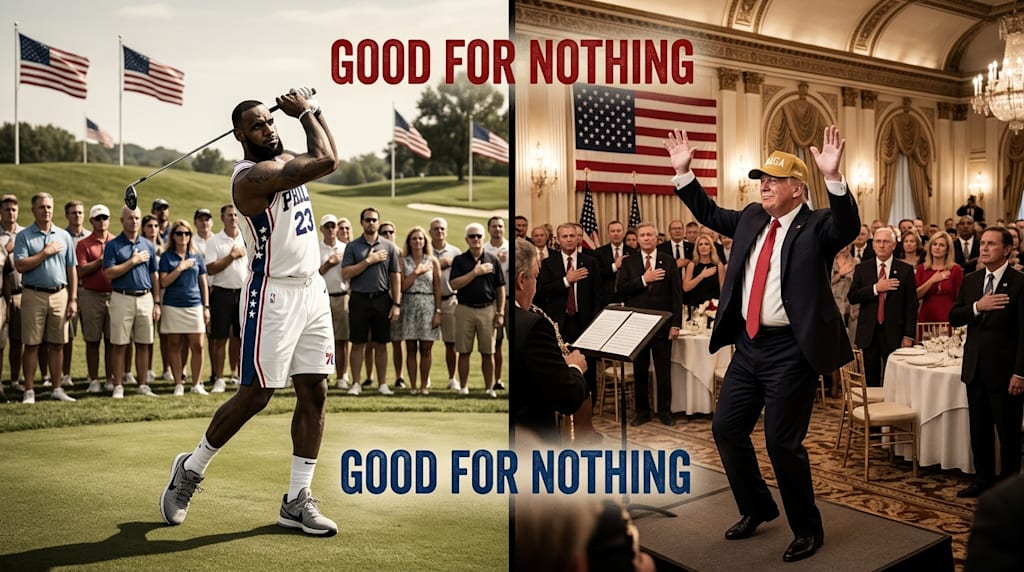
October 20, 2026, Madison Square Garden, New York. Before the season opener between the Philadelphia 76ers and the New York Knicks, “The Star-Spangled Banner” began. James stood in line. Most of his teammates had their hands at their sides or over their chests, bodies still. James did not. His arms were moving, his body turning slightly. He made a golf swing, finished the follow-through, then practiced two jump shots. When the broadcast camera swept past him, he was in the middle of his second shooting motion.
Two days later, Trump posted a video of the moment on Truth Social. His text read: “While listening to our national anthem, LeBron James disrespected our country! I said from the beginning that he was no good, a complete disgrace.” He demanded that James “apologize to all the great American soldiers and heroes who sacrificed for the American flag and everything this country stands for.” In another post, he put it more briefly: James was “good for nothing.”
“Good for nothing.” When the phrase appeared in October 2026, nine years had passed since it had last come from Trump’s keyboard.
In 2017, not long after Trump took office, James called Trump “good for nothing” on social media and wrote this: Trump “doesn’t understand that there are kids, no matter their race, who look up to the president of the United States, seeking guidance, leadership, and encouragement. He doesn’t understand that, and it disgusts me more than anything.” At the time, Trump was repeatedly speaking out about NFL players kneeling during the national anthem. At a rally in Alabama, he called those players “those sons of bitches” and demanded that teams fire anyone who refused to stand. James stood up for the players. Trump’s response was to mock James as “not smart” and to say publicly that when it came to the greatest of all time, he chose Jordan.
The rift between them began in 2016. That year, James published an article in his hometown Akron newspaper publicly supporting Hillary Clinton and appeared at a rally in Cleveland for her. After Trump won, James publicly expressed disappointment and chose not to stay in hotels bearing Trump’s name. In 2018, James criticized Trump for “using sports to divide America,” and Trump mocked him again. By the summer of 2026, James had joined the 76ers on a minimum contract. In an interview at the White House, Trump directly called him “probably a racist” and repeated, “I only like people who like me.”
So the “good for nothing” of October 2026 was not an improvised comment. It was a line saved for nine years and used again on the same opponent. Trump’s “I said from the beginning that he was no good”—the tense itself explains the problem: it is not an evaluation of a golf swing; it is the settling of an account that began accumulating in 2016.
But the standard Trump used to criticize James was one he himself had once failed to meet.
On February 2, 2020, Trump held a Super Bowl watch party at Mar-a-Lago. When the national anthem played, video from the scene showed him making motions with both hands as if conducting a band, his body swaying, looking around. Most people around him stood solemnly, hands over their hearts. He alone was conducting. That video also drew criticism at the time for “disrespecting the national anthem,” in almost the same wording he now used against James.
Trump had long been one of the loudest public defenders of anthem protocol. In 2017, he repeatedly attacked NFL players for kneeling during the anthem, calling it disrespect to the flag and the country. In 2018, the NFL introduced a policy requiring players to stand during the anthem. Then in 2020, he himself made conducting motions at a Super Bowl party.
None of this means “Trump did it, so James can do it.” That would be cheap symmetry. What it reveals is a problem: when the enforcer of anthem etiquette cannot consistently obey the norm he defends, the argument stops being about etiquette itself and becomes a contest over who has the standing to accuse whom.
James’s actions during the anthem are protected in law by a 1943 ruling. That year, the U.S. Supreme Court held in West Virginia State Board of Education v. Barnette that the First Amendment prohibits the government from forcing anyone to salute the flag or recite the Pledge of Allegiance. The Court’s opinion read: “No official, high or petty, has the power to require any student to pledge allegiance to the American flag.” This ruling overturned the position of the same justice only three years earlier in the Gobitis case, which had upheld compulsory saluting. The principle established in Barnette was later summarized as the basis of the “compelled speech doctrine”: the government cannot force an individual to express loyalty he does not hold.
It was this legal framework that later provided the constitutional basis for NFL players kneeling during the anthem, and that makes it impossible for James’s practice swings during the anthem to be subject to legal punishment. Legally speaking, James was free. Trump’s anger was aimed at something else: propriety. The law does not force you to respect, but public sentiment expects you to respect. Barnette settled whether the government can compel; it did not settle how a society should feel about those who choose not to express respect in the prescribed way.
Colin Kaepernick’s kneeling provides a reference. In August 2016, Kaepernick sat during the anthem in a preseason game; later, after talking with a veteran, he changed to kneeling. His action came with a clear statement and continuous explanation. James’s swing was much more ambiguous; he never gave a political explanation. But it fell into the same legal space marked out by Barnette: the state cannot force a person to express loyalty to a symbol in a prescribed way. Trump’s anger at both is structurally the same. What he defends is not a legal rule but an emotional norm he believes everyone should follow.
Back to October 2026. Two days after Trump’s “good for nothing,” the 76ers hosted the Cavaliers. When the anthem played, James stood with his hands behind his back and his head lowered. The motion had changed. He did not swing again, and he did not explain why it had changed. Asked about Trump’s remarks, he said: “Nothing to report from the office today, you know.”
Between the two “good for nothing”s lie nine years. In 2017, James used the word about Trump; in 2026, Trump used the same word about James. The word had not changed; the position had. In nine years, the anthem controversy had moved from NFL players kneeling to a basketball player swinging a golf club to a former president’s social media post. The law had not changed; Barnette was still there. The emotion had not changed; the people who were angry were still angry. What shifted was the direction of the accusation.
The anthem will play again. Someone will fail to stand according to protocol. The argument will return. And “good for nothing” will be ready.
About the Creator
Jin
Writer of reamstories
https://reamstories.com/jin
Enjoyed the story? Support the Creator.
Subscribe for free to receive all their stories in your feed. You could also become a paid subscriber, letting them know you appreciate their work.
Comments
There are no comments for this story
Be the first to respond and start the conversation.