
Harry Kane's Ballon d'Or Is a Win for the Quiet Ones
He didn't have the loudest year. He had the most consistent one—and the award finally noticed.
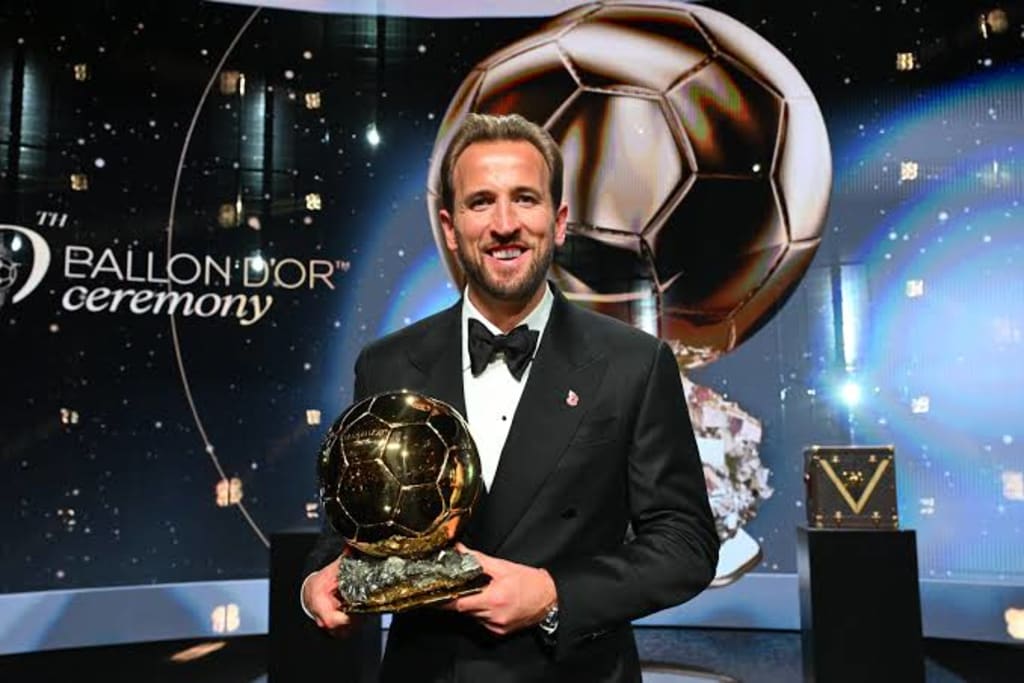
On October 26, 2026, London. A brief dispatch from Xinhua News Agency spread across the football world: at the 2026 France Football Ballon d'Or ceremony, Harry Kane won the men's Ballon d'Or.
No World Cup title. No Champions League trophy. For long stretches, Kane's name was not even the loudest one in the public conversation. Yet the Ballon d'Or ultimately went to him. The result looked untimely at first glance, but on reflection it was hard to dispute: in a World Cup year, in an era increasingly accustomed to defining greatness through single-night highlights, talking points and trophy halos, Kane tore a gap in the usual logic of the award with a year of almost absurd scoring consistency.
This is not a lucky story of fortune finally turning. It is a belated reckoning for hard work.
I. The Man They Called a Walking Jinx
Before he arrived at Bayern, Kane had long carried a slightly mocking label: a walking jinx.
At Tottenham, he won the Premier League Golden Boot. He also won the Premier League Playmaker award. He produced stunning seasons, and again and again he watched his team fall apart at the end of them. In 2016-17, he scored 30 league goals to take the Golden Boot; Tottenham finished second, seven points behind Chelsea. In 2017-18, he scored 30 again; Tottenham finished third. In 2018-19, he scored 17; injuries began to catch up with him. In 2020-21, he scored 23 goals and added 14 assists, sweeping both the Golden Boot and the Playmaker award; Tottenham finished seventh. In 2022-23, he scored 30; Tottenham finished eighth.
Every season, he kept scoring. Every season, the trophies ended up in someone else's hands.
For a player of his level, one club for life would normally have been the more likely choice. Shearer left Blackburn only after winning the title. Gerrard waited at Liverpool until Istanbul. Totti stayed at Roma for his entire career. Kane waited at Tottenham for more than a decade, and what he got was a League Cup final defeat to Manchester City, a Champions League final defeat to Liverpool, and the sense that every time he came close, something was missing.
He eventually left Tottenham. More importantly, he did not stay in the Premier League. He chose Bayern, leaving his comfort zone, leaving the familiar league, language and media environment, and joining a club where the margin for error is tiny and where winning trophies is treated as the default.
That choice was itself a statement. He chose a club where not winning is failure, not one that merely needed him to get over the line. He bet his career on a place where a broken ending would not be tolerated.
Kane had almost no adaptation period. He hit the ground running. In three years, he swept every domestic trophy. Bayern did lose the title in his first year, but over the past two years they have returned to dominance, and that has also allowed Kane to avoid another awkward line of questioning, the one aimed at Mbappe, who arrived at a club that had been league and Champions League champions, only to endure two consecutive trophy-less seasons. Kane did not fall into that narrative trap. Through his output, he made Bayern's dominance look natural again.
II. 65 Games, 73 Goals: Killing the Suspense in the Most Primitive Way
Kane's form last season no longer needed the word excellent. Across all competitions, he played 65 games, scored 73 goals and added 8 assists, second only to Lionel Messi in 2011-12. In any year, those numbers are hard currency for the Ballon d'Or.
What was more frightening was the distribution.
At club level: 51 games, 61 goals, 7 assists. In the Bundesliga: 31 games, 36 goals, 17 clear of the next-highest scorer. A demolition. In the Champions League: 13 games, 14 goals, one behind Mbappe. In the DFB-Pokal: 6 games, 10 goals. At international level: 14 games, 12 goals. At the World Cup: 7 games, 6 goals, leading England to third place.
His goal tally was nearly three times that of Lamine Yamal, and more than the total goals of Mbappe, who won three major Golden Boots. Rummenigge put it bluntly: "Since the start of this century, only Messi has scored more goals in a single year than he has."
This was not picking up scraps, nor was it a number built on penalties and weak opponents. Kane's most valuable quality was his consistency across multiple competitions. In the Champions League knockout rounds, Bayern eliminated Real Madrid head-on, and Kane scored in both legs. In the World Cup third-place match, England beat France, giving Kane the upper hand in direct comparison with Mbappe's team. Bayern's Champions League semi-final defeat came against eventual champions Paris; the team's results met expectations, and his individual performances matched the team's achievements.
Kane's scoring did not come at the cost of leeching off his team. He was not padding stats in a vacuum. He was producing continuously at the highest intensity, and turning that output into trophies and results.
At the centre-forward position, Kane is in a league of his own. Even in a World Cup year, his performances across the whole year were both steady and clutch. Even without the Champions League or World Cup title, the team's results were in line with expectations. Kane had historic individual numbers, every domestic league and cup trophy, and deep runs in the major tournaments.
This Ballon d'Or is deserved.
III. The Debate Over the Logic of a World Cup-Year Vote
The Ballon d'Or has traditionally favoured the combination of trophies plus major tournaments. 2026 was a World Cup year. Lamine Yamal and Rodri carried the afterglow of a World Cup triumph. Dembele had the Champions League. Kane had the Bundesliga, the DFB-Pokal and the German Super Cup. In an ordinary year, that honours list would have struggled to win.
The controversy lies exactly there.
Croatian senior Ballon d'Or juror Zdravko Reić ranked Kane sixth on his ballot and later publicly admitted, "I made a mistake." His reflection was representative: he made World Cup performance his primary criterion, so he voted for Rodri, while overlooking Kane's astonishingly stable consistency across the entire season. In a World Cup year, it is normal for tournament weight to be magnified, but Kane's case forced jurors to re-examine a question: should a centre-forward who produced historic output at club level and also led his national team to the semi-finals be downgraded simply because he did not lift the final trophy?
The answer ultimately was no. The margin was very small, but Kane won. That in itself is a mild correction to trophy determinism.
The Ballon d'Or did not give the trophy to the most talked-about player, nor to the most conspicuous man in the most decorated team. It gave it to a man who repeated himself 65 times in 65 games.
IV. The Victory of the Silent Man
When Oliver Kahn assessed Kane, he used two phrases: "a true leader" and "easy to get along with." Then he explained: "He doesn't irritate his teammates, and he doesn't constantly put pressure on them." A Russian juror put it more directly: in a public arena where Mbappe and Lamine Yamal hang the word I on their lips, Kane just quietly plays his own game.
In an age increasingly inclined to compete for attention through volume and persona, Kane won in an almost classical way: he spoke with goals, and let silence itself carry weight.
In his acceptance speech, he said, "Work quietly and let success speak for you." Set against the context of Mbappe's two consecutive trophy-less years and Lamine Yamal's World Cup title but third-place finish, the line was especially persuasive. The Ballon d'Or went to the man who spent the entire year doing the same thing, and doing it to the limit.
V. What This Ballon d'Or Means
Kane's win is less a reward for a single night of canonisation than a pricing of consistency as a scarce quality.
Football is increasingly accustomed to defining greatness through single-night highlights: a hat-trick, a last-minute winner, a dominant final performance. One such moment can create a heroic narrative. But Kane reminds people that doing it continuously is harder than being brilliant occasionally, and more worthy of being remembered. He did not suddenly become another person on some night. He simply did the same thing to the extreme across 65 games.
For Bayern, this Ballon d'Or is a vindication of their recruitment logic: Kane, who left his Premier League comfort zone, brought not only goals but also trophies and a model of silent leadership. For England, third place at the World Cup is certainly not the end, but Kane's steady output in a World Cup year at least proves that he remains the most reliable anchor in big matches. For the Ballon d'Or itself, this vote was a self-correction: between trophies and data, between noise and silence, it chose the latter: the man who never stopped all year.
Live Preview
The match is Bayern Munich vs. Magdeburg in the DFB-Pokal second round, kicking off at 03:45 Beijing time on Thursday, October 29, 2026. Bayern plan to hold a Ballon d'Or tribute before the match, and Kane is likely to play. Then on October 31, Bayern host Borussia Dortmund in the Bundesliga, with both teams level on 17 points. That will be Kane's first serious test as Ballon d'Or winner.
The celebration of honours is brief; the responsibility to score is permanent. For Kane, the Ballon d'Or is not the finish line. It is just another kick-off.
About the Creator
Jin
Writer of reamstories
https://reamstories.com/jin
Enjoyed the story? Support the Creator.
Subscribe for free to receive all their stories in your feed. You could also become a paid subscriber, letting them know you appreciate their work.
Comments
There are no comments for this story
Be the first to respond and start the conversation.