
Hanshang Hualian Is Closing. The Hanfu Boom Just Lost Its Loudest Warning.
The brand that sold a generation on fairy-like ruqun and Qing-style long shirts is clearing its shelves. The story behind its exit is less about one bad year than about what hanfu buyers now want to wear.
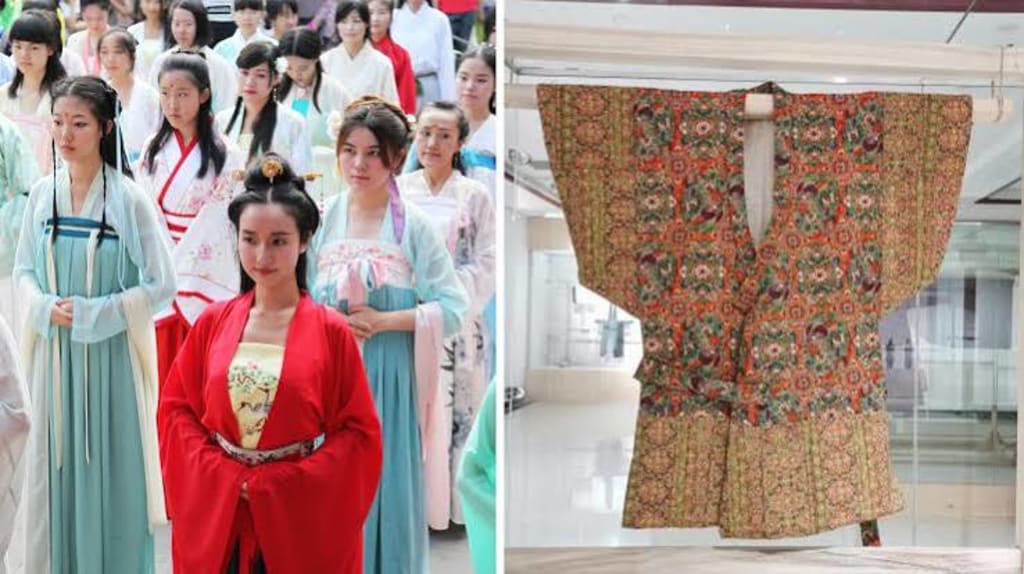
On October 8, 2026, at 8 p.m., Hanshang Hualian put its entire inventory on clearance. Sold until gone. The exit looks less like a sudden collapse than a delayed goodbye. Corporate records show the brand’s individual business entity was deregistered on February 12, 2026. By the time the clearance sale began, the legal shell was already gone. What makes this closure matter is not that another hanfu shop failed. Hanshang Hualian was the most visible commercial symbol of a period when hanfu moved from a cultural movement into a consumer market. Its exit closes a playbook built on making trends, harvesting attention, and moving on before the trend dies.
I. From Fairy-Style Hanfu to Qing-Style Dresses
To see why the closure matters, start at the peak.
On August 21, 2018, Hanshang Hualian celebrated its tenth anniversary. It released four major sets: Qiuhuang, Yexiange, Longmu, and Jiaoren Lei. Around them came Huaqi, Fengluanming, Huajianjiu, and other products. The launch was a product matrix in textbook form. By then the company had four brands: Hanshang Hualian, the han-element label Luyunji, the high-end line Jiujinsi, and the childrenswear brand Chuli. In April 2018, the brands appeared together at China Huafu Day. Longmu and Yexiange became shared memories for a generation of hanfu buyers. One consumer wrote on Zhihu: “Longmu and Yexiange are almost played out. Even people who know little about hanfu know Longmu and Yexiange.” That ubiquity was proof of the brand’s reach.
The success rested on a premise. What Hanshang Hualian sold as hanfu was often not a strict reconstruction of historical garment forms. It was a visual symbol that could be made quickly and spread faster. Flowing chest-high ruqun, bridal sets, dragon embroidery: these products sold because they matched the “fairy” imagination of the “three bankrupt sisters” era. That imagination sat in tension with strict historical research.
The bill arrived later. Ming-style hanfu rose in 2018. Song-style hanfu became popular in 2020. Buyers began to care about standing-collar diagonal-front long shirts, mamian skirts, and Song-style trousers. The market for xianfu shrank. At the same time, Cao County’s hanfu industrial belt entered the same market with extreme cost-performance. With an industrial chain that can complete all steps within five kilometers, Cao County could sell similar-looking products for far less than brand merchants. The price gap hit Hanshang Hualian hard.
Facing a smaller xianfu market, Hanshang Hualian turned to Qing-style clothing. In 2019 it sold the Duiyue long ao with a cloud collar. In 2020 it released Tanhua Yimeng, a pure Qing-style long shirt with a Qing cloud collar. The company tried to reactivate the market by making “Qing elements” the new selling point. People nicknamed it “Qingshang Hualian.” The nickname carried the anger of hanfu circles over “replacing Ming with Qing.” In the hanfu movement, whether Qing elements count as hanfu has long been a sensitive question. One core demand of the movement has been to heal the historical wound of the hair-cutting and clothing-change edicts. Putting mature Qing-style aesthetics under the “hanfu” label touched a cultural line. Hanshang Hualian stayed in that fight for five years. By 2024 and 2025, the Qing-style trend faced open resistance. The 2026 closure was the end of that road.
II. The “Tears of the Times” Model
Hanshang Hualian is more than one company. It shows a business model common in the hanfu industry: use “incorrect historical forms” as a filter, use aesthetic trends as fuel, make hit products fast, harvest customers fast, and finish a full cycle before the trend fades.
Why did this model last so long? The hanfu consumer group has a structural feature. A new buyer often cares first about visual beauty and social recognition, not strict historical form. At that stage, “correct form” is not the main need. “Looks good” is. Hanshang Hualian’s xianfu products served that stage well. They were beautiful, recognizable, and photogenic enough to earn likes.
Buyers grow. When a new fan becomes a serious enthusiast, they start to care about form, fabric, and fit. The xianfu they once bought becomes “tears of the times.” It holds memories. It no longer gets worn. This growth pattern sets the life cycle of the “tears of the times” model. Each trend harvests one generation of new buyers. When that generation learns more, or when a new trend with a more “correct” look replaces the old one, brands tied to the old trend stall.
Hanshang Hualian’s problem was that its name had become bound to xianfu and Qing-style. It could not switch tracks as quickly as more flexible merchants. When xianfu faded, it tried Qing-style. When Qing-style reached its end, it had no next trend.
III. The Hanfu Market in 2026: Growth, but Different Growth
One fact is easy to misread. Hanshang Hualian’s closure does not mean the hanfu market is shrinking. The industry is growing. iiMedia Research data shows China’s hanfu market reached 19.11 billion yuan in 2025 and is expected to pass 20 billion yuan in 2026. The number of hanfu enthusiasts reached 12.836 million and is expected to reach 14.312 million in 2026, with an average annual growth rate of 38.88 percent. In 2025, hanfu transaction value on Taobao grew by more than 25 percent year on year. On JD.com, it grew by more than 100 percent.
The structure of that growth has changed. The engine has shifted from trends to daily wear. Hanfu outfits are breaking the old rules that said they belonged only at festivals or scenic spots. They are becoming normal clothes for Gen Z. Simple Ming-style cloaks, everyday mamian skirts, and other new Chinese-style hanfu keep appearing. Modified styles reduce heavy historical forms and thick fabrics. They fit commuting, school, cafes, markets, and other daily scenes.
For brands, the meaning is direct. When hanfu moves from “clothes for photos” to “clothes for daily wear,” buyers change how they decide. Is the fabric comfortable? Is the fit good? Can I move in it? Can I match it with what I already own? These questions about wearability replace “fairy” looks and visual shock as the main reason to buy.
Hanshang Hualian’s closure notice blamed “low-price competition” and a “bad environment.” Customer comments point to a deeper problem. One hanfu fan said on Weibo: “A piece of clothing, besides its cultural attribute, must also have wearability. If the material is poor, it has to make up for it with design, so that people want to buy it.” Another wrote: “Now every store is caught in vicious competition. After multiple comparisons, the design cannot keep up, the quality cannot keep up, but only the price remains high.”
Those comments point to the weak spot in the “tears of the times” model. It cannot answer a simple question: why would anyone still wear this? If a garment’s main job is to give one moment of visual satisfaction on social media, repurchase rates and wear frequency stay low. When buyers start to treat hanfu as daily clothing, brands that worked on fabric, fit, and comfort start to win.
IV. Cao County and Chonghui Hantang: Two Ways to Survive
Two cases help explain the industry meaning of the closure: Cao County and Chonghui Hantang.
Cao County shows the extreme of efficiency. In the first half of 2026, hanfu online sales in Cao County reached 4.775 billion yuan. That is more than half of the national hanfu market. Cao County has nearly 3,000 hanfu-related enterprises, more than 100,000 workers, and an output value of 13 billion yuan. Its strength is cost-performance and fast production. Through e-commerce livestreaming, flexible manufacturing, and a complete local supply chain, Cao County can push a popular style to market at a low price in a short time.
The Cao County model has its own problems. It also faces pressure to move from scale manufacturing to brand creativity. But its presence changed the rules of the hanfu market. When buyers can get a similar-looking product for less, brands that live on design premiums and trend premiums must offer something Cao County cannot copy. That could be researched historical forms and quality. It could be a brand value no one else can replace.
Chonghui Hantang shows adaptability. Founded in 2006, it has lived through several cycles of the hanfu industry and still has strong sales. Its strategy has four parts: product innovation, continuous customer expansion, solving pain points, and cross-sector collaboration. It built its own cutting center, embroidery factory, and sewing factory. That supply chain integration improved production efficiency and delivery speed by 10 to 15 percent.
The key is that Chonghui Hantang does not cling to one trend or style. It sells relatively accurate Ming-style and Song-style products. It also knows when to release modified styles that meet demand. Its product line covers weddings, childrenswear, daily commuting, and cultural events. Because it does not put all its eggs in one basket, a single trend’s decline does not threaten the whole business.
Chonghui Hantang also pays attention to wearability. Recent product copy emphasizes “simple, clean tailoring, suitable for all kinds of daily scenes.” That matches what buyers want as hanfu becomes everyday wear.
The split between Hanshang Hualian and Chonghui Hantang comes down to this: one catches trends, the other satisfies demand. The trend-catcher seeks maximum profit in every window. The demand-satisfier delivers value in every scene. When the industry moves from trends to demand, the trend-catcher’s weakness shows.
V. What Comes Next
The closure sends a clear signal. The model that grows by making a trend, harvesting new customers, waiting for the trend to fade, then finding the next trend is ending. Since 2026, several waves of hanfu merchants have announced clearance sales and closures. Some are Taobao shops. Some are physical stores. Some are well-known brands.
The hanfu industry is not dying. This billion-yuan market is moving from a trend-window business to a foundation business. Future hanfu brands may need at least one of three abilities.
First, supply chain and efficiency. Cao County has proved this. For brands serving the mass market, offering a competitive price while keeping basic quality is the baseline. That requires building or deeply integrating a supply chain, not relying on outside contract manufacturing.
Second, historical research and quality. The cultural value of hanfu is its core competitive advantage. That value rests on respect for historical forms and craft. Brands that master artifact-based forms and improve fabric and fit will build long-term trust as buyers learn more. Cao County cannot replace that trust. A buyer who wants correct historical form will not accept a wrong-form product just because it is cheap.
Third, scene adaptation and innovation. The daily-wear trend asks brands to connect traditional forms with modern needs. This goes beyond modification or simplification. It means reinterpreting traditional clothing with modern fabrics and cutting on the basis of understanding why the original forms worked. That requires deep knowledge of both tradition and modern life.
The three paths are not mutually exclusive. They do require a clear strategic choice. Hanshang Hualian tried to move between trend-catching and brand-building. It lost ground in both.
The clearance racks at Hanshang Hualian are not just empty shelves. They are a receipt. The “tears of the times” model worked as long as buyers were new, trends were fresh, and nobody asked whether the clothes were comfortable enough to wear again. That bargain is over. The next hanfu brand that lasts will not be the one that names the next trend first. It will be the one that makes a garment someone reaches for on an ordinary Tuesday.
About the Creator
Jin
Writer of reamstories
https://reamstories.com/jin
Enjoyed the story? Support the Creator.
Subscribe for free to receive all their stories in your feed. You could also become a paid subscriber, letting them know you appreciate their work.
Comments
There are no comments for this story
Be the first to respond and start the conversation.