
Green Buildings Market Signals a Global Shift
Green buildings reshape urban living through sustainability and scale
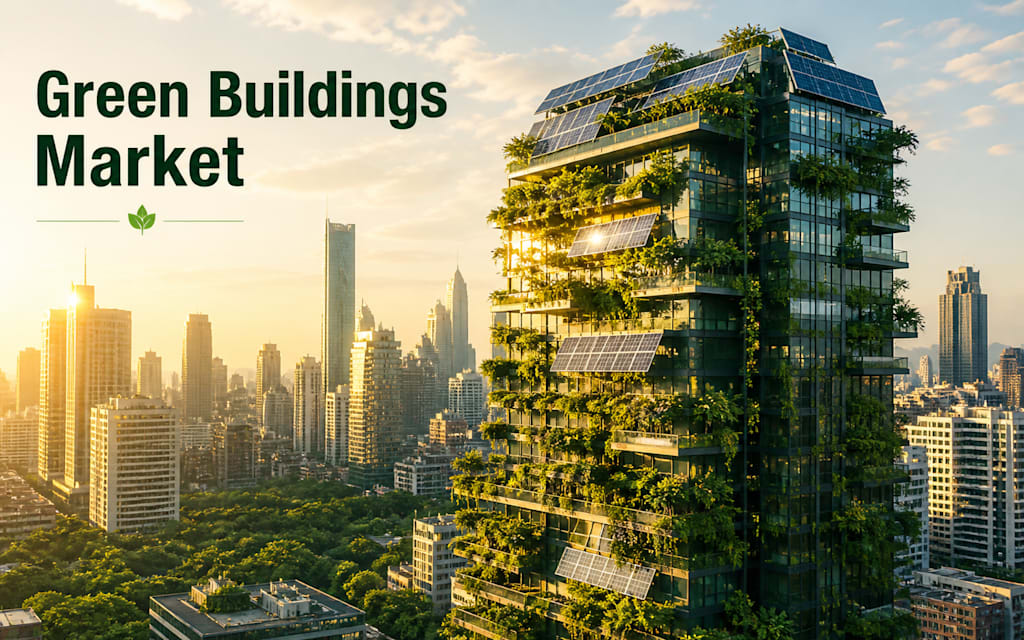
The city breathes differently now. Glass towers no longer just reflect sunlight, they harvest it. Rooftops hum quietly with solar panels, while walls bloom with living greenery that cools the air and soften the skyline. Beneath the surface, buildings think, adapt, and conserve, turning everyday spaces into silent allies against climate change.
This quiet transformation isn’t a distant vision, it’s already unfolding across continents. Investors, architects, and governments are aligning around a shared realization: the future of infrastructure must not only stand tall but stand responsible. And at the center of this evolution lies a rapidly accelerating force, the green buildings market.
The Momentum Behind Sustainable Skylines
After decades of unchecked urban expansion, the world is recalibrating its priorities. Sustainability is no longer a niche concept, it’s a necessity embedded in policy, design, and consumer expectations. The shift is measurable and striking.
According to data from Mordor Intelligence, the Green Buildings Market is projected to be USD 417.05 billion in 2025, USD 461.23 billion in 2026, and reach USD 763.12 billion by 2031, growing at a CAGR of 10.59% from 2026 to 2031.
This surge reflects more than economic expansion, it signals a structural shift in how buildings are conceived and valued. Developers are no longer just competing on aesthetics or location, but on efficiency, environmental impact, and long-term cost savings. As a result, green buildings market size continues to expand across both developed and emerging economies, driven by regulatory mandates and rising environmental awareness.
Urban planners are integrating energy-efficient systems, water conservation technologies, and sustainable materials as standard practice rather than premium upgrades. The buildings themselves are becoming ecosystems, self-regulating, adaptive, and deeply interconnected with their surroundings.
Human Stories Within Sustainable Spaces
Behind every statistic lies a human story. A family living in a naturally ventilated apartment that reduces electricity bills. An office worker enjoying better air quality and natural lighting, leading to improved well-being and productivity. A city resident walking through cooler streets lined with green rooftops that mitigate heat.
These experiences are reshaping expectations. Sustainability is no longer abstract, it’s personal.
The rising green buildings market growth reflects this emotional connection. People are choosing spaces that align with their values, even if it means paying a premium upfront. Over time, the benefits, lower energy costs, healthier environments, and increased property value, justify the investment.
Architects are responding with designs that blend innovation and empathy. Natural materials, biophilic design, and energy optimization are no longer trends—they’re becoming the language of modern construction. In this evolving landscape, buildings are not just structures; they are experiences shaped by intention.
Industry Transformation and Global Impact
The ripple effect extends far beyond individual buildings. Entire supply chains are adapting to meet new sustainability standards. From eco-friendly cement to smart energy management systems, the green buildings industry is fostering innovation across multiple sectors.
Governments are accelerating this transition through incentives, certifications, and stricter building codes. Financial institutions are also playing a pivotal role, offering green financing options that make sustainable construction more accessible.
At the same time, the green buildings market share is becoming increasingly competitive. Companies that fail to adapt risk being left behind, while those embracing sustainability are gaining a decisive edge. This competition is fueling rapid advancements, pushing the boundaries of what green architecture can achieve.
The impact is global. From densely populated Asian cities to expanding urban centers in Africa and Latin America, green buildings are redefining growth itself, ensuring that development does not come at the expense of the environment.
A Future Built with Intention
The skyline of tomorrow is being designed today, with intention, responsibility, and vision. Every solar panel installed, every green roof planted, and every efficient system integrated represents a step toward a more balanced coexistence between humanity and nature.
But the journey is far from complete. The challenge now is scaling these solutions while maintaining affordability and accessibility. The question isn’t whether green buildings will dominate the future, it’s how quickly that future will arrive.
As cities continue to rise, the choices made today will echo for generations.
Would you choose to live or work in a building that actively protects the planet—and if so, what would matter most to you?
Explore JA Titles from Mordor Intelligence
1. Hungary Freight and Logistics Market
About the Creator
Enjoyed the story? Support the Creator.
Subscribe for free to receive all their stories in your feed.
Comments
There are no comments for this story
Be the first to respond and start the conversation.