
Google Just Published Its First Official AEO and GEO Guide — Here Is What It Actually Means for Your Website
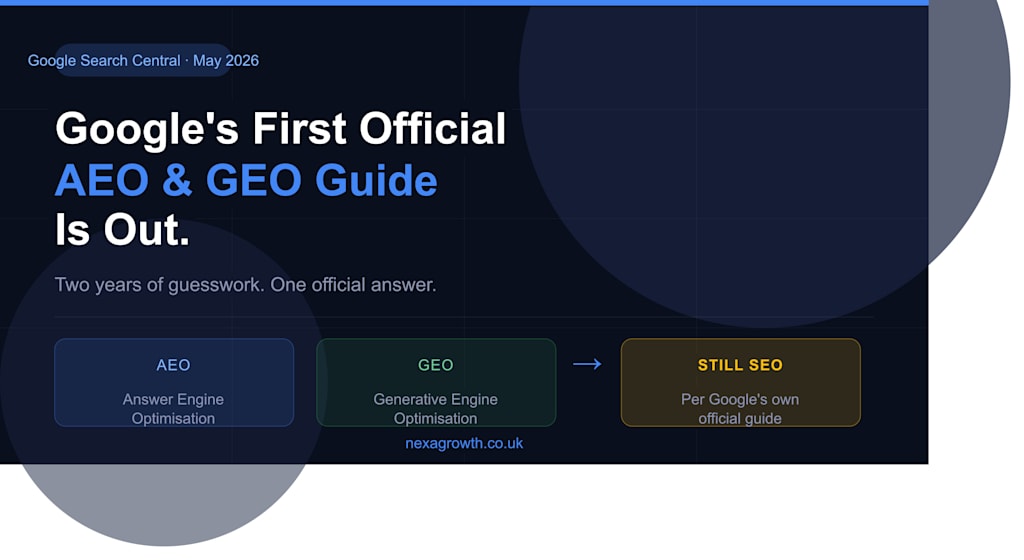
Two years of guesswork just ended. Google published its first official guide to AI search optimisation on 15 May 2026. Here is the plain English version of what it says.

Note: This article was written with AI assistance based on Google's official published documentation. All source references are genuine and link to Google Search Central.
On 15 May 2026, Google did something it had never done before.
It published an official guide telling website owners exactly how to optimise for its generative AI search features — AI Overviews, AI Mode, and everything that comes next.
For two years, the SEO industry had been filling that silence with theories, frameworks, and no shortage of expensive advice. Chunking content. Creating llms.txt files. Obsessing over AEO hacks. Chasing mentions across every corner of the internet.
Google has now responded to all of it. And the answer is more straightforward than most people expected.
Here is what the guide actually says.
What Are AEO and GEO — And Does Google Even Use Those Terms?
AEO stands for Answer Engine Optimisation. GEO stands for Generative Engine Optimisation. Both terms have been circulating in the SEO industry as ways to describe the work of optimising content specifically for AI-powered search experiences.
Google's official position, stated clearly in the guide, is that both of these are simply SEO.
Google's exact words: "From Google Search's perspective, optimizing for generative AI search is optimizing for the search experience, and thus still SEO."
Source: developers.google.com/search/docs/fundamentals/ai-optimization-guide
This is not Google dismissing the question. It is Google telling you that the foundations that made websites rank well in traditional search are the same foundations that make content appear in AI Overviews and AI Mode. There is no separate strategy required. There is no new playbook to learn.
If your SEO is strong, your AI search presence will follow.
The One Thing Google Says Matters More Than Anything Else
Of everything in the guide, this section carries the most weight.
Google describes it as content that will "likely influence your website's presence in generative AI search in the long run more than any of the other suggestions in this guide."
That content is what Google calls non-commodity, people-first content.
The distinction Google draws is specific and worth understanding. Commodity content is information based on common knowledge that anyone could produce. Google gives an example: "7 Tips for First-Time Homebuyers." Generic. Replaceable. Forgettable.
Non-commodity content is the opposite. It provides a unique perspective based on genuine experience or expertise that goes beyond what is commonly known. Google's example: "Why We Waived the Inspection and Saved Money: A Look Inside the Sewer Line." Specific. First-hand. Impossible to replicate without having lived it.
The implication for businesses is direct. If your website content could have been written by someone who has never worked in your industry, never spoken to your customers, and never solved the problems your service solves — it is commodity content. And commodity content is exactly what AI systems are trained to look past.
The Myths Google Just Officially Killed
This is the section most SEO professionals have been waiting for. Google's guide directly addresses the most widely circulated AEO and GEO hacks — and dismisses each one.
llms.txt files: Google states clearly that you do not need to create new machine-readable files, AI text files, or special markup to appear in generative AI search. The llms.txt file has no special treatment in Google's systems.
Chunking content: There is no requirement to break content into smaller pieces for AI to process it more effectively. Google's systems can understand multiple topics on a single page. Page length should be determined by your audience and subject matter, not by AI optimisation theory.
Rewriting content for AI systems: You do not need to restructure your writing style for generative AI search. Google's AI systems understand synonyms, general meanings, and contextual relevance. Exhaustively targeting every keyword variation is unnecessary.
Chasing inauthentic mentions: Pursuing artificial brand mentions across blogs and forums is not only ineffective but risks violating Google's spam policies, which now explicitly apply to generative AI responses as well.
Overfocusing on structured data: Structured data is not required for AI search features and there is no special schema markup that improves AI visibility specifically.
Google's position across all five of these points is consistent: none of them are substitutes for strong foundational SEO and genuinely useful content.
What Google Says About AI-Generated Content On Your Website
Google's second document, published alongside the optimisation guide, addresses a question most businesses using AI writing tools have been asking.
The answer is clear. AI-generated content is not prohibited. It is not penalised by default. What Google requires is that AI-assisted content meets the same quality standards as any other content — accurate, relevant, and genuinely useful to the reader.
Google's exact words: "Using generative AI tools or other similar tools to generate many pages without adding value for users may violate Google's spam policy on scaled content abuse."
Source: developers.google.com/search/docs/fundamentals/using-gen-ai-content
The operative phrase is without adding value. AI assistance in content creation is not the problem. AI content published at volume without editorial judgement or genuine usefulness is.
Google also confirmed that its spam policies now apply explicitly to generative AI responses in Google Search — including AI Overviews.
What This Means Practically For Your Business
Stop investing time in AEO or GEO tactics that are not grounded in SEO fundamentals. llms.txt files, content chunking, and artificial mention campaigns are not worth the time or the budget. Google has now said so directly.
Audit your existing content for commodity versus non-commodity quality. Read your most important pages and ask honestly: does this say anything that could not have been written by someone with no experience in this field? If the answer is no, that content needs rethinking.
Make sure your pages are technically crawlable and indexed. Google's AI features are built on top of its core Search index. If Google cannot crawl and index your pages, they will not appear in AI Overviews or AI Mode regardless of content quality.
Use AI tools to assist your content creation, not replace your judgement. The editorial layer — the unique perspective, the first-hand experience, the specific insight — has to come from you.
Focus on the specific, not the generic. The more specific your content is to a real situation, a real problem, or a real outcome, the more it resembles what Google describes as non-commodity content.
The Bigger Picture
Google's guide is not a revolution. It is a confirmation.
The businesses that have been investing in genuine expertise, honest content, and strong technical SEO foundations are already positioned well for AI search. The businesses that chased quick wins, bought into the AEO hype, or produced content at volume without quality control now have Google's official response to that approach.
Search is changing in how it presents results. It is not changing in what it values.
Sources:
Google AI Optimisation Guide, published 15 May 2026:
- developers.google.com/search/docs/fundamentals/ai-optimization-guide
Google Guidance on Using Generative AI Content:
- developers.google.com/search/docs/fundamentals/using-gen-ai-content
Google Search Updates, May 2026:
- developers.google.com/search/updates#may-2026
About the Creator
Shakeel
Shakeel Ahmed | CEO at Nexa Growth Marketing Ltd, Helping businesses grow with SEO, PPC, and data-driven marketing.
Enjoyed the story? Support the Creator.
Subscribe for free to receive all their stories in your feed.
Comments
There are no comments for this story
Be the first to respond and start the conversation.