
Global Asphalt Market Outlook: Growth, Trends, and Opportunities Through 2034
How infrastructure spending, urban expansion, and sustainable materials are driving steady market growth worldwide

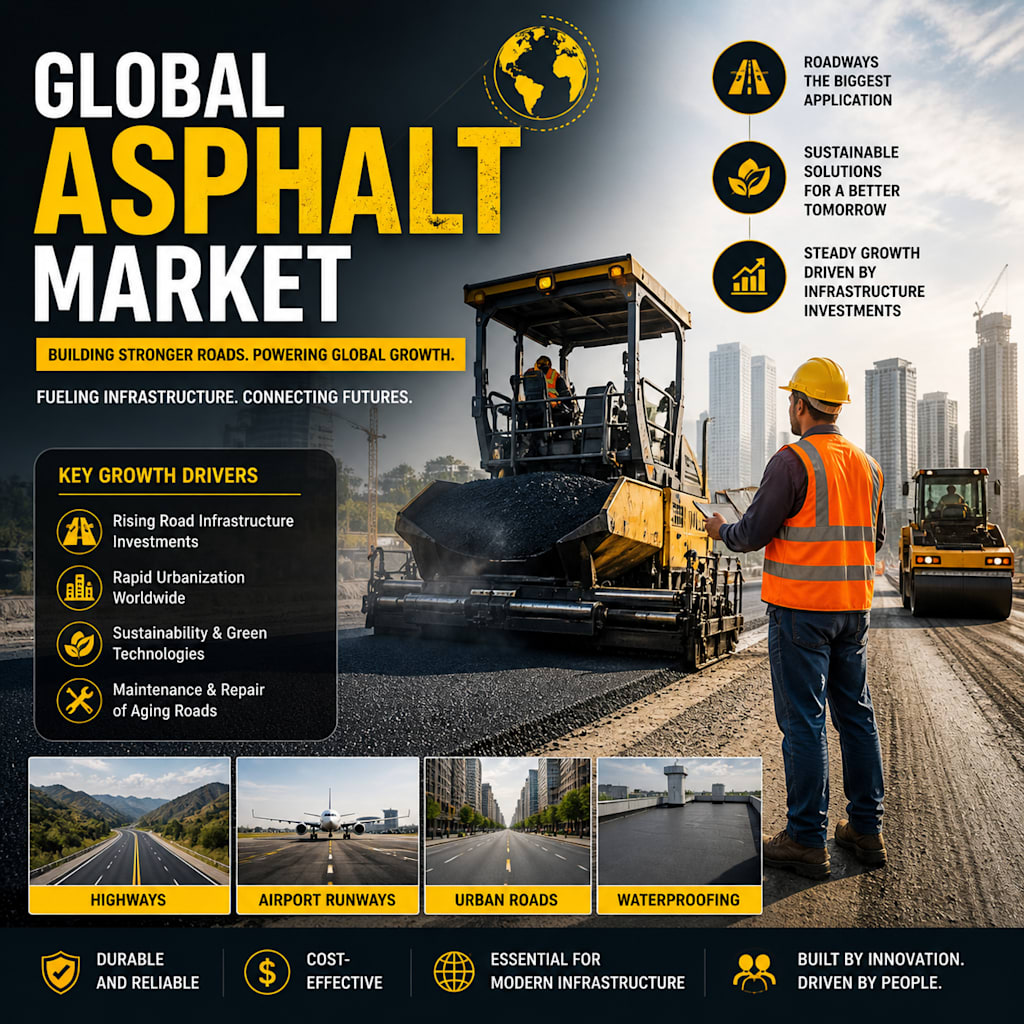
Think of global development, and skyscrapers, smart cities, and high-speed rails come to mind. But underneath all that innovation, there's something much simpler: roads.
And at the heart of those roads, is asphalt.
Often overlooked, it's one of the most critical materials to modern infrastructure, from highways and airport runways to urban streets and industrial areas, and it plays a pivotal role in connecting economies and fostering growth.
Today, the global asphalt market is growing steadily, fueled by large-scale infrastructure investments, fast-paced urbanization, and a growing need for durable and cost-effective road networks.
A Market Reliant on Long-Term Infrastructure Needs
The global asphalt market size was valued at roughly USD 271.8 million in 2025 and is expected to reach about USD 409.3 million by 2034.
This equates to steady growth of approximately 4.66% each year between 2026 and 2034.
While certain industries can experience fluctuation, demand for asphalt is intrinsically linked to long-term infrastructure planning, and governments globally continue to heavily invest in road construction, maintenance, and expansion-ensuring sustained demand for this material over time.
Whether it's for American infrastructure modernization initiatives, India's expansion of highways, or China's ambitious global connectivity projects, asphalt is a key component of all major development strategies.
Drivers of Global Asphalt Market Growth
There are several compelling factors fueling the growth of the asphalt market:
1. Significant Road Infrastructure Investments
Governments worldwide recognize the importance of robust road networks for economic advancement and are making substantial investments. Projects are transforming transportation infrastructure, including:
- Expansion of national highways
- Development of rural road networks
- Upgrades to aging infrastructure
- Construction and resurfacing of airport runways
These initiatives require large amounts of asphalt, making infrastructure spending a major growth catalyst.
2. Rapid Urbanization in Emerging Economies
Urban areas are expanding at an unprecedented rate. By 2050, an estimated 70% of the world's population will live in cities, creating demand for:
- New roads and highways
- Urban transportation systems
- Smart city infrastructure
- Residential and commercial developments
As cities grow, asphalt becomes an essential building block for their transportation networks.
3. Increased Need for Maintenance and Repair
Beyond new construction, the upkeep of existing infrastructure is equally critical. Roads are subjected to constant wear and tear from heavy traffic, weather, and age, leading to a consistent demand for asphalt for resurfacing, repair, and rehabilitation.
Dominance of Road Applications
A defining characteristic of the asphalt market is its heavy reliance on road construction applications, which constitute more than 60% of global asphalt demand. Asphalt remains the preferred material for highways, expressways, rural roads, and urban streets due to its:
- Flexibility and durability
- Cost-effectiveness
- Ease of maintenance
- Smooth riding surface
Even in developed regions with extensive road networks, ongoing maintenance and upgrades continue to drive consumption.
Hot Mix Asphalt Still Leads, but Change is Underway
Traditional hot mix asphalt (HMA) currently holds the largest market share due to its resilience against heavy traffic and extreme weather conditions, making it suitable for high-load applications like highways.
However, the market landscape is starting to shift.
The Emergence of Warm Mix Asphalt
Warm mix asphalt (WMA) is gaining traction as an environmentally friendly alternative. It is produced at lower temperatures, offering benefits such as:
- Reduced energy consumption
- Lower emissions
- Improved working conditions for construction crews
- Cost savings during production
With increasingly stringent environmental regulations, WMA is poised to play a more significant role in the future.
Sustainability is Reshaping the Industry
The asphalt industry is transforming with a strong focus on sustainability.
Recycled Asphalt Becomes Mainstream
Recycled asphalt pavement (RAP) is now commonly used in road construction, which helps:
- Reduce material costs
- Minimize environmental impact
- Divert waste from landfills
This trend is reshaping asphalt production and usage globally.
Bio-Based Asphalt Is Emerging
Innovation is also being seen in bio-asphalt, which utilizes renewable materials instead of traditional petroleum-based components. These alternatives, though still evolving, show promising potential in reducing reliance on fossil fuels.
Smart Roads Are on the Horizon
The future of asphalt may extend beyond traditional uses. Emerging technologies include:
- Sensor-embedded roads for traffic monitoring
- Self-healing asphalt for automatic crack repair
- Smart infrastructure integrated with IoT systems
These innovations are expected to redefine the function of roads in the coming decades.
Regional Growth Patterns: Where the Market is Expanding Most Rapidly
Asphalt market growth is not uniform across the globe.
Asia-Pacific Leads the Way
Asia-Pacific dominates the market, driven by:
- Large-scale infrastructure projects
- Rapid urbanization
- Expanding transportation networks
China and India are at the forefront of this expansion.
North America Remains Strong
North America continues to experience robust demand due to:
- Significant government investment in infrastructure
- Ongoing road maintenance programs
- Airport and highway upgrades
The United States, with one of the largest road networks globally, requires continuous investment.
Emerging Markets Hold Great Potential
Regions like the Middle East and Africa are projected to experience higher growth rates. These areas are heavily investing in infrastructure to support their economic development, creating new opportunities for asphalt demand.
Challenges Facing the Asphalt Industry
Despite its steady growth, the asphalt market faces several challenges:
Competition from Alternative Materials
Concrete is increasingly being adopted for certain high-load applications, such as industrial areas and ports, creating competition for asphalt.
Environmental Regulations
Stricter environmental policies are pushing companies to lower emissions and implement cleaner production methods, adding pressure but also fostering innovation.
Supply Chain Constraints
Asphalt production is dependent on crude oil refining, and fluctuations in refinery operations and global energy trends can affect availability.
Opportunities That Could Shape the Future
The challenges, however, also present new opportunities:
- Development of eco-friendly asphalt solutions
- Expansion in underserved regions with inadequate road infrastructure
- Advancements in smart road technology
- Growing demand for high-performance asphalt materials
Companies that prioritize innovation and sustainability are positioned to lead in the next growth phase.
Looking Ahead
The future of the asphalt market is inextricably linked to the future of global infrastructure. As governments continue to invest in transportation networks and urban areas expand, asphalt demand will remain strong and consistent. Concurrently, the industry is becoming more sustainable, technologically advanced, and efficient. By 2034, the market is expected to surpass USD 400 million, a testament to sustained growth driven by long-term infrastructure commitments.
In Conclusion
Asphalt may not be the most conspicuous aspect of modern development, but it is undoubtedly one of the most vital. Every road we travel, every runway we land on, and every city we navigate relies on this essential material. As the world continues to build, expand, and innovate, asphalt will remain at the core of that progress, quietly supporting the infrastructure that keeps everything in motion.
About the Creator
Robert
Senior Market Researcher at IMARC Group, specializing in global market analysis, industry trends, and data-driven insights across diverse sectors.
Enjoyed the story? Support the Creator.
Subscribe for free to receive all their stories in your feed.
Comments
There are no comments for this story
Be the first to respond and start the conversation.