
GHK-Cu Dosage
What the Research Actually Says About This Copper Peptide's Protocol Structure

If you've spent any time in peptide research circles, you've probably run into GHK-Cu — a copper-binding tripeptide that keeps showing up in conversations about skin, hair, and tissue repair research. But most of what gets written about it stays stuck at the mechanism level: what it might do, what pathways it might touch. Less gets written about the actual structure researchers use when studying it — the cycle length, the reconstitution math, the escalation logic. This piece is an attempt to fill that gap, sourced from peer-reviewed literature rather than marketing copy.
What GHK-Cu Actually Is
GHK-Cu (glycyl-L-histidyl-L-lysine, bound to a copper ion) isn't a synthetic invention dreamed up in a lab — it's a naturally occurring tripeptide found in human plasma, and its concentration declines measurably with age. That decline is part of why it's drawn research interest in the first place: if a molecule occurs naturally and its levels drop as tissue repair capacity drops, it becomes a reasonable candidate for studying repair signaling directly.
The foundational research here traces back to Loren Pickart, whose decades of work culminated in a widely cited 2018 review in the International Journal of Molecular Sciences documenting that GHK-Cu modulates the activity of thousands of human genes tied to tissue remodeling, antioxidant defense, and inflammatory regulation. That's a genuinely unusual profile for a three-amino-acid molecule — most peptides this size have a narrow, specific target. GHK-Cu behaves more like a systemic signal.
The Research-Standard Cycle Structure
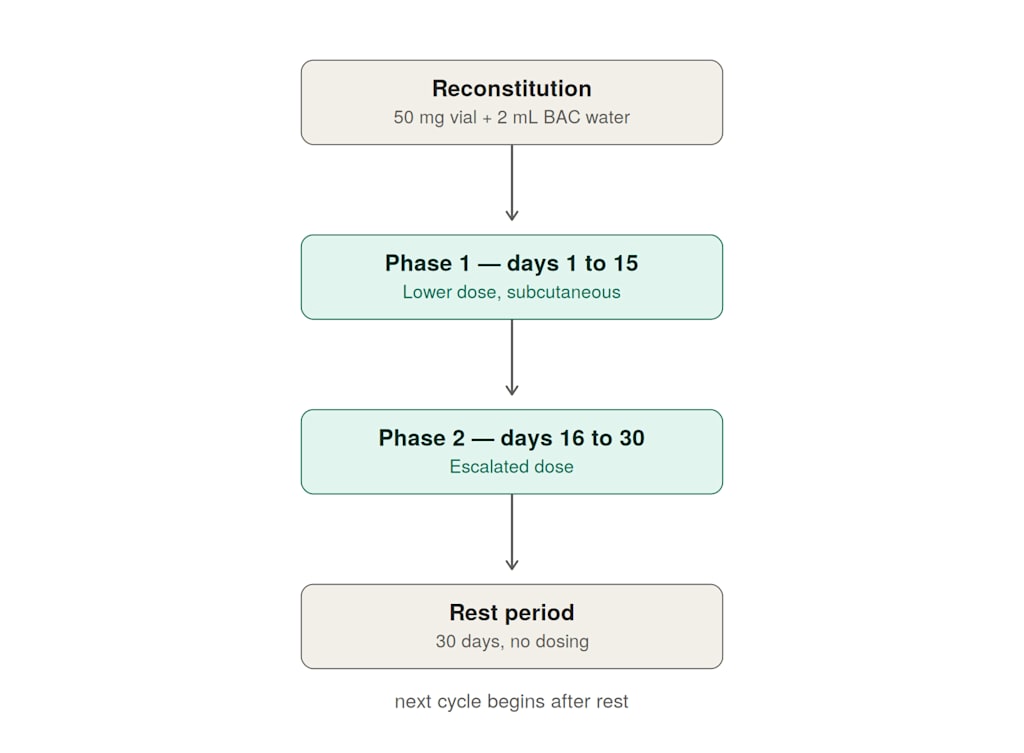
Across the peptide research literature, GHK-Cu protocols tend to follow a cyclical structure rather than continuous daily dosing — a pattern rooted in how the peptide is understood to work. Because GHK-Cu operates through cumulative signaling rather than peak concentration, researchers commonly build in an escalation: a lower dose in the first half of a cycle, a higher dose in the second half, followed by a deliberate rest period before starting again. The logic mirrors something seen across other signaling-based compounds — continuous, unbroken exposure tends to blunt the very receptor sensitivity the protocol is trying to engage.
For reconstitution, the standard research approach for a lyophilized GHK-Cu vial involves bacteriostatic water added slowly along the vial wall (never injected directly onto the powder) and gently rolled — never shaken — until fully dissolved. Vigorous agitation is avoided across peptide research generally because it can shear peptide bonds and degrade the compound before it's even used.
What the Tissue-Level Research Shows
The most consistently replicated findings involve skin. GHK-Cu is understood to upregulate collagen synthesis in dermal fibroblasts, a mechanism explored in multiple studies, including research on copper peptides and skin regeneration published in Biomolecules, which also examined GHK's broader gene-modulating effects. Since baseline collagen production is known to decline roughly 1% per year starting in the mid-20s, a compound that reactivates a suppressed signaling pathway — rather than simply adding raw material — is mechanistically interesting in a way that most topical actives aren't.
Hair biology is the second major area of research interest, and it's more mechanistically indirect than the skin data. Research reviewed by Spartan Peptides and other groups points to GHK-Cu's involvement in Wnt/beta-catenin signaling — the pathway that governs whether a hair follicle sits dormant (telogen) or actively grows (anagen). This is the same pathway broadly implicated in dermal papilla cell regulation across the hair-biology literature, and it's worth being precise here: the connection between GHK-Cu and follicle-specific Wnt activation is still an area of active study rather than settled fact, and most of the strongest data so far comes from cell culture and animal models rather than large human trials.
Wound healing and tissue remodeling research goes back further and is more robust. Pickart's foundational work — and subsequent studies on copper peptides and wound closure — point to upregulation of matrix metalloproteinases, the enzymes responsible for remodeling collagen into organized structure during repair, rather than the disorganized collagen deposition that produces visible scarring. Research on ischemic and diabetic wound models has similarly reported meaningful improvements in wound closure rates alongside reduced inflammatory markers when GHK-Cu was introduced into the healing process.
More recent research has pushed into less expected territory. A 2025 study published in Frontiers in Pharmacology examined GHK-Cu's effects in a colitis model, finding that it modulated SIRT1 and STAT3 signaling in colon tissue — a reminder that this peptide's research footprint extends well past skin and hair into broader inflammatory and metabolic pathways.
Why Sourcing Is the Variable Nobody Talks About
Here's the part that rarely gets said plainly: a huge share of inconsistent GHK-Cu research outcomes — the reports of no effect, or unpredictable irritation — trace back to the material itself rather than a failure of the underlying science. Peptide degradation from poor storage, incorrect reconstitution, or simply underdosed product is a bigger confound in this space than most discussions acknowledge. A peptide that hasn't been verified for identity and purity via third-party testing isn't a controlled variable — it's an unknown, and no amount of protocol precision fixes that.
This is really the whole argument for working with a supplier that provides a batch-specific Certificate of Analysis rather than taking purity claims on faith. Iron Peptides publishes COAs for its research compounds, including GHK-Cu, which at minimum removes one major variable from any research protocol built around it.
The Bottom Line
GHK-Cu sits in a strange spot in the peptide research world — genuinely old research (Pickart's earliest work goes back to the 1970s), genuinely broad mechanistic reach (thousands of modulated genes), but still a compound where the human clinical trial base lags behind the mechanistic and cell-culture data. The cyclical dosing structure researchers use — escalating within a defined window, followed by a rest period — reflects an understanding of the peptide as a signaling molecule rather than a substance that accumulates and produces dose-dependent effects the way a drug typically does. That distinction matters more than most surface-level content about GHK-Cu tends to acknowledge.
This article is for informational and educational purposes only and does not constitute medical advice. GHK-Cu and all peptides referenced are intended strictly for laboratory research use and are not approved for human consumption, diagnosis, treatment, or prevention of any disease. Consult a licensed medical provider before making any decisions related to your health.
About the Creator
Valeria Marulanda
Valeria Marulanda is a board-certified Family Nurse Practitioner (FNP-BC) with a Bachelor of Science in Nursing from Florida Atlantic University and a Master of Science in Nursing from St. Thomas University. Since 2018.
Enjoyed the story? Support the Creator.
Subscribe for free to receive all their stories in your feed.
Comments
There are no comments for this story
Be the first to respond and start the conversation.