
⚔️ GAZA ON THE BRINK: Israel Now Controls 59% of the Strip, 828 Palestinians Have Been Killed Since the “Ceasefire” — And Full-Scale War Could Restart Any Day
A ceasefire that was never really a ceasefire is about to collapse. The people trapped inside Gaza are bracing. And the world has been looking away.
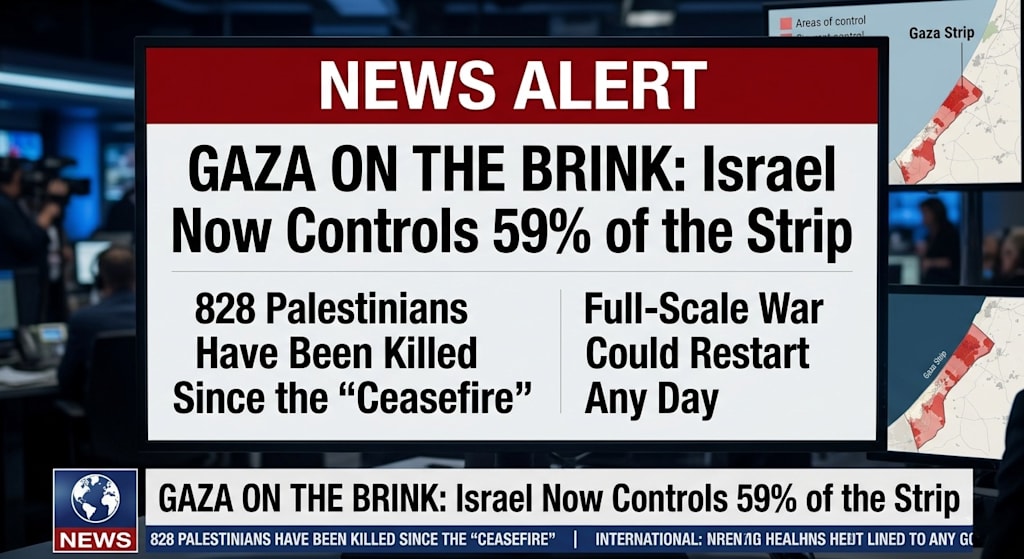
In the shattered neighborhoods of Khan Younis and Deir el-Balah in the Gaza Strip, the roar of Israeli drones and the concussive thud of controlled demolitions are the sounds of daily life. Families continue to pull bodies from rubble. According to local medical sources, 828 Palestinians have been killed since the so-called “truce” began in October 2025. The ceasefire agreement, signed after a devastating two-year war that resulted in at least 72,608 Palestinian deaths, was supposed to mark a turning point. Instead, it has marked the beginning of a slow-motion second act of the same tragedy — one that may be about to accelerate dramatically.
On the ground, Israeli forces have not merely failed to withdraw from Gaza, as required under the ceasefire terms. They have actively expanded. By gradually pushing the “Yellow Line” — a boundary established under the ceasefire framework — progressively westward, the Israeli military has expanded its territorial control to 59 percent of the Gaza Strip. It now controls large swaths of Rafah, Khan Younis, and northern Gaza. The withdrawal that the ceasefire agreement stipulated, which was supposed to have been completed during phase one, has not happened. Instead, troops have been moved from the Lebanese front into Gaza and the occupied West Bank, increasing rather than decreasing the military footprint inside the besieged enclave.
The political crisis at the top of the Israeli government mirrors the military situation on the ground. Prime Minister Benjamin Netanyahu abruptly cancelled a scheduled security cabinet meeting over the weekend, opting for smaller, closed-door consultations — a sign, analysts say, that major decisions are being made in a compressed, informal setting. The Israeli military’s General Staff told Channel 15 that an additional round of fighting was “almost inevitable,” citing Hamas’s refusal to surrender its weapons and what they described as the “failure” of the International Stabilization Force, a multinational body deployed under the truce framework. The drumbeat of war is growing louder by the hour.
At the center of the dispute is the question of Hamas’s weapons. The U.S.-backed plan, pushed by Nikolay Mladenov — the high representative for the Board of Peace — would require Hamas to completely disarm over 281 days across five stages. Crucially, the plan conditions humanitarian aid, reconstruction, and the opening of border crossings into Gaza on the phased handover of weapons. In other words: disarm first, then receive assistance. Hamas and every other major Palestinian faction have universally and unequivocally rejected this framework. Abdul Jabbar Said, a member of the Hamas political bureau, confirmed that a unified front comprising Hamas, Palestinian Islamic Jihad, and the Popular Front for the Liberation of Palestine has rejected the disarmament prerequisite. The groups insist that Israel must first implement the existing ceasefire in full — including the 600 aid trucks per day it agreed to allow in but has blocked — before any discussion of weapons can take place.
The disagreement goes deeper than logistics. Political analyst Wissam Afifa, speaking to Al Jazeera, explained that Hamas is deliberately linking the weapons question to a broader political horizon — specifically, a path toward Palestinian statehood and an end to the Israeli occupation. The American and Israeli position, by contrast, tries to decouple the weapons issue entirely from any political resolution, treating disarmament as a purely security matter disconnected from questions of governance, sovereignty, or nationhood. Hamas views this framing as a trap: disarm first, then negotiate from a position of total vulnerability. For any armed resistance movement anywhere in the world, that is not a negotiating position — it is a surrender demand.
Israel’s own military situation complicates its ability to restart the war even if it wants to. Mamoun Abu Amer, an expert on Israeli affairs, told Al Jazeera that the war threats are partly a “smoke screen” designed to put pressure on mediators and shore up Netanyahu’s political standing before Israeli elections in October. The Israeli military is, by multiple accounts, deeply fatigued. Reservists are serving an average of 80 days per year in 2026. The crisis in southern Lebanon, where Hezbollah and Israeli forces continue exchanging fire despite a nominal ceasefire, remains an open wound. Reopening full-scale hostilities in Gaza while managing southern Lebanon, policing the West Bank, and facing diplomatic pressure from Washington would present, in Abu Amer’s words, “a strategic nightmare.”
Humanitarian conditions inside Gaza remain at crisis levels that defy adequate description. The UN’s Office for the Coordination of Humanitarian Affairs and field reports document a reality in which the Yellow Line is not a fixed, clearly marked boundary but a shifting, ambiguous buffer zone that creates life-threatening confusion for civilians trying to return to their homes or tend their farmland. Medical evacuations have been almost completely suspended. Border crossings have been restricted. The population lives with severely limited medical care, food insecurity, and inadequate shelter. Children are among the most affected. The Gaza Ministry of Health documented more than 2,073 ceasefire violations between October 2025 and March 2026 — violations that have continued, at lower intensity but without cessation, every month since.
The broader Middle East context adds another dimension. With a fragile ceasefire holding between the U.S., Israel, and Iran — and with the Strait of Hormuz crisis consuming global diplomatic attention — Gaza has been, in the words of media scholars, “eclipsed” in international coverage even as conditions inside the enclave remain unchanged or worsen. The UN Commission of Inquiry warned this week that the regional conflict has “eclipsed a surge in human rights violations against Palestinians,” and reiterated its conclusion that Israel continues to “perpetrate genocidal acts” in Gaza. Israel rejects this characterization. The international community remains deeply divided.
For the people of Gaza — for the families who have lost children, the hospitals treating the injured with inadequate supplies, the workers navigating an economy that has essentially collapsed — the geopolitical calculations of great powers offer no comfort. They are waiting, as they have been waiting for months, to find out whether the fragile semblance of calm will hold one more day. Based on every signal coming from Jerusalem, Cairo, and Washington, the answer grows less certain by the hour.
About the Creator
Enjoyed the story? Support the Creator.
Subscribe for free to receive all their stories in your feed.
Comments
There are no comments for this story
Be the first to respond and start the conversation.