
Gas Is Now $4.46 a Gallon — and It Could Hit $5 Before Memorial Day. Here Is the Full Economic Nightmare Playing Out at Your Gas Station
The Strait of Hormuz is still closed. The summer driving season starts in weeks. Analysts warn $150 oil is possible by June. Energy Secretary Chris Wright says sub-$3 gas may not return until next year. Every day without a deal costs American families real money — and the world more than that.
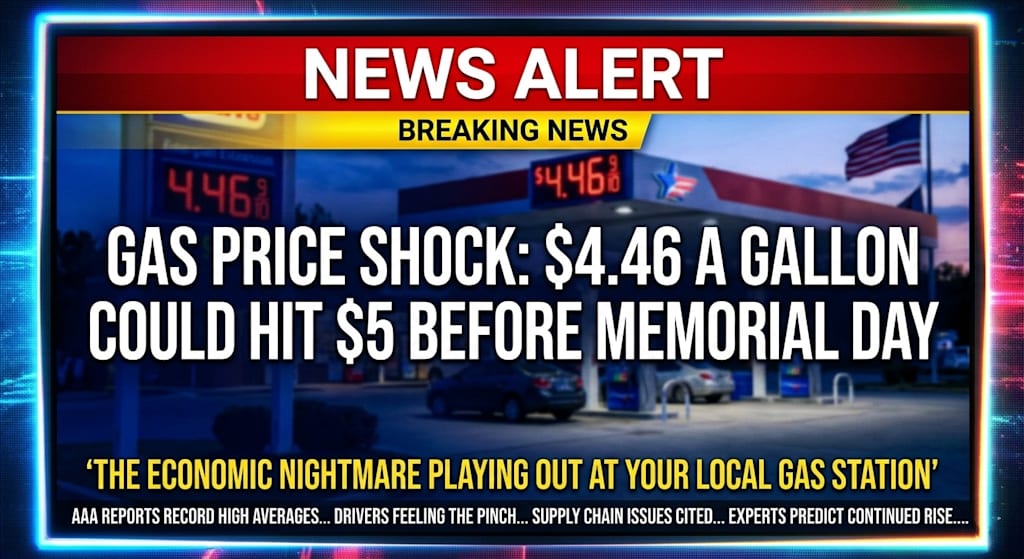
On Monday, May 4, the national average price of regular gasoline in the United States reached $4.46 per gallon — the highest level in nearly four years, and a record high for this specific calendar date, according to the AAA fuel tracking service. That number represents a 50 percent increase from the $2.98 per gallon that Americans were paying on February 26, 2026 — exactly two days before the U.S.-Israel strikes on Iran launched the war that closed the world's most critical oil shipping lane and triggered the most severe energy crisis since the 1970s. The pain is real. It is widening. And according to energy experts, it is not close to over.
The mathematics of the crisis are not complicated. The Strait of Hormuz — a 21-mile-wide waterway between Iran and Oman — is the sole exit route for oil produced in Saudi Arabia, the UAE, Kuwait, Iraq, and Qatar. Before February 28, approximately 20 million barrels of crude oil and 20 percent of global liquefied natural gas passed through the strait every single day. Iran's closure of the waterway removed the largest single-point oil supply in history from the global market — 14 million barrels per day, overnight. Crude oil was trading at $70 a barrel before the war. It surged above $116. Citigroup analysts have warned in writing that if the strait remains closed through the end of June, Brent crude could reach $150 per barrel. At $150 oil, American gas prices would likely reach $6 or more nationally — and significantly higher on the West Coast and in urban markets. Some California stations are already there.
"Gas prices could reach $5 a gallon if the Strait remains closed." — Oil market expert, CNN, May 4, 2026
The regional variation is already extreme. Illinois drivers are paying $4.93. Florida is at $4.34. Georgia: $3.85. Texas: $3.92. West Coast states have already cleared $6 in many locations. Diesel — the fuel that moves freight, agriculture, and the nation's supply chain — has reached $5.64 per gallon nationally, up $2.09 from a year ago. Every time diesel rises, so does the cost of everything transported by truck: groceries, medications, building materials, clothing, electronics. The inflationary ripple from diesel prices typically takes four to eight weeks to appear fully in consumer prices. That wave is coming.
The political consequences for the Trump administration are acute. In December 2025, the national average dipped below $3 per gallon for the first time in four years — a moment Republicans celebrated as proof that Trump's energy and economic policies were delivering results. That narrative is now in ruins. Energy Secretary Chris Wright, who appeared on CNN's State of the Union just weeks ago saying sub-$3 gas was "not a months thing — in the worst case, this is a weeks thing," returned to the same programme this week to walk that prediction back entirely: "I don't know. That could happen later this year. That might not happen until next year." The contrast was devastating. The promise was made in March. It was abandoned in May.
The U.S. Department of Energy has released 17.5 million barrels of crude oil from the Strategic Petroleum Reserve — a meaningful but ultimately limited buffer. OPEC+ announced Sunday it would increase production by 188,000 barrels per day starting in June. Neither measure comes close to replacing the 14 million barrels per day lost from the Hormuz closure. Experts caution that even if a diplomatic deal is struck tomorrow and the strait reopens immediately, prices will not normalise quickly. Ships stranded inside the Gulf must be guided out. Iranian mines must continue to be cleared. Damaged facilities along the coast must be repaired. Depleted global inventories must be rebuilt. The timeline from reopening to price relief at the pump is estimated at two to three months minimum.
For millions of Americans who live paycheck to paycheck, that timeline is not abstract. It is the difference between affording the commute to work and not. It is the cost of a road trip that will not happen this summer. It is the rising grocery bill, the costlier prescription delivery, the freight surcharge quietly added to an online order. The war in the Gulf has an address — and it is every gas station in America.
About the Creator
Enjoyed the story? Support the Creator.
Subscribe for free to receive all their stories in your feed.
Comments
There are no comments for this story
Be the first to respond and start the conversation.