
Gamma-Cyclodextrin: A Practical Guide to a Small Ring-Shaped Molecule with Big Uses
How this natural cyclodextrin helps improve solubility, stability, flavor, fragrance, and formulation design

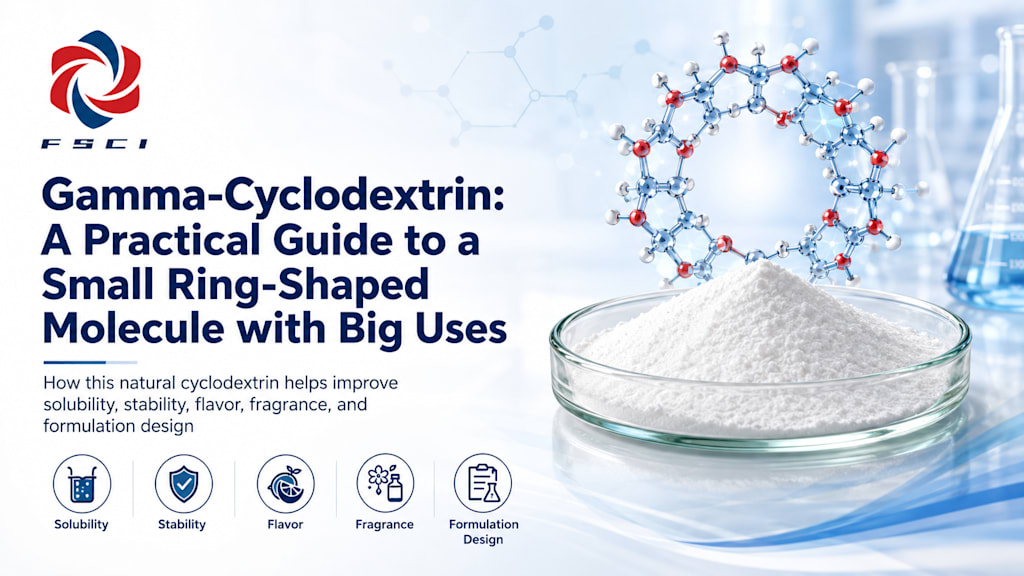
Gamma-Cyclodextrin is one of those materials that sounds highly technical at first, but its basic idea is surprisingly easy to understand. It is a ring-shaped molecule made from glucose units, and its structure gives it a special ability: it can hold certain smaller molecules inside its cavity. This simple feature has made gamma-cyclodextrin interesting in food science, pharmaceuticals, cosmetics, flavors, fragrances, and modern formulation research.
To picture it, imagine a tiny molecular doughnut. The outside of the ring is friendly to water, while the inner cavity is more comfortable holding less water-friendly molecules. Because of this structure, Gamma-Cyclodextrin can help carry, protect, or stabilize ingredients that may otherwise be difficult to use. It does not always change the identity of the guest molecule, but it can change how that molecule behaves in a mixture.
This is the main reason cyclodextrins have become useful in formulation science. Many active ingredients, flavors, oils, fragrances, and sensitive compounds are not easy to dissolve or keep stable. Some break down when exposed to air, light, heat, or moisture. Others have strong odors, bitter tastes, or poor compatibility with water-based systems. Gamma-Cyclodextrin can help by forming what chemists call an inclusion complex, where part of another molecule is held inside the cyclodextrin cavity.
Among the common cyclodextrins, alpha, beta, and gamma forms are often discussed together. The difference between them comes mainly from the number of glucose units in the ring. Gamma-Cyclodextrin has a larger cavity than alpha-cyclodextrin and beta-cyclodextrin, which allows it to interact with a different range of guest molecules. This larger internal space is one reason it is studied for more complex or bulkier compounds.
In food-related applications, Gamma-Cyclodextrin is often valued for its ability to support flavor protection and controlled release. Some flavors are volatile, meaning they can disappear over time. Others are easily affected by oxygen or processing conditions. By holding certain flavor molecules within its cavity, Gamma-Cyclodextrin can help reduce loss, soften harsh notes, or improve how a flavor is released. This does not mean it makes every flavor better automatically. It simply gives formulators another tool for managing delicate sensory ingredients.
Fragrance chemistry follows a similar logic. A fragrance may smell pleasant when freshly added, but it can fade, oxidize, or behave unpredictably in a finished product. Cyclodextrins can help slow release and protect certain fragrance components. This is useful in personal care products, household products, and deodorizing systems where a more controlled scent experience is desired. The public may notice only that a product smells fresher for longer, while the chemistry behind that effect remains invisible.
Gamma-Cyclodextrin also appears in conversations about solubility. Many compounds of interest in pharmaceutical and nutraceutical research are poorly soluble in water. Poor solubility can make a compound harder to study, harder to formulate, and less predictable in performance. Cyclodextrin complexation can sometimes improve apparent solubility by helping the molecule disperse more effectively in aqueous environments. This is one reason Gamma-Cyclodextrin continues to attract attention in laboratory research and formulation development.
Stability is another important area. A sensitive ingredient may lose activity or develop unwanted changes during storage. If Gamma-Cyclodextrin can reduce direct exposure to oxygen, light, or other reactive surroundings, it may help improve stability in certain systems. The effect depends heavily on the guest molecule, concentration, moisture level, and full formulation. Still, this protective behavior is one of the most important reasons cyclodextrins are studied.
Cosmetics and personal care products offer another good example. Modern formulations often combine oils, plant extracts, fragrances, active ingredients, and water-based components. These ingredients do not always behave well together. Some separate, some oxidize, and some create strong odors or unpleasant textures. Gamma-Cyclodextrin can help manage selected ingredients by improving compatibility or modifying release behavior. In this sense, it supports a cleaner and more controlled product experience.
When people evaluate Gamma-Cyclodextrin for a formulation, the first question is not only “What is it?” but “What problem should it solve?” If the goal is to improve solubility, the guest molecule must fit well enough into the cavity. If the goal is odor masking, the molecule responsible for the odor must interact with the cyclodextrin structure. If the goal is controlled release, the complex must be stable enough to hold the guest molecule, but not so stable that release becomes difficult. This balance is what makes cyclodextrin chemistry both practical and subtle.
The physical form also matters. Gamma-Cyclodextrin is typically handled as a powder, and its behavior in a real formulation depends on particle characteristics, moisture content, purity, and processing conditions. A good formulation study usually looks beyond the name of the ingredient and examines how it performs in the final system. Mixing method, temperature, pH, water content, and the nature of the guest molecule can all influence the result.
Another point worth noting is that Gamma-Cyclodextrin is often chosen when a larger cavity is useful. Beta-cyclodextrin may be more familiar in some applications, but it does not fit every molecule well. The wider ring of Gamma-Cyclodextrin can make it more suitable for certain larger molecular structures. This does not make it universally better. It simply means that cavity size should match the chemistry of the ingredient being studied.
For readers who want to understand the material more directly, Gamma-Cyclodextrin is commonly introduced as a cyclic oligosaccharide used in solubility enhancement, stabilization, flavor protection, fragrance control, and formulation research. Its usefulness comes from structure rather than hype: a hydrophilic outer surface, a less polar internal cavity, and the ability to form inclusion complexes with suitable guest molecules.
The best way to think about Gamma-Cyclodextrin is not as a magic additive, but as a molecular helper. It can make difficult ingredients easier to handle, protect sensitive compounds from the environment, reduce unwanted sensory effects, or create more controlled release behavior. Whether it works well depends on the match between molecule, formulation, and purpose.
In a world where products are expected to be stable, pleasant, effective, and carefully designed, small supporting materials often make a large difference. Gamma-Cyclodextrin is a good example of that quiet chemistry. It does not usually become the visible feature of a product, but it can influence how that product smells, tastes, dissolves, stores, and performs.
That is why this ring-shaped molecule continues to matter. It connects natural carbohydrate chemistry with modern formulation needs, offering a practical bridge between difficult ingredients and usable products. From food science to personal care and pharmaceutical research, Gamma-Cyclodextrin shows how a small molecular cavity can open up many possibilities.
About the Creator
Enjoyed the story? Support the Creator.
Subscribe for free to receive all their stories in your feed.
Comments
There are no comments for this story
Be the first to respond and start the conversation.