
From Oil Wells to Grocery Shelves
How a small Caribbean island’s energy sector shapes food prices

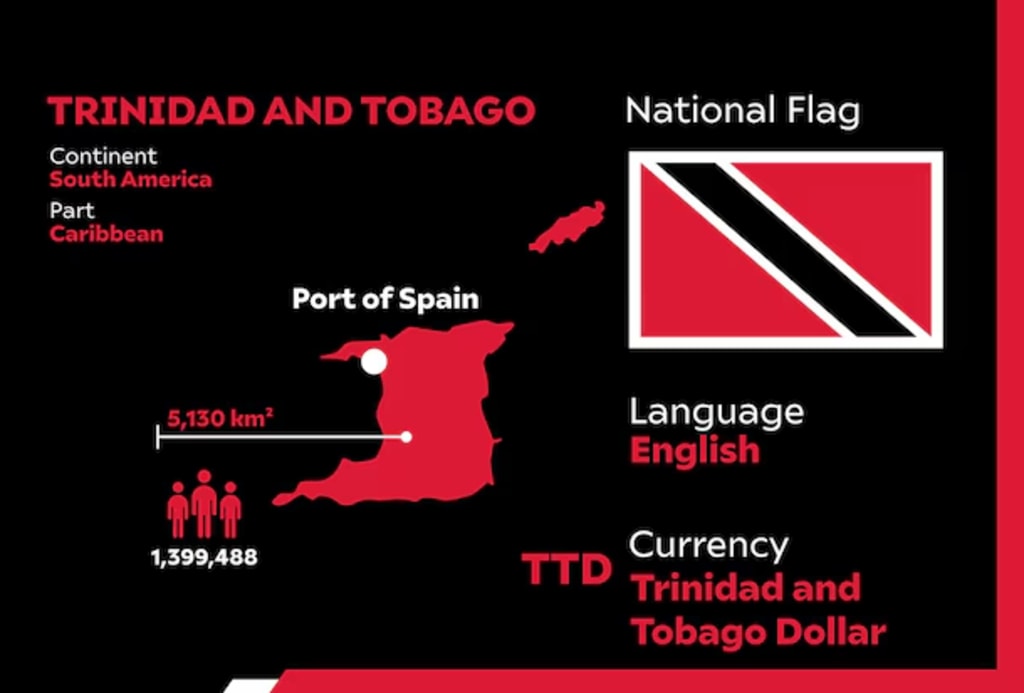
In this short read, we take a look at how Trinidad and Tobago, a small twin-island state located at the southern-most point of the Caribbean archipelago, finds the price of food in the local grocery stores inextricably linked to the performance of the Energy market.
It's not for the obvious reason you may think!
But first, a bit on Trinidad and Tobago.
Trinidad and Tobago in context
Trinidad and Tobago is home to only 1.3 million people - and has been my home for my entire life of 35 years. Known mostly for the lifestyle it epitomizes - Soca music, Carnival, steelpan - among the Financiers of the world it is better known for its lucrative energy resources. Trinidad and Tobago is the leading producer of oil and gas in the Caribbean and accounts for roughly 80% of the country's exports and 40% of its GDP.
Meanwhile, as rich as the country is in Energy, its food security struggles. It should be noted that Trinidad and Tobago is not the only Caribbean state facing this challenge. According to a report published by the Food and Agriculture Organization of the United Nations (FAO)[1], the food security challenges of the entire Caribbean region are notably prominent. In fact, moderate or severe food insecurity as a percentage of total population is estimated at 59% in 2023 compared to a global average of 29% - this is comparable to that of Africa! Trinidad and Tobago scores a staggering 43% on this scale. 43% of the population faces what the United Nations would consider moderate or severe food insecurity.
Why is it important to understand the link between Energy and Food?
We have already established that Trinidad and Tobago faces a notable food security issue and yet is one of the wealthiest Caribbean states due to its energy exports. Simply put - this should not be the case. And yet, it is!
No matter where we live, it is important to understand the connection between macroeconomic trends and our daily lives. It is why people care and it informs when, why and how we, as a people, act and react to the changes our leaders promote. When we ignore these links, we misunderstand our governments' policies and may often find ourselves arguing or even striking for something that ultimately won't benefit us. I can give a simple example to demonstrate how it's often a balancing act for governments in setting policy whether we agree or not as a people:
Your government provides a subsidy on fuel to keep transportation and electricity costs low, which helps local farmers by reducing their production costs. If global oil prices rise, the government either must spend more to buy fuel or earns less by exporting subsidized fuel. This means less money is available for things like agriculture and social services. Alternatively, if the government cuts fuel subsidies in response, fuel prices at the pump increase, raising production costs for farmers and ultimately leading to higher food prices.
The bottom line is that the population should have some degree of understanding of this to inform not just how we vote but also how we respond to changes that the people we elect choose to enact.
Link between Energy and Grocery Prices
Trinidad and Tobago is a net importer of food and a net exporter of oil and gas. In the last 10 years (2013 to 2023), Trinidad and Tobago has imported 3.57 times more food than it has exported.[2] Trinidad and Tobago is the 2nd largest market in the English-speaking Caribbean for US Agricultural exports[3]. On a global scale, this corroborates the food insecurity already referenced. While this is typical of small island developing states (SIDS), globally, this puts Trinidad and Tobago in the top 20–30% of nations dependent on food imports for their security.[4]
But isn't Trinidad rich? Short answer is yes!
With a projected real Gross Domestic Profit growth for 2024 at 2.4% and a GDP per capita at $16,725 USD[5] - Trinidad and Tobago aint poor! This puts Trinidad and Tobago at top quartile within the Caribbean and mid quartile globally. Remember its wealth is owed primarily to energy exports. Have a look at the graphs below which show how closely the revenue of Trinidad and Tobago follows commodity prices of oil and gas - mostly oil price as the Pearson coefficient factor here is 0.7 compared to 0.38 for gas price.
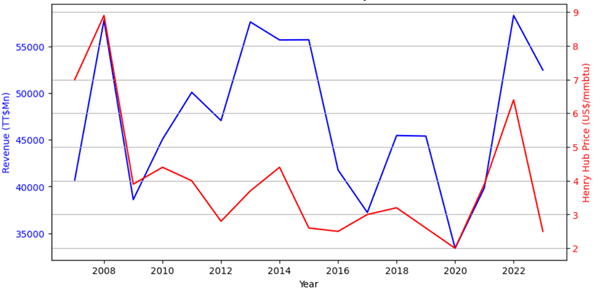
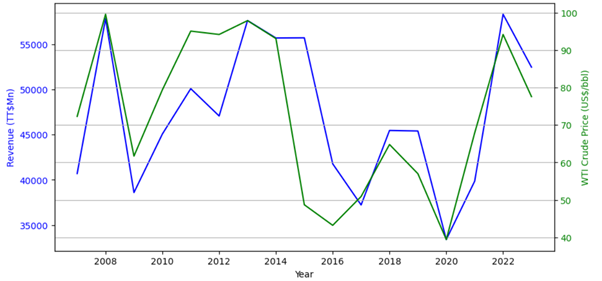
So far we've established the following, Trinidad and Tobago is rich; it imports most of its food and is considered to be facing notable food insecurity. What does this mean for the price of food on their grocery shelves?
The best way to measure this is by the Consumer Price Index (CPI) - Food sub-index. The CPI is a common indicator used to understand the change in prices over time that a consumer pays for a basket of goods. CPI - Food for instance is a ratio that compares the price of a basket of food products such as fruits, vegetables, meats, etc today to the set price of the same food items some time in the past.
Taking a look at Central Bank of Trinidad and Tobago CPI data, we see that compared to 2015, the price of a basket of food has risen by 47% with no indication of stopping.
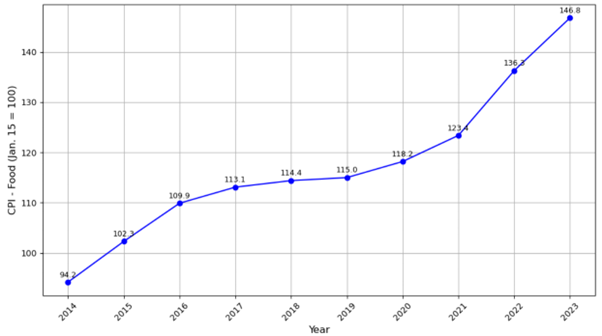
A CPI-food of 146.8 is not unusual for an emerging economy like Trinidad and Tobago however it is in the top quartile globally. This suggests a higher-than-expected inflation in the cost of food within Trinidad and Tobago compared to the rest of the world. What's also glaringly obvious is the upward trend which is not just increasing, but also appears to be rising at an even faster rate than before.
Let's see why.
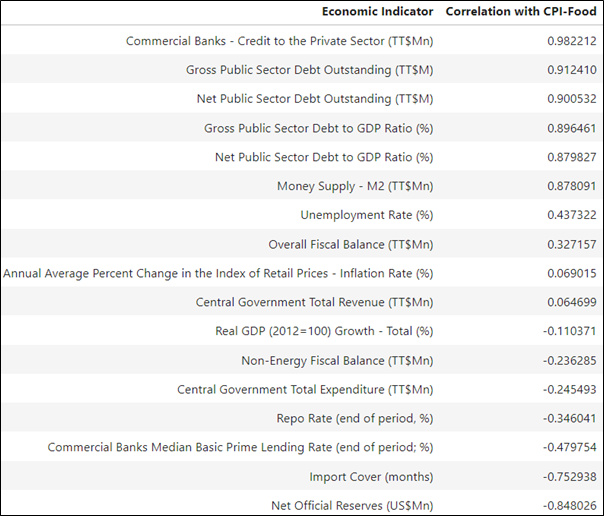
Let's use the Pearson correlation coefficient again here. Remember the closer this number is to +1, the closer the relationship - i.e. the strong the dependency on the CPI-Food to that metric. The closer the coefficient is to -1, the relationship between CPI-food and that metric is inversely true such that if one goes up, the other goes down. If this coefficient is 0, there is no correlation at all, and CPI-food is considered completely independent of that metric.
Looking at the table above we see that the cost of food is most sensitive to the credit provided to the private sector by commercial banks. This speaks to how much money the banks lend to both consumers as well as businesses in the local community. This suggests that if the banks lend more, the cost of food raises and when the banks lend less the cost of food is lower.
Important side note: it isn't this black and white, I know… However, lets jump on the logic train here and see where it takes us.
In Trinidad and Tobago, the ability of commercial banks to lend is actually closely linked to the country's economic structure and dependence on the energy sector. When oil prices are high which we know leads to higher revenue for Trinidad and Tobago, a variety of things happen:
- The overall economy is stimulated - even amidst the psychology of the people. Consumer confidence is increased which leads to more business activity and this ultimately turns into more demand for bank credit.
- With higher revenue to the government, spending on public projects which promotes jobs and overall private sector growth adds to the economic stimulation
- The banks also feel a bit better to lend as they perceive lower risk in doing so in a healthier economic environment
In a stimulated economy, how people choose to spend their money directly impacts the price of the commodities they spend it on - simple supply-demand logic. In Trinidad and Tobago, there's a saying, "We like nice ting".
When the bank lends more, overall, the purchasing power of the people increases. What the people choose to do with that power has a significant impact on almost everything around them. In the case of Trinidad and Tobago, that added purchasing power goes into a lot of things, but rarely would we see a proportional increase in the purchase of locally produced food items. And if the demand does not increase, neither will the supply. Instead, any additional purchasing power goes into the 'nice tings' that are often imported.
The Bottom Line
This simple fact points to one simple truth: in a health energy market, the people of Trinidad and Tobago have stronger purchasing power but choose to import over buying local ultimately driving up the price on the grocery shelves now littered with foreign treasures to meet the demand of the people they serve.
"We have met the enemy, and he is us" - Walt Kelly (1970)

[1] "The State of Food Security and Nutrition in the World Report 2023"
[2] Trinidad and Tobago Central Statistics Office https://cso.gov.tt/subjects/international-trade/
[3] International Trade Administration US Department of Commerce (Mar 2024)
[4] OECD-FAO Agricultural Outlook
[5] World Bank Data
About the Creator
Brian Ali
Brian Ali explores the use of data, using his industry experience to make complex topics relatable. He writes to reveal how big-picture economics affects daily life, inviting readers to understand and engage.
Enjoyed the story? Support the Creator.
Subscribe for free to receive all their stories in your feed.
Comments
There are no comments for this story
Be the first to respond and start the conversation.