
From Creative Ideas to Finished Edits: The Evolution of AI Video Production
AI Video Production

A successful video rarely comes together in one editing session. Behind a polished commercial, tutorial, or social media campaign are hours of planning, footage review, scene selection and revisions. For years, these responsibilities depended heavily on manual effort. Artificial intelligence is now changing how creators approach this work. With a ChatGPT AI video maker and connected editing tools such as CapCut × Codex, creators can move from production instructions to an editable video draft through a more streamlined process. The real opportunity is not eliminating creative involvement. It is reducing repetitive work while giving editors more time to focus on storytelling, presentation and quality.
The Real Evolution of AI Video Production
Early video editing tools focused mainly on helping users manipulate footage. Creators could trim recordings, arrange scenes, add transitions and adjust audio. Although these features made editing more accessible, the creative process still required considerable manual involvement.
Modern AI-assisted workflows introduce a different approach. Instead of performing every preparation task independently, creators can describe their objectives and use intelligent assistance to organize parts of the production process.
This development is particularly relevant to businesses producing content regularly. A marketing department might record one product demonstration and need several versions for its website, YouTube channel and social media accounts. Each version requires different pacing, framing and messaging.
AI can help organize the original material and prepare an initial editing structure. The editor can then adapt that foundation for each audience.
However, automation does not automatically produce a compelling story. A video still needs a clear purpose, relevant information and a logical sequence. Technology improves the production process; creative direction determines whether the result deserves attention.
From an Idea to a Production-Ready Brief
The quality of a video often depends on decisions made before recording begins. A broad idea such as creating a video about digital marketing does not provide enough direction for an effective production.
A more useful concept might explore why small businesses struggle to convert website visitors into customers. This gives the creator a specific problem to address and suggests which visuals could support the explanation.
ChatGPT can help develop this initial concept into a practical production brief. It can suggest content angles, organize research, prepare interview questions and structure a script around the intended audience.
For professional projects, the brief should identify:
The objective: What should the video achieve?
The audience: Who needs this information?
The narrative: What should viewers understand first and what follows?
The visual direction: Which demonstrations, recordings, or graphics are necessary?
The delivery format: What duration, aspect ratio and platform requirements apply?
This information gives the production team a foundation for making consistent decisions.
Generated scripts should still undergo editorial review. Creators need to verify factual claims, remove unnecessary repetition and replace generic language with examples that reflect the actual subject.
How CapCut × Codex Connects AI Instructions With Video Editing
One of the more interesting developments in this area is the move toward conversational editing workflows.
CapCut × Codex allows creators to upload existing video clips and describe their editing requirements using natural-language instructions. The workflow can review the supplied footage, identify useful moments, remove unnecessary sections, arrange selected clips and prepare an editable rough cut in CapCut.
Consider a company recording a series of customer interviews. The original material may contain several hours of conversations, repeated answers, long pauses and unrelated discussion. Before editing, someone must identify the sections that contribute to the intended story.
With CapCut × Codex, the creator can provide footage alongside instructions explaining the desired sequence, important moments, preferred pacing and target duration. The workflow helps prepare an initial arrangement that can be reviewed and refined.
Another useful capability involves matching supplied footage with suitable CapCut templates. This can provide a starting point for visual styling without requiring creators to build every element from scratch.
The result is not a guaranteed finished video. It is an editable draft that remains under the creator's control. Editors can change clip order, adjust timing, replace footage and refine the overall direction in CapCut. <Cite refs={["turn350109search0","turn350109search1"]}/>
Which AI Capabilities Matter at Different Production Stages?
Not every AI feature contributes equally to the finished result. The value depends on the production problem being addressed.
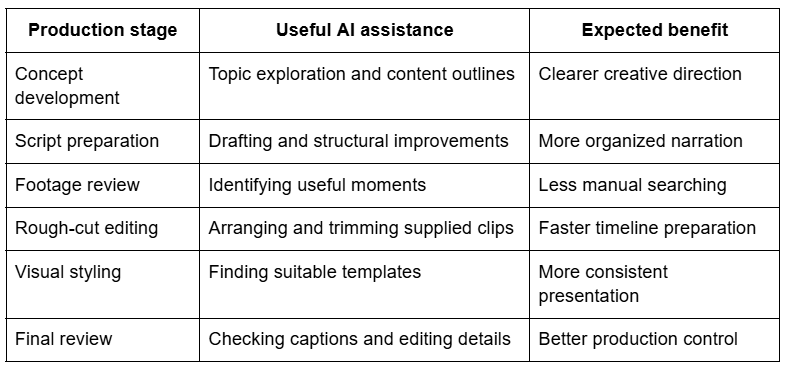
This distinction helps creators avoid adopting tools simply because they advertise impressive features. A production team recording interviews has different requirements from a creator making animated explainers.
The best technology investment is the one that addresses an actual bottleneck.
The Benefits and Limitations of AI-Assisted Video Creation
AI can make production more efficient, but its contribution should be evaluated realistically.
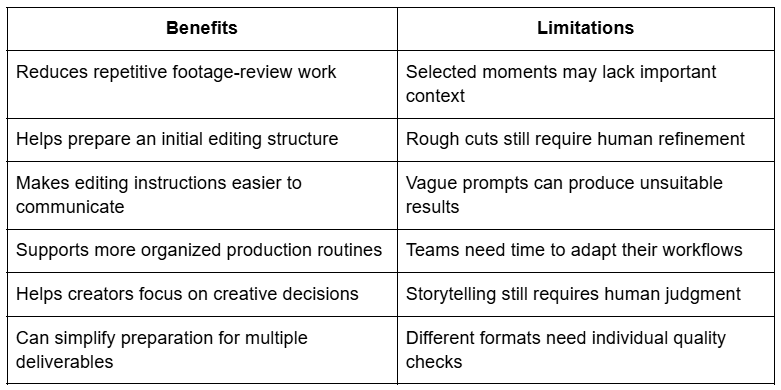
The strongest advantage is the opportunity to redirect working hours toward higher-value tasks. An editor who spends less time organizing footage can invest more attention in narrative structure, sound design and visual consistency.
The limitations are equally important. An automated system might select a visually attractive interview response without recognizing that the preceding question is essential. A short clip might appear suitable independently but create confusion when placed in the larger sequence.
That is why every AI-generated draft needs editorial supervision.
Why Professional Results Depend on Better Instructions
Natural-language editing can simplify communication, but a good result requires more than a general request.
Imagine asking an editing workflow to create a promotional video from ten product recordings. Instructions such as "make it engaging" leave several decisions unanswered. The system still needs direction about the audience, sequence, duration and important footage.
A stronger brief might request an opening demonstration, followed by three product features, a real-world application and a closing shot. It could also specify that repeated demonstrations should be removed and important product details preserved.
The difference is the amount of editorial thinking included in the instructions.
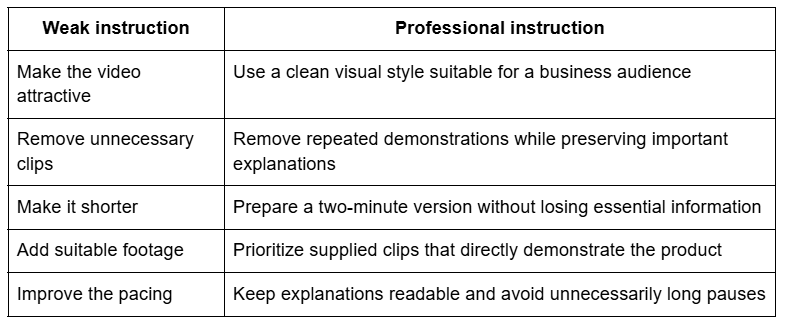
These instructions also make revisions easier. When the initial brief contains clear priorities, editors can identify whether the draft meets the project's requirements.
Where Human Creativity Remains Essential
AI-assisted editing does not remove the need for professional judgment. In some situations, it makes that judgment even more important.
Storytelling is one example. An editor must understand why a scene belongs in a particular position and how it influences the viewer's understanding. A technically correct sequence can still feel disconnected if the narrative lacks direction.
Audio requires similar attention. Background music should complement the subject without overpowering narration. Captions need accurate wording and timing. Transitions should support the sequence rather than become the main attraction.
There are also responsibilities involving copyright and privacy. Creators should only upload material they have permission to process and publish. Third-party music, footage and images must meet the project's licensing requirements.
The final exported video should always receive a complete review. Automation can accelerate preparation, but it cannot transfer responsibility for the published result.
Building a More Efficient Workflow With AI and CapCut
A connected production process offers greater value than using individual AI features without a clear plan.
Start by defining the video objective and preparing a detailed script or production brief. Organize the available footage into meaningful groups and identify the scenes essential to the story. Then use supported AI-assisted editing workflows to prepare an initial cut.
Once the draft is available, move into the editing stage. Review the sequence, correct timing, improve transitions, refine audio and check the visual treatment. If the project requires several deliverables, prepare separate versions with the appropriate framing and pacing.
Finally, evaluate the finished content against its original objective. A promotional video should communicate the product's value. An educational video should explain its subject clearly. A social media clip should deliver its message without unnecessary delays.
This approach also creates opportunities to improve future projects. Production teams can document which instructions worked, which edits required correction and where manual intervention remained necessary.
The Next Chapter of AI-Powered Video Production
The evolution of video production is moving toward more connected workflows where planning, footage organization and editing assistance work together.
CapCut × Codex represents one example of this direction. Its documented workflow connects natural-language instructions with footage review, template matching and editable rough-cut preparation. It gives creators a more structured starting point while preserving their ability to control the final edit.
The wider lesson is that professional video creation is not about using the greatest number of AI tools. It is about choosing technology that solves practical problems without weakening the creative process.
When intelligent assistance is combined with accurate research, thoughtful storytelling and experienced editing, production becomes more manageable and the final content becomes more valuable. That balance will define the next generation of effective video creation.
About the Creator
Mohammad Akhtar
Mohammad Akhtar is an SEO and SEM Expert with over 10 years of experience in digital marketing and search engine optimization. A 2013 graduate of The Islamia University of Bahawalpur, he has worked with various IT companies.
Enjoyed the story? Support the Creator.
Subscribe for free to receive all their stories in your feed. You could also become a paid subscriber, letting them know you appreciate their work.
Comments
There are no comments for this story
Be the first to respond and start the conversation.