
Flutter Application Development: Future Trends for 2025
Flutter Application Development Trends
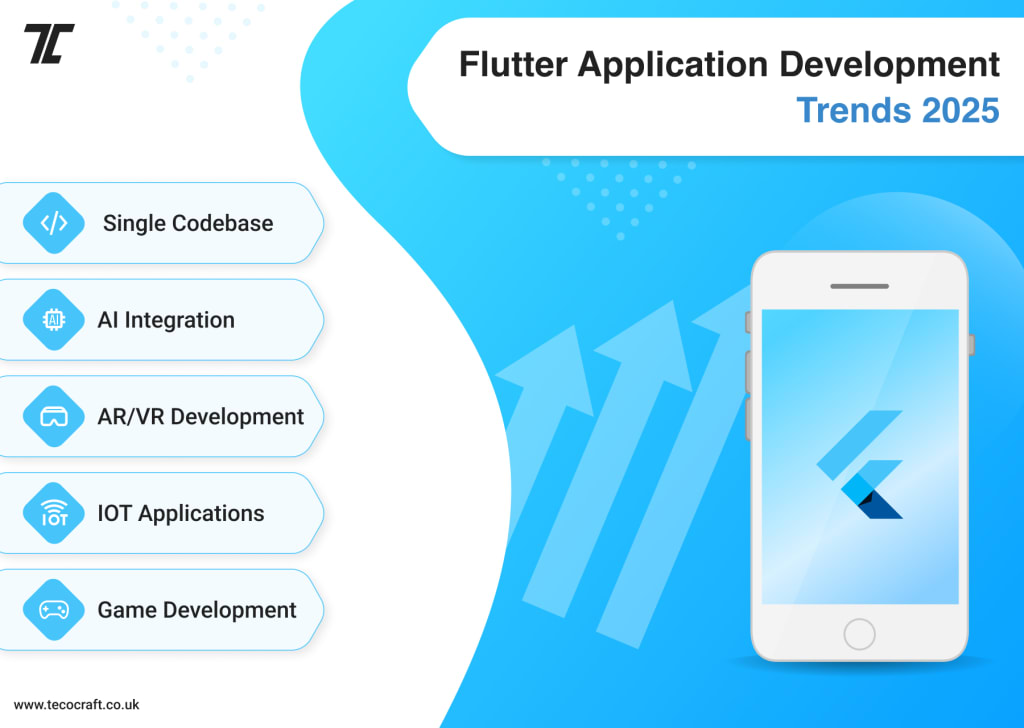
Dreaming of creating speedy and scalable digital solutions for 2025? Flutter is unmatched in performance standards for all the platforms—here's what's coming next. From MVPs to enterprise solutions, Flutter is bringing a new dawn in cross-platform development with speed and scalability.
One of the most promising tools this time is Flutter, an open-source UI toolkit by Google, to import Android and iOS applications without pain and with relatively high productivity. In 2025, the future-ready approach of Flutter application development continues to dominate, along with very robust performance across mobile app development, web, desktop, and embedded platforms under a single codebase.
This small article demystifies the trends and good practices for innovations that will shape the future of Flutter application development in 2025. For startup companies that want to develop their MVPs quickly or for enterprises that are establishing scalable digital products, Flutter has enough promise to prove its value over time.
1. The Rise of Flutter: A Past and Present Survey
Launched in 2017, Flutter found instant traction with its claim of native performance and pretty UIs using a single code base. It focused solely on mobile (Android and iOS) and has developed into:
- Web applications (using HTML, CSS, and CanvasKit)
- Desktop Platforms (Windows, macOS, Linux)
- Embedded systems (via Flutter Embedder API)
In 2025, Flutter could be used by well-heeled companies such as Google Pay, Alibaba, eBay, and BMW alongside thousands of startups and SMEs.
2. Trends in Flutter App Development for 2025
1. Cross-Platform, but Not Mobile
The biggest advantage of Flutter is that it supports multiple platforms. In the year 2025, developers are building:
- Web dashboards for SaaS platforms
- Desktop administration panels and POS systems
- Progressive Web Applications (PWAs)
- IoT dashboards and embedded GUIs
With the new updates of the Flutter framework, specific integration platforms such as macOS menu bar enablement, system tray support on Windows, and full-screen modes in Linux have been offered.
2. Integration of AI to Flutter Apps
Modern-day apps must think smart. Flutter's ability to integrate AI and ML tools will empower smart features like:
- Personalized experiences and content for each individual.
- Predictive search and recommendations.
- Real-time translation and face detection.
Conversational AI through chatbots and voice assistants, using Dialog Flow or OpenAI APIs.
3. AR/VR Development Using Flutter
Flutter is being used as the UI layer for immersive applications through integration with Unity, ARKit, and ARCore, and is not an AR/VR engine in itself. In 2025:
- Retailers build AR product previews for e-commerce apps.
- Navigation apps use AR overlays
- Education apps have interactive 3D models
And because Flutter interfaces with platform channels to render custom native views, AR/VR projects fit well into its front.
4. Flutter in IoT Applications
Flutter is slowly picking up in IoT app development, thus providing developers with the following advantages:
- Dashboards for smart home devices
- UIs for wearables and sensors.
- Connectivity to IoT systems such as MQTT, BLE, and HTTP APIs.
The various operations with fewer resources is another reason, coupled with the ability to integrate via plugins or native code, that Flutter is an excellent choice for the interface of IoT.
5. Flutter in Game Development
Not designed as a 3D game engine, Flutter is apt for 2D casual games, game UIs, and companion apps. In 2025:
- For building games, Flame Engine is an excellent choice for game development.
- Flutter, which is used for creating game dashboards.
- Firebase and Flutter provide a real-time multiplayer game mechanism.
For a hybrid gaming experience, the Unity game engine is used through Flutter for the non-gaming portions of the interface, creating smooth navigation and consistent UI throughout the gaming and non-gaming screens.
6. Low-Code and No-Code Development
With tools such as FlutterFlow, AppGyver, or Codemagic, Flutter development is becoming increasingly user-friendly for everyone:
- Designers can visually construct and export Flutter code.
- Start-ups are developing MVPs at a faster pace.
- The enterprise is applying low code for its internal tools.
This kind of development complements the usual pure Flutter development and shaves off much time in the prototyping phase.
7. DevOps, CI/CD, and Automation
In 2025, it'll be said that automation is a given. Flutter developers would have internalized,
- For testing and deployment, use Codemagic and GitHub.
- iOS build using fastlane;
- Get live app insights using Crashlytics and performance monitoring.
By using Flutter for its fast-to-market and high-code-quality capabilities, one can fully exploit such advantages for their apps through CI/CD pipelines.
3. Best Flutter Development Practices in 2025
1. Modern State Management
What should one know regarding modern state management?
- Riverpod: Null-safe, scalable, and test-friendly
- Bloc/Cubit: Best for the larger apps, having complex business logic
Following clean, slim code with the separation of logic from UI will help make Flutter perform well.
2. Follow Clean Architecture Principles
Layered Architecture:
- Presentation Layer: UI + state
- Domain Layer: Business logic
- Data Layer: APIs, local storage
This, in turn, increases the testability and maintainability of the whole Flutter mobile application.
3. Performance Optimization
For a fast and responsive user experience for applications.
- Apply const constructors wherever applicable
- Avoid building large widget trees.
- Cache heavy data and images
- Perform deferred/lazy loading regarding large modules.
- Profile applications with Flutter DevTools
4. Design for Accessibility
Inclusivity matters:
- Use semantic widgets like Semantics and MergeSemantics.
- Provide screen reader labels.
- Choose readable fonts and colors for better visibility.
5. Live Testing and QA
Testing can take quality Flutter applications to higher levels:
- Unit Tests: Business logic
- Widget Tests: UI components
- Integration Tests: End-to-end functionality
The automation happens with Flutter Driver or the Integration_test package.
4. The Business Case for Flutter in 2025
1. Speedy Delivery
Development time is cut considerably through Flutter's hot reload and the use of a single code, thus allowing updates to be released more quickly in competitive markets where time is money.
2. Cost-Effective
A single team that serves five platforms, instead of five different teams working on one platform, results in a 50% reduction in development and maintenance costs compared with the same platforms developed natively.
3. Branding
With Flutter's widget-based architecture, cross-platform mobile apps maintain uniform UI/UX across all platforms to safeguard the brand identity.
4. Scalability
Fostering MVP or enterprise-scale applications, Flutter scales well in its clean architecture, modular design, and state management.
5. Road Ahead for Flutter Framework
Google's roadmap for Flutter revolves around:
- Enhanced Web/desktop support
- Improved dev tools/debugging experience
- Novel rendering backends, e.g., Impeller
- Integrate with the new Dart async
- Animation and custom shader enhancements
Yes, Flutter can easily integrate with the open-source Fuchsia OS by Google
Final Thoughts
In 2025, Flutter is expanding beyond just mobile development. It is now a complete toolset for multi-platform development that has strong pillars for AI, AR/VR, IoT, and Automation integrated into it. Companies not only need their business apps to develop rapidly, but also want cross-platform access and performance on par with native applications; thus, Flutter stands out in app development.
Following best practices in architecture, state management, testing, and performance tuning will future-proof an application while providing a great digital experience.
Whether you are a new startup launching its first product or an enterprise scaling across multiple platforms, Flutter is ready to power your journey.
Want to know more about your Flutter project? Connect with our expert Flutter app development team to get started!
About the Creator
Enjoyed the story? Support the Creator.
Subscribe for free to receive all their stories in your feed.
Comments
There are no comments for this story
Be the first to respond and start the conversation.