
Five Errand Riders Took Her iPhone 18 Pro. Who Pays If It Never Comes Back?
A tracking number, a sleepy confirmation call, and a liability chain that runs from a social post to a courier counter to an errand app.
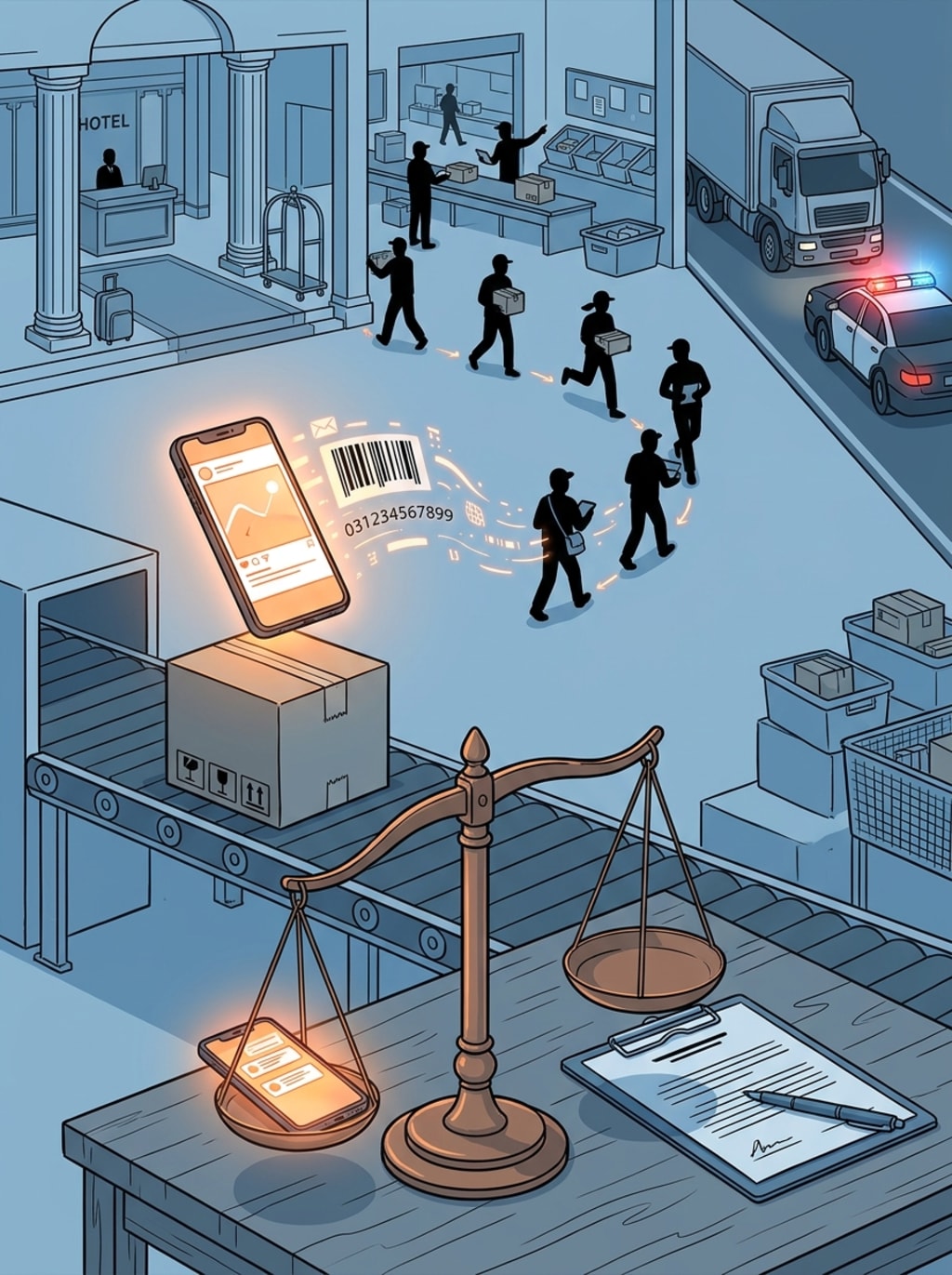
A 11,999-yuan iPhone 18 Pro was taken from a logistics park in Shiyan by an errand rider who used a tracking number to collect it. The parcel was then relayed by five local errand riders who did not meet or communicate with one another. It was left at hotel front desks, packed at another courier station, and sent toward Kaifeng, Henan. Police traced the shipment, intercepted it at the Wuhan Wushanshan station, and returned the phone to Ms. Wang on October 7.
The phone came back. What remains unresolved is how the civil liability would have been divided if it had not.
The reported facts run through four nodes: an unredacted social media post, a handover at the logistics park, a relay through errand platforms, and a cross-city shipment. Each node involves a different actor. The criminal responsibility of the person who engineered the collection is the main issue. Civil fault allocation becomes relevant if recovery fails or if losses remain.
Ms. Wang’s fault: the origin of the risk, not a universal shield
Ms. Wang posted an order screenshot that showed the order number and the tracking number. The phone had reached the Shiyan logistics park but had not been sorted to local delivery stations. A fraudster used the tracking number to place an errand order. An errand rider went to the logistics park and collected the phone.
The courier called Ms. Wang to confirm the collection. She was asleep. She did not ask for details and gave a brief response before hanging up. The courier treated that response as consent and handed the phone to the errand rider without strict identity verification.
Article 1173 of the Civil Code provides that where the victim is at fault for the occurrence or aggravation of the same damage, the liability of the tortfeasor may be reduced. If the phone had not been recovered, Ms. Wang would bear part of the loss. Her fault has two parts. She published order and tracking information without basic redaction. She also gave a vague response when the courier called to confirm collection. The first created the information opening. The second weakened the last verification step.
Her fault reduces the liability of others. It does not automatically eliminate the courier’s independent delivery obligation. A fault comparison does not end with the first person who made a mistake. It asks whether each actor met the duty of care attached to its role, its capacity, and the risk involved.
The courier: the issue is not whether a call was made, but what the call confirmed
The courier company’s likely defense is simple. The collector provided the correct order number and tracking number. The courier called Ms. Wang. Ordinary pickup verification does not require bank-counter identity checks. That defense has a practical basis. In daily practice, most courier stations verify pickup by pickup code, phone tail number, or name. Requiring full identity verification for every parcel would slow delivery beyond what the market accepts.
The fact that matters here is different. The courier knew the collector was not Ms. Wang. The collector was an errand rider. Article 25 of the Interim Regulations on Express Delivery requires an express delivery enterprise to deliver to the agreed address, the recipient, or a recipient designated by the recipient, and to inform the recipient or collector of the right to inspect the parcel face to face. In a proxy pickup, a phone call asking “did you send someone to collect it?” is not enough. The courier should confirm who is collecting, what is being collected, for whom, and whether the recipient has given specific authorization. A vague answer is not specific authorization.
An order number and a tracking number are query information. They are not authorization credentials. A pickup code works more like a delivery password. The fraudster did not have a pickup code. The courier handed over a 11,999-yuan phone on the strength of a tracking number, an errand rider identity, and a brief phone response. For a high-value parcel, the combination of non-self pickup, no pickup code, and a high-value item should have prompted more scrutiny. If the sender did not insure the parcel or disclose its value, the courier’s value-related duty is lower. The identity-verification duty in a proxy pickup does not disappear.
On the contract side, if Ms. Wang bought the phone directly from a merchant, the sales contract is between Ms. Wang and the merchant, and the courier company has a delivery contract with the merchant. Improper delivery may first create liability between the courier company and the merchant, followed by the merchant’s liability to Ms. Wang. Ms. Wang may also claim against the courier enterprise under applicable rules. The courier company is unlikely to escape liability entirely. The dispute is over proportion. Ms. Wang’s fault reduces that proportion. A zero-liability position is weak when the courier knew the collector was a third-party errand rider and did not obtain specific authorization.
The errand platform: intermediary defense and the boundary of risk-control duties
The errand platform’s liability is harder to pin down. The first question is not whether the platform had a risk-control problem. The first question is what role the platform played in these orders: information intermediary, dispatch organizer, or carrier.
Judicial practice is split. Some courts hold that where a platform only provides an order-grabbing channel and does not directly control the rider’s work arrangements or service process, the platform is an intermediary and generally is not liable in contract for the rider’s tort. That reasoning has force. A platform is not the rider’s employer, and the rider’s conduct may fall outside the platform’s control.
That defense cannot be applied mechanically to all the facts here. The platform faced a set of orders with unusual features. Several riders relayed the same parcel within a short period. The handover points were hotel front desks rather than ordinary recipient addresses. The parcel value was far out of proportion to the errand fee. The same tracking number was indirectly linked across multiple orders. A platform that holds order data, rider tracks, and transaction patterns has some capacity to identify such anomalies. Article 38 of the E-Commerce Law reflects a “knew or should have known plus necessary measures” standard. If the platform could identify a relay pattern and took no warning, manual review, or customer-service intervention, its intermediary defense becomes weaker.
The liability remains fault-based. It is not automatic joint liability or advance compensation. The platform will argue that it is not a carrier, that the rider acted beyond its control, and that real-time crime detection would impose an excessive burden. Those arguments have weight. The boundary depends on what the platform actually does: pricing, dispatch, route tracking, customer service, abnormal-order interception. More control and more data capacity raise the duty of care. A pure information-matching role lowers it.
Criminal characterization: closer to fraud than simple theft
The collector did not take the phone secretly from Ms. Wang’s hands. The collector placed an errand order and created the courier’s mistaken belief that the rider had authority to collect the parcel. The courier then disposed of the parcel on the basis of that mistaken belief. That structure fits fraud: deception, mistaken belief, and disposal of property. Article 266 of the Criminal Law covers fraud. Judicial practice tends to treat impersonation and deception of delivery personnel in this way rather than as simple theft.
The phone was worth 11,999 yuan. In most places that amount reaches at least the “relatively large” threshold for fraud. Whether it reaches “huge” depends on local standards. The five-rider relay, the no-contact handoffs, the hotel front desks, and the out-of-province shipment show premeditation and organization beyond a single opportunistic act. Whether the group is linked to telecom fraud or money laundering is an investigation question. The relay pattern is a lead, not a conclusion.
Criminal recovery is the main path. Civil fault allocation is secondary when recovery fails.
If the phone had not been recovered: allocation is not mechanical
Assume the phone had not been recovered. Civil liability would follow a rough sequence. Ms. Wang’s own fault reduces the liability of others. The courier company bears liability for the verification defect in the proxy handover. The errand platform bears liability according to its legal role and its fault in handling abnormal orders. The fraudster bears final tort and criminal responsibility.
No preset percentages should be assigned. Ms. Wang’s unredacted post and vague phone response could be treated as a large share of fault. The courier’s verification defect is difficult to excuse entirely when the collector was a third-party errand rider and no pickup code was provided. The platform’s liability could be lighter if it is a pure intermediary with no practical ability to identify the anomaly. It could be heavier if it organizes dispatch or failed to take reasonable measures despite data showing the relay pattern.
Evidence would drive the result. Ms. Wang would need to show she did not authorize the proxy collection. The courier company would need to show delivery to the recipient or a recipient designated by the recipient. The platform would need to show it exercised reasonable care over abnormal orders. Call records, order screenshots, platform backend data, rider tracks, and handover location records would all matter.
Three places to tighten the rules
The first is personal information. Order numbers, tracking numbers, phone numbers, and addresses should be redacted before posting. Social platforms can warn users about high-risk fields. A tracking number is not a pickup code, but it is enough to support a false claim of authority when combined with a proxy collector.
The second is delivery verification. Courier enterprises should set clearer rules for high-value parcels and proxy pickups. Pickup codes, specific authorization confirmation, and collector identity registration should not be formalities. A phone call should confirm the scope of authorization, not accept a vague response. For a 11,999-yuan phone, the handover should not turn on a tracking number and a sleepy “okay.”
The third is platform risk control. Errand platforms should build warnings and manual review for multi-rider relays, abnormal handover locations, and orders where parcel value is far out of proportion to the errand fee. They should also establish a fast police-cooperation channel for abnormal orders.
The phone was handed back to Ms. Wang on October 7. The rules that failed before the parcel left the logistics park are still the ones that need fixing.
About the Creator
Jin
Writer of reamstories
https://reamstories.com/jin
Enjoyed the story? Support the Creator.
Subscribe for free to receive all their stories in your feed. You could also become a paid subscriber, letting them know you appreciate their work.
Comments
There are no comments for this story
Be the first to respond and start the conversation.