
Fire Fighting Aircraft Market: Battling Wildfires from Above
How aerial firefighting is becoming critical in a climate challenged world
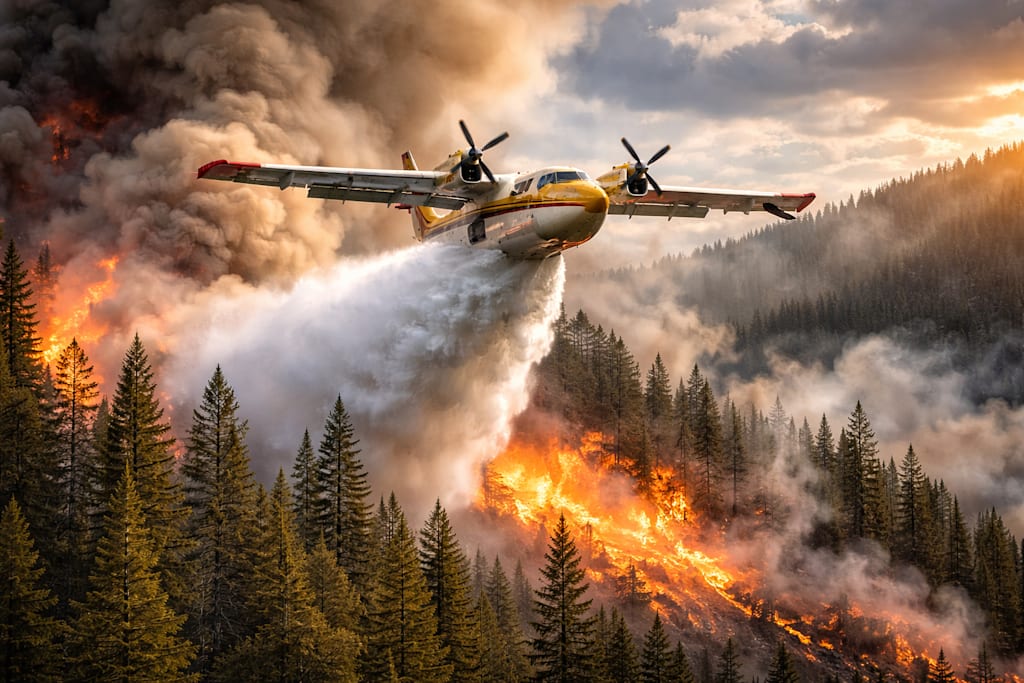
Smoke thickens the horizon. Flames spread faster than crews on the ground can contain. Then, from above, a low rumble cuts through the chaos. A massive aircraft sweeps across the sky, releasing a powerful cascade of water that reshapes the fire line in seconds.
This is modern wildfire response. As climate patterns shift and fire seasons intensify, aerial firefighting has become a frontline defense. At the center of this transformation is the Fire Fighting Aircraft Market, where aviation meets emergency response to protect ecosystems, infrastructure, and lives.
Why Fire Fighting Aircraft Matter Today
Wildfires are growing in scale, frequency, and intensity across regions. Ground crews alone are often not enough to contain fast-moving fires, especially in remote or mountainous terrain. Fire fighting aircraft provide rapid response, wide-area coverage, and critical support during peak fire conditions.
According to Mordor Intelligence, the Fire Fighting Aircraft Market size reached USD 8.32 billion in 2026 and is projected to grow to USD 11.63 billion by 2031, advancing at a CAGR of 6.92 percent during the forecast period.
Inside the Fire Fighting Aircraft Market Structure
The Fire Fighting Aircraft industry includes a range of platforms designed for different fire suppression roles.
Fixed wing aircraft dominate operations due to their ability to carry large volumes of water or fire retardant. In 2025, fixed wing platforms accounted for about 52.50 percent of the Fire Fighting Aircraft Market share, reflecting their efficiency in covering large wildfire areas.
Rotorcraft, such as helicopters, are used for precision drops and operations in complex terrain. Meanwhile, unmanned aerial systems are emerging as a fast-growing segment, expected to expand at around 8.87 percent CAGR, driven by reduced risk and improved accessibility in dangerous conditions.
Government agencies remain the primary users, holding 67.80 percent of the market share in 2025, while private contractors are gaining traction as outsourcing models expand.
These dynamics show how the Fire Fighting Aircraft Market analysis reflects both operational necessity and evolving deployment models.
Trends Driving Aerial Firefighting Innovation
Several Fire Fighting Aircraft Market trends are shaping the future of wildfire response.
• Conversion of retired passenger aircraft into air tankers reduces acquisition costs and accelerates deployment
• Precision drop technologies improve targeting and reduce resource wastage
• Unmanned aerial systems expand into hazardous zones with lower operational risk
• Cross border fleet sharing enables better utilization across fire seasons
Aircraft with tank capacities below 10,000 liters accounted for 47.80 percent of the Fire Fighting Aircraft Market size in 2025, while large capacity aircraft above 40,000 liters are growing faster at 7.74 percent CAGR, reflecting demand for high impact suppression in mega fires.
These trends show a shift toward efficiency, scalability, and advanced firefighting capabilities.
Regional Growth and Deployment Patterns
The global market shows strong regional variation based on wildfire risk and government investment.
North America leads the Fire Fighting Aircraft Market share with 47.10 percent in 2025, supported by large scale wildfire management programs and significant funding.
Asia Pacific is the fastest growing region with a CAGR of about 7.45 percent, driven by increasing wildfire incidents and investments in national firefighting fleets.
Europe continues to expand coordinated response programs and shared fleet systems to manage cross border fire risks.
These regional patterns highlight how climate challenges are driving global adoption of aerial firefighting solutions.
Challenges in Aerial Firefighting
Despite strong growth, the market faces several challenges. High acquisition and maintenance costs remain a major barrier, especially for emerging economies. Fire fighting aircraft require specialized pilots, and shortages of trained personnel are becoming more pronounced.
Operational limitations also exist. Aircraft cannot always operate in extreme smoke conditions or severe weather, which can restrict effectiveness during peak fire events.
However, advancements in automation, leasing models, and shared fleet programs are helping to address these constraints over time.
Fire Fighting Aircraft Market Forecast
The Fire Fighting Aircraft Market forecast points to sustained growth as wildfire risks continue to rise globally. Governments, utilities, and private operators are expected to invest further in aerial firefighting capabilities to protect infrastructure and natural resources.
Future developments will focus on integrating automation, improving fuel efficiency, and enhancing real time data coordination between air and ground teams.
As wildfire seasons grow longer and more unpredictable, aerial firefighting will become even more central to disaster response strategies.
About the Creator
Enjoyed the story? Support the Creator.
Subscribe for free to receive all their stories in your feed.
Comments
There are no comments for this story
Be the first to respond and start the conversation.