
FastAPI vs Flask in 2026: A Complete Python Microframework Guide
Compare FastAPI vs Flask in 2026 across performance, hiring economics, AI workloads, and ecosystem maturity.
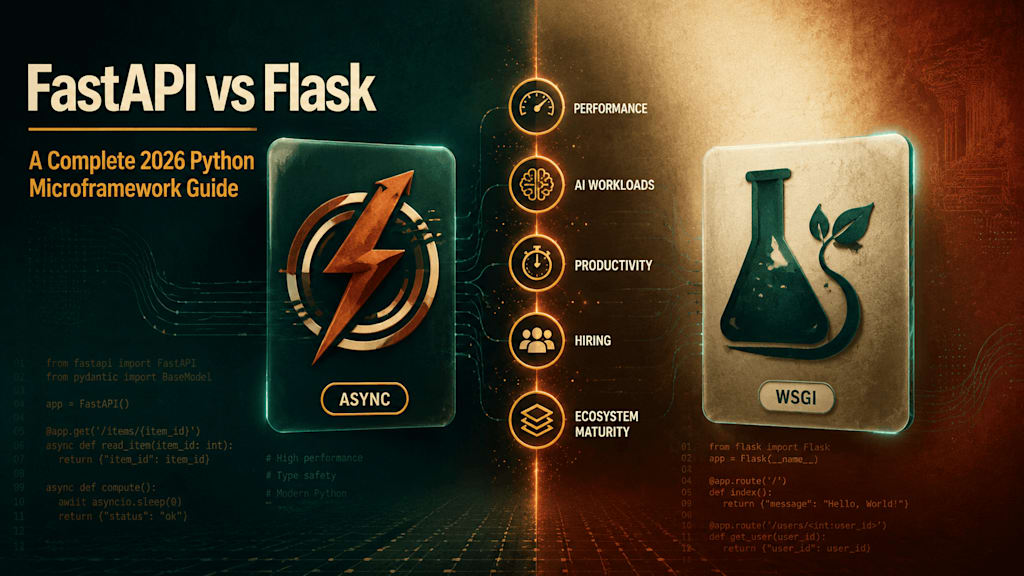
FastAPI vs Flask has become one of the most consequential Python microframework decisions facing engineering leaders. The conversation shifted from "which is faster" to "which fits the production realities of modern API-driven products." Both frameworks have evolved, both remain relevant, and the right choice depends on factors that go well beyond benchmark numbers.
Per the 2026 JetBrains Python Developers Survey, FastAPI adoption grew approximately 40% year over year through 2025-2026, while Flask retained roughly 40 million monthly PyPI downloads. FastAPI now powers production APIs at Netflix, Uber, Microsoft, Spotify, and Google. Flask remains the dependable workhorse for thousands of internal tools and content-driven web applications. This complete Python microframework guide walks CTOs and engineering leaders through what matters for Flask vs FastAPI in 2026, with real benchmark data, business-impact translation, and a decision framework that goes beyond features.
Why the FastAPI vs Flask Decision Matters for Businesses in 2026
Framework choice is a 3 to 5-year business commitment. Both options are production-grade in 2026, which means the wrong pick is no longer a technical mistake. It is a strategic one with real cost. Migration from Flask to FastAPI on a 34-endpoint API took one 2026 team 6 days and cut compute spend from $1,200 per month to $340 per month, a 72% reduction. For larger systems, migration costs land at 1 to 3 engineering months plus opportunity cost on feature shipping.
Flask developers are roughly 3x more common in the global talent pool, but FastAPI developers command 15-25% rate premiums for their async expertise. Customer-facing latency on I/O-heavy workloads runs roughly 3.5x faster on FastAPI. The Flask vs FastAPI question in 2026 is a business decision wearing technical clothing, and the right answer compounds across years.
Flask
It was released in 2010 by Armin Ronacher. Microframework philosophy: give you the essentials, let you pick the rest via extensions. 68,000+ GitHub stars in 2025. Approximately 40 million monthly PyPI downloads. Runs on WSGI with synchronous request handling. Best fit for: simple REST APIs under 50 endpoints, internal tools, admin panels, content-driven web apps, prototypes, teams with deep Flask muscle memory. Flask 3.0 added async support, but the framework's heart remains synchronous, and that shows up under high-concurrency load.
FastAPI
It was released in 2018 by Sebastián Ramírez. Modern async-first framework built on Starlette and Pydantic. 78,000+ GitHub stars in 2025. Native async/await support, automatic OpenAPI documentation, Pydantic-based data validation, and dependency injection out of the box. Runs on ASGI with non-blocking I/O. Best fit for: production REST APIs, AI/ML model serving, microservices, high-concurrency I/O, fintech, and healthcare APIs requiring strict validation. FastAPI has become the industry default for new Python API projects in 2026.
FastAPI vs Flask: 5 Core Decision Factors
Most comparisons compare features. For business leaders, the FastAPI vs Flask choice in 2026 turns on five factors with measurable consequences.
1. Performance and Customer-Facing Latency
Performance is the first decision factor in any Flask vs FastAPI analysis. FastAPI handles 15,000 to 20,000 requests per second on Uvicorn. Flask handles 2,000 to 3,000 requests per second on Gunicorn with equivalent hardware, a 5-8x throughput gap. On I/O chain workloads (auth then vector database then LLM then Postgres), FastAPI completes in roughly 90ms versus Flask at 320ms, about 3.5x faster end-to-end. For consumer-facing SaaS, this translates directly to customer experience metrics. For internal tools serving 100 requests per minute, the gap is invisible.
2. AI and ML Workload Fit
FastAPI is the de facto standard for serving ML models in 2026. Async request handling matches inference workload patterns well, and Pydantic validation handles model input and output cleanly. Flask works for simple ML APIs but creates bottlenecks under concurrent inference load. Teams that hire Python developers experienced in AI/ML workloads in 2026 consistently default to FastAPI for new model-serving endpoints because the async model fits LLM and vector database call patterns natively. If your product roadmap includes AI features within 18 months, FastAPI is the safer pick.
3. Developer Productivity and Time-to-Market
In the FastAPI vs Flask choice, developer productivity is where the gap is widest in 2026. FastAPI ships with built-in Swagger and ReDoc documentation generated automatically from Python type hints. One 2026 case study showed Flask teams spending approximately 11 developer-days manually building Swagger documentation with Flasgger, while FastAPI generated equivalent docs automatically. Pydantic validation eliminates an entire class of runtime input bugs. FastAPI teams report shipping new API endpoints roughly 30% faster than equivalent Flask teams. The framework removes scaffolding decisions and validation boilerplate, which compounds across quarters of product development.
4. Hiring Economics and Talent Availability
Flask developers are 3x more common globally than FastAPI developers based on 2026 LinkedIn and Stack Overflow data. For teams scaling engineering headcount fast, this matters. FastAPI talent commands 15-25% rate premiums in most US markets but is concentrated in higher-velocity teams. The hiring question depends on whether your business prioritizes team scaling speed (favors Flask) or engineering velocity per developer (favors FastAPI).
5. Ecosystem Maturity and Production Reliability
Flask has a 15+ year battle-tested ecosystem with thousands of extensions covering every conceivable integration. FastAPI's ecosystem expanded substantially through 2025-2026 but remains smaller for niche integrations. For products requiring obscure third-party integrations or legacy system connectivity, Flask's ecosystem depth can save weeks of engineering. For greenfield APIs in modern stacks, FastAPI's native features remove most ecosystem gaps. The Flask vs FastAPI ecosystem question depends on whether your project leans toward modern-stack or legacy-integration.
Flask vs FastAPI in 2026: Quick Comparison Table
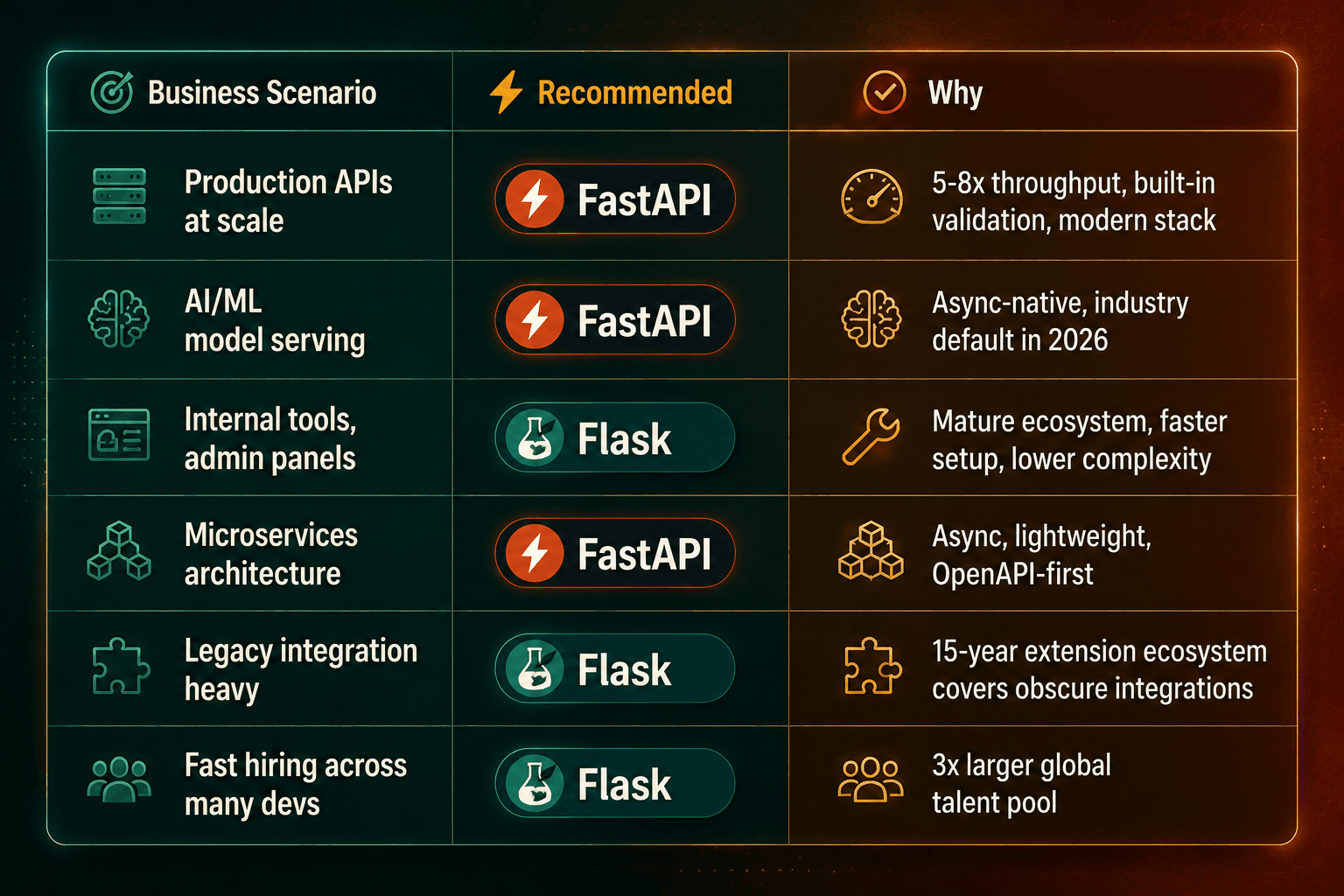
Stitching the five factors together, here is the FastAPI vs Flask scenario view of when each Python microframework wins in 2026.
When Flask Still Wins in the FastAPI vs Flask Comparison
Honest balance matters in any Flask vs FastAPI analysis. Four scenarios where Flask remains the better business choice in 2026:
- Simple REST APIs under 50 endpoints with no async I/O requirements, where the performance gap does not affect customer experience.
- Teams with deep existing Flask expertise where the migration cost exceeds the performance benefit over a 3-year horizon.
- Content-driven applications with server-rendered pages, sessions, and admin panels that benefit from Flask's broader scope.
- Internal tools and prototypes were shipping in days; matters more than long-term performance characteristics.
Making the Right FastAPI vs Flask Decision for Your Business in 2026
The FastAPI vs Flask decision in 2026 is no longer about which framework is better. Both are production-grade. The decision is about which one matches your specific business: your product roadmap, your hiring pipeline, your customer-facing performance requirements, and your existing engineering capacity. Partnering with an experienced Python development company that has shipped production systems in both frameworks helps engineering leaders pressure-test the decision before committing.
For new API projects, AI/ML serving, and high-concurrency production workloads, FastAPI is the stronger 2026 pick. For internal tools, content-driven apps, and teams with deep Flask expertise, Flask remains the right call. The wrong choice carries real cost in compute spend, engineering velocity, and customer experience. The right choice compounds the advantage across the lifetime of the product.
About the Creator
Dhruvil Joshi
I'm a dynamic digital marketing executive with experience in the IT industry, I've developed a deep understanding of the unique challenges and opportunities that come with technologies.
Enjoyed the story? Support the Creator.
Subscribe for free to receive all their stories in your feed.
Comments
There are no comments for this story
Be the first to respond and start the conversation.