
Everyone Says AI Killed the Middleman. They're Wrong About Who Wins Next.
A factory owner, a crypto founder, and a compliance consultant walk into the same economy. Only one of them is ready.
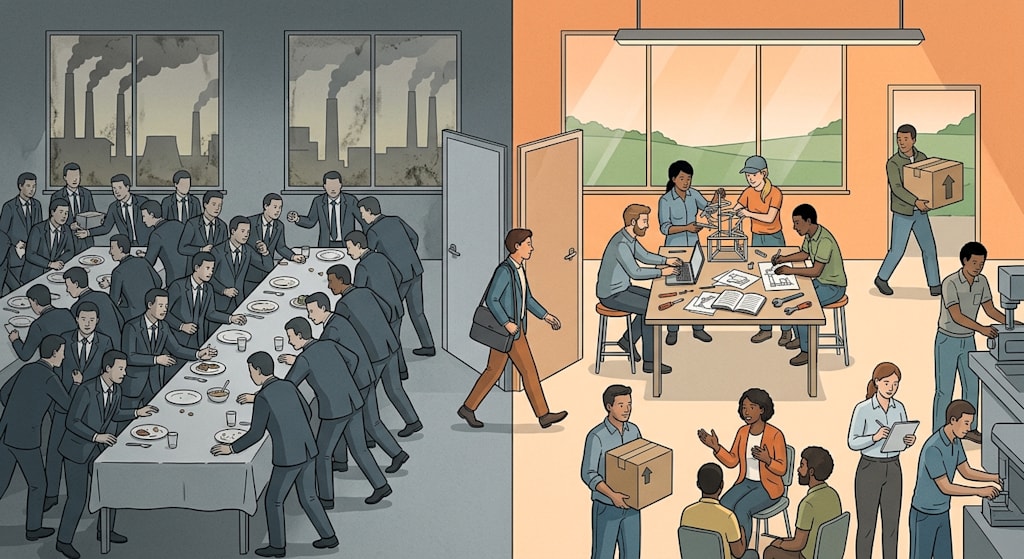
The narrative of entrepreneurship has been changing versions over the past two years. The change is less romantic than it sounds.
Old-version entrepreneurship was a war of attrition over resources and price. Whoever had channels, supply chains, licenses, or the ability to drink their way into relationships at dinner tables survived first. No one could put together anything formidable, so they competed on resources, price, and execution on the same crowded track. Industry margins were razor-thin. A factory owner did the math: tens of millions in annual revenue, and the net profit wasn't enough to replace a single piece of equipment. It wasn't for lack of effort. The old version of competition locked most people into a "replaceable" position. Apart from a handful of giants, everyone else was barely surviving.
The new version is different.
Once tools became abundant, the barrier to entrepreneurship split in two: the barrier to execution was falling, while the barrier to definition was rising. Traffic platforms, AI, crypto, cloud services, payments, and no-code tools let one person turn an idea into a product faster, reach users sooner, and validate the market in weeks. What used to require a team, months of development, and a large customer-acquisition budget can now, with one person and a stack of tools, produce a prototype in a few weeks. Customer acquisition no longer depends entirely on the traditional playbook of heavy dinners, heavy drinking, and heavy relationship-building. Content, community, product-led virality, and algorithmic distribution are replacing some of the old resources.
Entrepreneurship began to become radically non-standardized.
Non-standardized means you can hardly explain a newly emerging project with "average industry margins," "channel costs," or "labor-efficiency models." Because it may never have been on the old track in the first place. It might be a product in another dimension rather than a better one. It might redefine the service rather than making it cheaper. It might carve out a new market from needs users themselves haven't articulated rather than fighting for existing demand. For something like that, there are no coordinates on the old map.
The word "genius" is starting to matter again. But genius here doesn't mean academic credentials, nor an IQ score. Genius here means someone who can design, plan, and execute what ordinary people wouldn't think of. Someone who can turn a badass idea in their head into reality. It's those super-outliers in that uncomfortable saying: "Whatever you think of, someone thought of it long ago." They don't necessarily have impressive résumés, haven't necessarily been certified by the old system, and may not even be good at management in the traditional sense. But they have a heterogeneous kind of super-competitive capability. In an age of tool proliferation, they can judge what is worth doing. In an age of information overload, they can find the gap that hasn't been filled. While others are still competing on price, they can redefine price.
The importance of academic credentials is falling compared with the old version. This doesn't mean credentials are useless. It means their value as a signal is being diluted. Newcomers increasingly rely on talent, on the heterogeneous capability that talent creates. The importance of learning ability is rising. Credentials prove that you were once trained by a system. Learning ability proves whether you can survive when the system changes. The old version rewarded people who had already learned. The new version rewards people who can keep relearning.
Those who have broken out in the past two years all carry some of this flavor. Some used an extremely narrow product wedge to create growth invisible to the old industry. Some used content and community to bypass traditional channels. Some used AI to turn high-cost delivery into low-cost service. Some used crypto and open source to reorganize collaboration and incentives. They aren't necessarily moral saints, and they won't necessarily go far. But they share one thing: they didn't win by piling up resources. They won through a definition that others didn't think of, or thought of but didn't dare to execute.
Resources haven't left the stage.
Saying resources don't matter is another kind of naivety. Resources still matter. Their form has changed. Old resources were dinners, licenses, channels, supply chains, and local connections. New resources are traffic gateways, compute, data, brand trust, community relationships, compliance capability, and patient capital. In the old version, resources picked projects. In the new version, formidable things start picking resources. The more formidable a thing is, the more frantically resources scramble for it. Things that matter are always scarcer than the resources they attract. At the top, it is always the thing that picks the resource. Once a good project achieves validation, resources will come to it on their own. Before validation, resource holders are often path-dependent and risk-averse, and may not understand it. "Things pick resources" holds, but only after the thing is formidable enough and has been validated.
That's also why "genius entrepreneurship" must not be romanticized.
Entrepreneurial success is not a single variable of talent. It is talent multiplied by tools, distribution, organization, compliance, resources, and luck. Survivorship bias makes you see only the outliers who broke out, not the many people who "had a genius idea but died on customer acquisition, compliance, or cash flow." Tools lower the execution barrier but raise the barriers of competition for attention, trust-building, data compliance, platform dependence, and ongoing operations. AI makes building products cheaper and homogenization faster. What you can build with AI today, someone will build more cheaply with AI tomorrow. The easier a business is to do, the easier it is to get dragged into a race to the bottom.
The more accurate statement: the future is an era of "high-impact creators plus collaborators." A few people define new things. A large number of people provide high-value complements around those new things. Ordinary people don't have to become geniuses, but they must move close to high-impact links and not remain stuck in the grunt layer that AI can standardize.
What counts as a high-impact link? It's not only coding, product-building, and fundraising. Around a genius project, delivery, operations, customer success, compliance, channels, content, community, industry know-how, tool integration, and vertical services are all force multipliers. A new project that breaks out cannot rely on one genius brain to do everything. It needs someone to land the product in a specific industry, someone to handle platform rules and legal boundaries, someone to turn early users into a long-term community, someone to turn one-time traffic into repeat purchases. The "soup" ordinary people get is not leftovers handed out by geniuses. It is a high-value collaboration position in the system.
But the precondition is: you have to change position.
In the old version, the ordinary person's position was "executor": competing on diligence, cost, and obedience. In the new version, the pure execution layer is the easiest to replace with tools. If all you can do is make graphics, write copy, build spreadsheets, and run processes by template, AI will be faster and cheaper than you. If all you can do is compete on price, platforms will drag you into zero profit. If all you can do is wait for resources to be allocated, resource holders will pick the scarcer thing. The smart move for ordinary people: stop fantasizing about suddenly becoming a genius. Make yourself an "irreplaceable collaborator in a genius network."
To be specific: find a vertical scenario and do the industry know-how that AI and platform tools cannot solve. Learn to use tools to make small products, content, and distribution, rather than only executing. Actively complement high-impact creators in delivery, operations, compliance, channels, and customer success. Keep learning, but don't fetishize talent determinism. Turn talent into verifiable, differentiated work. Guard against platform dependence and homogenization, because the easier a business is to do, the easier it is to get dragged into a race to the bottom.
One more important point: there must be boundaries for "outlier geniuses."
Being intellectually strong, daring to exploit loopholes, and able to do what others didn't think of does not equal legitimacy. Some "outliers" may break out in the short term, but legal and moral risk can wipe out the gains in one stroke. New-version entrepreneurship rewards heterogeneity. It does not reward having no bottom line. Talent needs institutional boundaries. Otherwise, the faster you run, the harder you fall.
Back to the judgment at the beginning.
"The future is an era of genius entrepreneurship, and ordinary people will get to drink some soup from the foundations they create." This sentence is half sharp and half too absolute. The sharp part: after the democratization of tools, entrepreneurship has shifted from a contest over resources to a contest over the right to define, and the price of talent, judgment, learning ability, and heterogeneous capability is rising. The absolute part: ordinary people are not limited to drinking soup. More accurately, ordinary people must change tables. They must move from executors competing on resources and price in the old version into collaborators or niche creators close to high-impact links in the new version.
Geniuses turn the impossible into the possible. Ordinary people turn the possible into the sustainable. The former is scarce. So is the latter. The danger: you're still waiting for the new version's soup from an old-version position.
About the Creator
Jin
Writer of reamstories
https://reamstories.com/jin
Enjoyed the story? Support the Creator.
Subscribe for free to receive all their stories in your feed. You could also become a paid subscriber, letting them know you appreciate their work.
Comments
There are no comments for this story
Be the first to respond and start the conversation.