
Europe Artificial Intelligence Market: Trends, Growth, Challenges, and Future Outlook
Explore growth, trends, size, and forecast of the Europe Artificial Intelligence Market, driven by innovation, regulation, and rising AI adoption.

The Europe Artificial Intelligence Market is emerging as one of the most transformative sectors in the region’s digital economy. From automation in manufacturing to predictive analytics in healthcare and finance, artificial intelligence is reshaping how businesses operate and compete. Understanding this market is essential for enterprises, investors, and policymakers aiming to capitalize on technological advancement and maintain a competitive edge. This blog explores the structure, trends, regulatory environment, growth drivers, challenges, and future opportunities within the Europe Artificial Intelligence Market.
Overview of the Europe Artificial Intelligence Market
Artificial intelligence refers to the development of computer systems capable of performing tasks that typically require human intelligence. These include learning, reasoning, problem-solving, perception, and language understanding. In Europe, AI adoption spans multiple sectors such as healthcare, automotive, retail, finance, and manufacturing, supported by strong digital infrastructure and innovation-focused policies.
The market operates across several key segments:
By Component: Hardware, software, and services
By Technology: Machine learning, natural language processing, computer vision, and robotics
By End Use Industry: Healthcare, automotive, BFSI, retail, manufacturing, and others
Each segment contributes uniquely to market expansion, driven by advancements in computing power, data availability, and enterprise demand for automation.
Market Size
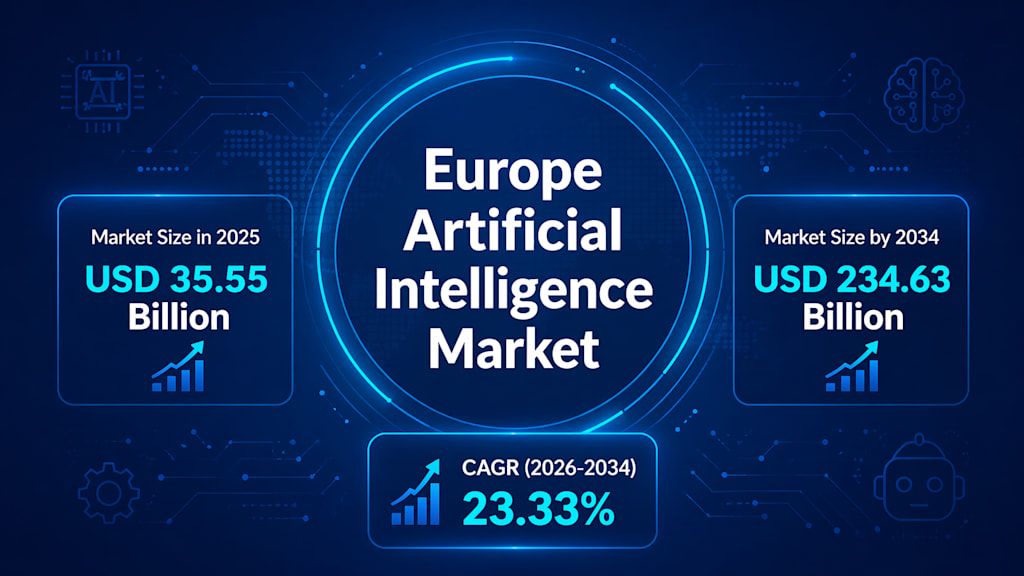
According to IMARC Group, the Europe Artificial Intelligence Market size reached USD 35.55 Billion in 2025 and is projected to reach USD 234.63 Billion by 2034, growing at a CAGR of 23.33% during 2026-2034. This rapid expansion reflects increasing investments in digital transformation, strong research capabilities, and widespread adoption of AI-powered solutions across industries.
Key Trends in the Europe Artificial Intelligence Market
Rapid Adoption Across Industries
AI integration is accelerating across sectors in Europe. In healthcare, it supports diagnostics and drug discovery. In automotive, it powers autonomous driving systems and predictive maintenance. Financial institutions rely on AI for fraud detection and risk management. This widespread adoption is fueling consistent demand for advanced AI technologies.
Rise of Generative AI
Generative AI is gaining traction across Europe, enabling content creation, code generation, and advanced simulations. Businesses are leveraging these tools to enhance productivity, reduce operational costs, and create innovative customer experiences. The growing use of large language models is also transforming communication and decision-making processes.
Focus on Ethical AI and Transparency
Europe is known for its strong emphasis on ethical technology deployment. Organizations are prioritizing transparency, fairness, and accountability in AI systems. This focus ensures trust among users and aligns with regional values, making ethical AI a defining characteristic of the European market.
Growth of AI Startups and Innovation Hubs
Cities such as Berlin, Paris, and London are emerging as major AI innovation hubs. A strong startup ecosystem, supported by venture capital funding and research institutions, is driving technological breakthroughs. Collaboration between academia and industry is further accelerating innovation.
Integration with Cloud Computing
Cloud-based AI solutions are becoming increasingly popular due to their scalability and cost efficiency. Businesses are leveraging cloud platforms to deploy AI applications without heavy upfront investment in infrastructure. This trend is expanding access to AI technologies for small and medium-sized enterprises.
Regulatory Landscape
The Europe Artificial Intelligence Market is shaped by a comprehensive regulatory framework aimed at ensuring safe and responsible use of technology.
AI Act and Compliance Standards
The European Union is implementing the AI Act, which categorizes AI systems based on risk levels. High-risk applications, such as those used in healthcare or law enforcement, must meet strict compliance requirements. This regulation ensures safety while promoting innovation.
Data Protection Laws
Strict data protection regulations, including GDPR, play a crucial role in AI development. Organizations must ensure data privacy and security when training AI models. Compliance with these laws is essential for maintaining consumer trust and avoiding legal penalties.
Ethical Guidelines
European authorities emphasize ethical AI practices, including fairness, accountability, and transparency. Companies are required to minimize bias in algorithms and ensure that AI systems operate responsibly.
Cross-Border Collaboration
European countries are working together to create a unified AI strategy. This collaboration enhances research capabilities, promotes knowledge sharing, and strengthens the region’s global competitiveness.
Market Growth Drivers
Digital Transformation Initiatives
Businesses across Europe are investing heavily in digital transformation. AI plays a central role in optimizing operations, improving efficiency, and enhancing customer experiences. This widespread adoption is a major driver of market growth.
Increasing Data Availability
The growing volume of data generated by digital platforms is fueling AI development. Access to large datasets enables more accurate predictions and improved decision-making, driving demand for AI solutions.
Government Support and Funding
European governments are actively supporting AI development through funding programs and policy initiatives. Investments in research and innovation are accelerating technological advancement and encouraging private sector participation.
Skilled Workforce and Research Excellence
Europe has a strong talent pool of AI researchers and engineers. Leading universities and research institutions are contributing to advancements in machine learning, robotics, and data science, supporting market expansion.
Automation and Cost Efficiency
Organizations are adopting AI to automate repetitive tasks and reduce operational costs. This efficiency gain is encouraging businesses to invest in AI technologies, further driving market growth.
Challenges in the Europe Artificial Intelligence Market
High Implementation Costs
Deploying AI solutions requires significant investment in infrastructure, talent, and data management. Small and medium-sized enterprises may face financial constraints, limiting adoption.
Data Privacy Concerns
Strict data protection laws, while essential, can create challenges for AI development. Companies must navigate complex regulations while ensuring compliance, which can slow down innovation.
Talent Shortage
Despite a strong talent pool, demand for skilled AI professionals exceeds supply. This shortage can hinder the development and deployment of advanced AI solutions.
Integration Complexity
Integrating AI systems with existing business processes can be complex and time-consuming. Organizations must invest in training and infrastructure to ensure successful implementation.
Ethical and Bias Issues
Ensuring fairness and eliminating bias in AI algorithms remains a challenge. Companies must continuously monitor and सुधार their systems to maintain ethical standards.
Future Opportunities
Expansion of AI in Healthcare
AI has significant potential in healthcare, including personalized medicine, early disease detection, and efficient hospital management. Continued investment in this sector will drive innovation and improve patient outcomes.
Smart Cities Development
AI is playing a key role in developing smart cities across Europe. Applications such as traffic management, energy optimization, and public safety are enhancing urban living conditions and creating new opportunities for growth.
Industrial Automation
Manufacturing industries are increasingly adopting AI for predictive maintenance, quality control, and process optimization. This trend is expected to boost productivity and competitiveness in the industrial sector.
AI in Sustainability
AI is being used to address environmental challenges, including energy efficiency, climate modeling, and waste management. This aligns with Europe’s sustainability goals and opens new avenues for innovation.
Collaboration and Partnerships
Strategic partnerships between technology providers, governments, and enterprises are driving AI adoption. Collaborative efforts are accelerating research, development, and commercialization of AI solutions.
Conclusion
The Europe Artificial Intelligence Market is a rapidly evolving landscape characterized by innovation, strong regulatory frameworks, and increasing adoption across industries. With a market size projected to grow from USD 35.55 Billion in 2025 to USD 234.63 Billion by 2034 at a CAGR of 23.33%, the region is poised for significant expansion. While challenges such as high costs, regulatory complexities, and talent shortages persist, the opportunities far outweigh the obstacles. Organizations that embrace AI-driven transformation, prioritize ethical practices, and invest in innovation are likely to thrive in this dynamic market.
About the Creator
Tim David
Creator Blog and Analysis delivers concise, data-driven insights, trend analysis, and expert perspectives, helping readers understand markets, technologies, and opportunities through clear, actionable, and research-backed content.
Enjoyed the story? Support the Creator.
Subscribe for free to receive all their stories in your feed.
Comments
There are no comments for this story
Be the first to respond and start the conversation.