
Engineering the Footprint: Matching Wheel Configuration to RTG Tonnage
A Technical Guide to Selecting 4, 8, 16, or 32-Wheel Configurations.

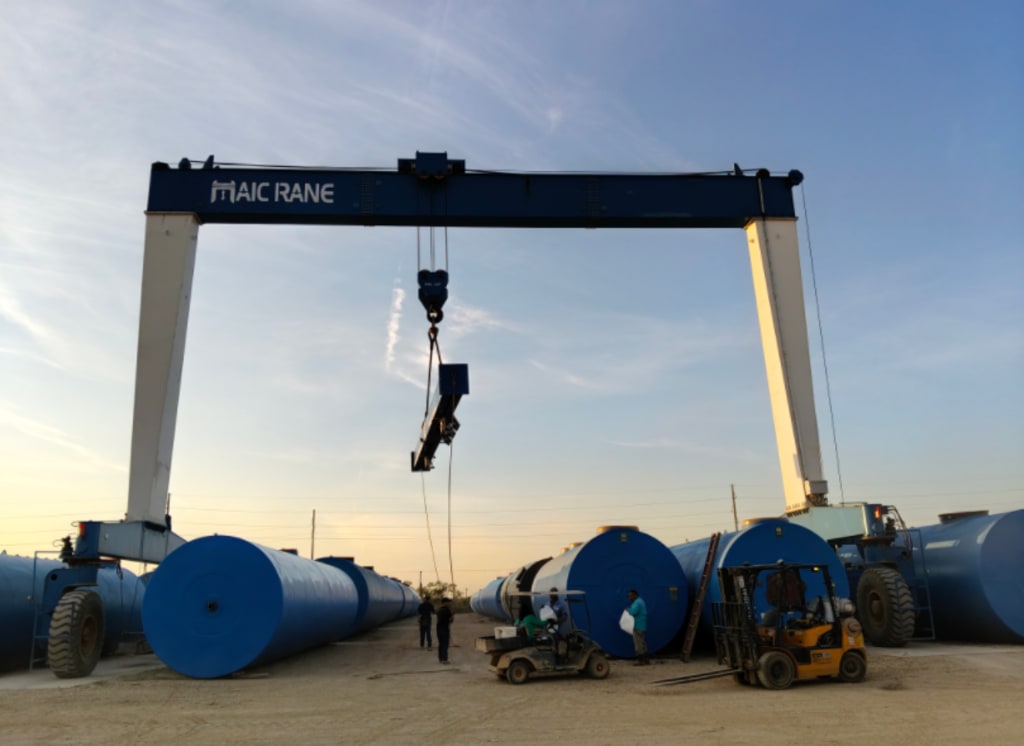
In the world of Rubber Tyred Gantry (RTG) cranes, the relationship between lifting capacity and wheel quantity is a matter of pure physics. As the tonnage increases, the "point load" exerted on the ground becomes the primary engineering constraint. To prevent the crane from crushing the yard’s pavement or destabilizing during a lift, engineers utilize a geometric scaling of wheels: 4, 8, 16, and 32.
Selecting the correct configuration is a strategic balance between the crane's Gross Vehicle Weight (GVW) and the California Bearing Ratio (CBR) of your yard's soil.
1. 4-Wheel Configuration: Efficiency for Light Loads
Capacity: Under 100 Tons
The 4-wheel setup (one wheel per corner) is the standard for light-to-medium industrial applications.
The Logic: For loads under 100 tons, a single high-load industrial tire at each corner can typically support the combined weight of the structure and the cargo.
Operational Profile: These machines are often used in smaller marinas for yacht handling or in precast yards for moving standard concrete beams.
Ground Requirement: Requires high-strength reinforced concrete. Because the entire load is concentrated on just four contact patches, any weakness in the subgrade will lead to immediate cracking.
2. 8-Wheel Configuration: The Mid-Range Workhorse
Capacity: 100 to 400 Tons
When capacity crosses the 100-ton threshold, the internal pressure required for a single tire to hold the load becomes unsafe. Transitioning to an 8-wheel configuration (two wheels per corner) is the most common upgrade.
Load Distribution: By doubling the tires, you effectively reduce the ground pressure by nearly 50%. This allows the crane to operate on standard industrial asphalt rather than specialized thick-pour concrete.
Stability in Motion: 8-wheel gantry cranes offer significantly better stability when traveling with a load at height. The dual-wheel "bogie" at each corner provides a wider base to resist the swaying forces (pendulum effect) common in shipyard operations.
3. 16-Wheel Configuration: Heavy-Duty Load Spreading
Capacity: 500 to 800 Tons
At the 500-ton level, the crane itself becomes a massive structural weight. A 16-wheel configuration (four wheels per corner) is mandatory to ensure the machine remains mobile and safe.
Advanced Bogie Design: 16-wheel units utilize "articulated bogies." This means each 4-wheel cluster can pivot, ensuring that even if the ground is slightly uneven, all four tires maintain equal contact and pressure.
Steering Complexity: These units typically feature electronic "Steer-by-Wire" systems. To prevent "tire scrubbing" (excessive friction during turns), each wheel group is synchronized via a central controller to allow for crab steering, 90-degree turns, and carrousel rotation.
Environmental Impact: This configuration is often chosen for yards with "soft" ground conditions, as the 16 contact points spread the weight enough to prevent the crane from sinking into the substrate.
4. 32-Wheel Configuration: The Titan Class
Capacity: 800 to 1200+ Tons
For ultra-heavy lifting—such as moving massive ship sections, nuclear components, or 1000-ton precast segments—the 32-wheel configuration (eight wheels per corner) is the pinnacle of RTG engineering.
The "Walking Beam" Principle: Supporting 8 wheels at a single corner is a mechanical challenge. Engineers use a series of "walking beams" (nested hinges) that distribute the weight across the 8-tire cluster like a suspension system. This is critical for preventing "point failure" where a single bump could cause a tire blowout.
Drive Redundancy: In a 32-wheel machine, the drive power is usually distributed across multiple motors. This redundancy ensures that the crane can continue to operate even if one or two drive units require maintenance.
Infrastructure Investment: Even with 32 wheels, a 1200-ton lift exerts immense pressure. These machines almost always operate on specially engineered runways or high-density compacted zones.
Final Decision: Ground Pressure vs. Tonnage
The choice of wheel configuration is ultimately a conversation between the Rubber Tired Gantry Crane Manufacturer and the Civil Engineer.
Calculate the "Allowable Pavement Load": If your yard can only support 10 tons per square meter, you will need more wheels (16 or 32) even if your load is relatively light.
Consider Tire Maintenance: More wheels mean higher consumable costs. A 32-wheel machine has a massive "tire bill," so it should only be used when the tonnage or ground conditions absolutely require it.
Maneuverability: If your yard is tight and requires constant 90-degree changes, the complex steering systems of 16 and 32-wheel units offer superior agility despite their size.
By aligning your wheel configuration with these tonnage benchmarks, you ensure that your investment is both structurally sound and operationally efficient, protecting both your cargo and your facility's infrastructure.
About the Creator
Aicrane01
Welcome to the Aicrane Blog, your practical guide to lifting solutions. Discover articles covering overhead cranes, gantry cranes, winches, steel structures, boat lifts, and more.
Website: https://steelmillcranes.com/
Enjoyed the story? Support the Creator.
Subscribe for free to receive all their stories in your feed.
Comments
There are no comments for this story
Be the first to respond and start the conversation.