
ECB Faces Delicate Balancing Act: France’s Fiscal Strain and the Future of Monetary Policy
Central Bank Navigates Political Pressure from Paris as Eurozone Inflation Risks Persist

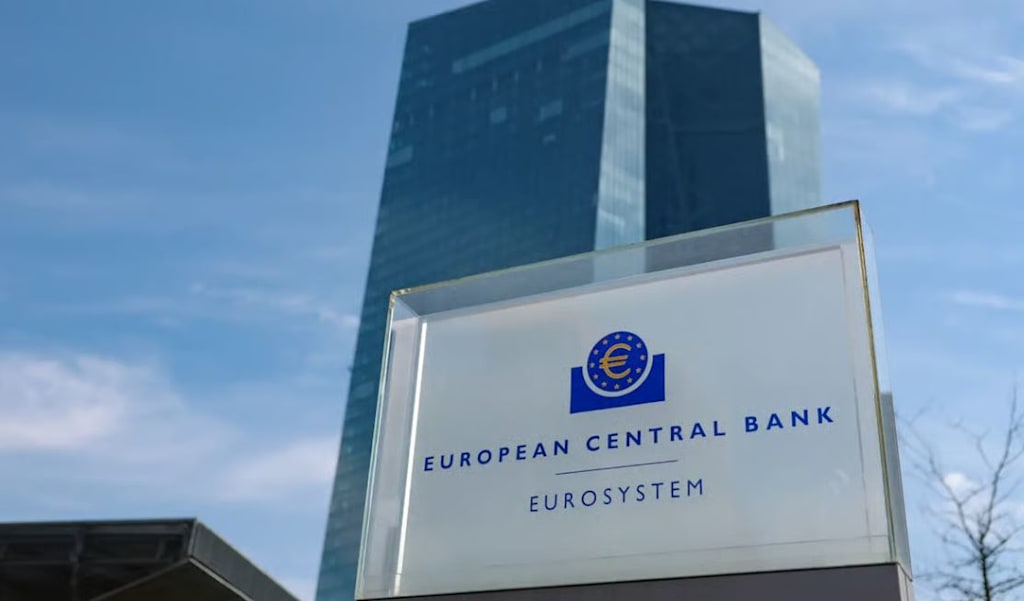
When the European Central Bank’s Governing Council gathers this Thursday, the technical business of setting interest rates may take a backseat to a far more urgent question: how to respond to France’s deepening fiscal and political crisis. The eurozone’s second‑largest economy finds itself locked in a bitter standoff over its budget; street violence has returned to levels not seen in years, and borrowing costs have surged to their highest in more than two decades. Yet despite growing pressure, the consensus remains clear: the ECB will not throw France a lifeline, at least not yet.
A Crisis Takes Centre Stage
France’s troubles have mounted rapidly. Last week, yields on French government bonds a measure of the cost of borrowing, jumped to their highest level since 2002. The trigger was a double crisis: political deadlock over the government’s plan to rein in a towering national debt, and widespread protests that began as demands for greater public service investment before descending into some of the worst civil unrest in recent memory. The combination has rattled investors and raised fears that France’s difficulties could spill across the eurozone.
Andrew Kenningham, chief Europe economist at Capital Economics, summed up the shift in focus: “The focus of Thursday’s meeting is likely to shift quickly to France and how the ECB will respond to the ongoing fiscal and political crisis.” Speculation has grown that the central bank might intervene directly to cap rising yields, using a powerful crisis‑fighting tool known as the Transmission Protection Instrument, or TPI. But the reality is far more complicated.
The TPI: A Safety Net With Strict Rules
The TPI was designed to prevent market stress in one part of the eurozone from spreading to others to counter what the ECB calls “unwarranted” and disorderly moves in bond markets. Crucially, it is not intended to bail out governments facing difficulties of their own making. The criteria for activation are exacting: a country must have sound and sustainable fiscal policies, among other conditions. If the problem stems from poor governance rather than external market panic, the tool is simply not meant to apply.
That is why most observers believe France does not yet qualify. ECB President Christine Lagarde, who previously served as France’s finance minister, has made her position unambiguous: “The primary and first solution lies at home in France. And it has to do with fiscal policies.” Her stance has been echoed by the Governor of the Banque de France, a member of the ECB’s Governing Council, who stated flatly that “conditions are not met” for intervention. Kenningham put it plainly: “No lifeline for France.” He noted that the gap, or spread, between French and benchmark German bond yields would need to widen significantly further before the ECB would even consider stepping in.
Bond Markets Do the Heavy Lifting
In the meantime, the markets have effectively done some of the ECB’s work for it. Rising French yields mean tighter financial conditions across the economy, higher costs for businesses, households, and the government alike. Carsten Brzeski, chief economist at ING, pointed out that “France’s crisis has actually lowered chances of another rate hike,” adding that “the bond markets have taken over the ECB’s task.” The result is a de facto tightening of credit conditions without the central bank lifting a finger a dynamic that complicates, but also partly achieves, the ECB’s goal of cooling inflation.
Inflation, Energy Shocks, and the Rate Path Ahead
The broader economic picture also calls for caution. The ECB is widely expected to hold its key interest rate steady at 2.5% this week, pausing after two hikes earlier this year. The decision comes against a backdrop of renewed inflationary pressure: headline inflation rose to 3.8% in September, a three‑year high, driven largely by climbing energy prices tied to the conflict in the Middle East. Yet core inflation, which strips out volatile food and fuel costs, remained remarkably steady, and Brzeski noted there have been “very few knock‑on effects from higher energy prices” so far.
Most economists believe one final rate increase may still come in December, when the Governing Council will have fresh forecasts for growth and inflation to guide its decision. For now, though, the priority is stability: navigating between the need to contain prices and the risk of exacerbating economic weakness, particularly in France.
Uncertainty Around Lagarde’s Future
Adding another layer of complexity to Thursday’s meeting is growing speculation about Lagarde herself. Reports have linked her to the presidency of the World Economic Forum in Davos, raising questions about whether she will step down before her term as ECB chief officially ends in October 2027. She has remained characteristically guarded, telling reporters in September: “There is nothing to report.” Still, the uncertainty has injected an element of transition into an already delicate moment, with her leadership under closer scrutiny than ever.
A Defining Moment for the Eurozone
Ultimately, this week’s meeting is about more than numbers. It is a test of the eurozone’s architecture whether monetary authorities can remain impartial guardians of stability even as a major member state stumbles. The message from Frankfurt, for now, is firm: France must fix its own house. But if yields keep rising, or if instability threatens to spread beyond its borders, that message may need to be rewritten. Until then, the ECB watches, waits, and holds its ground.
About the Creator
Mark Lim
Hi I am mark an automotive student and a car, tech and food enthusiast ! Im gonna try and post daily & hope you enjoy what I write and do share my page with people you know. I would gladly appreciate it! Cheers
Enjoyed the story? Support the Creator.
Subscribe for free to receive all their stories in your feed.
Comments
There are no comments for this story
Be the first to respond and start the conversation.