
E-Bike Market: Redefining Urban Mobility on Two Wheels
How electric bikes are transforming commuting, sustainability, and everyday transportation
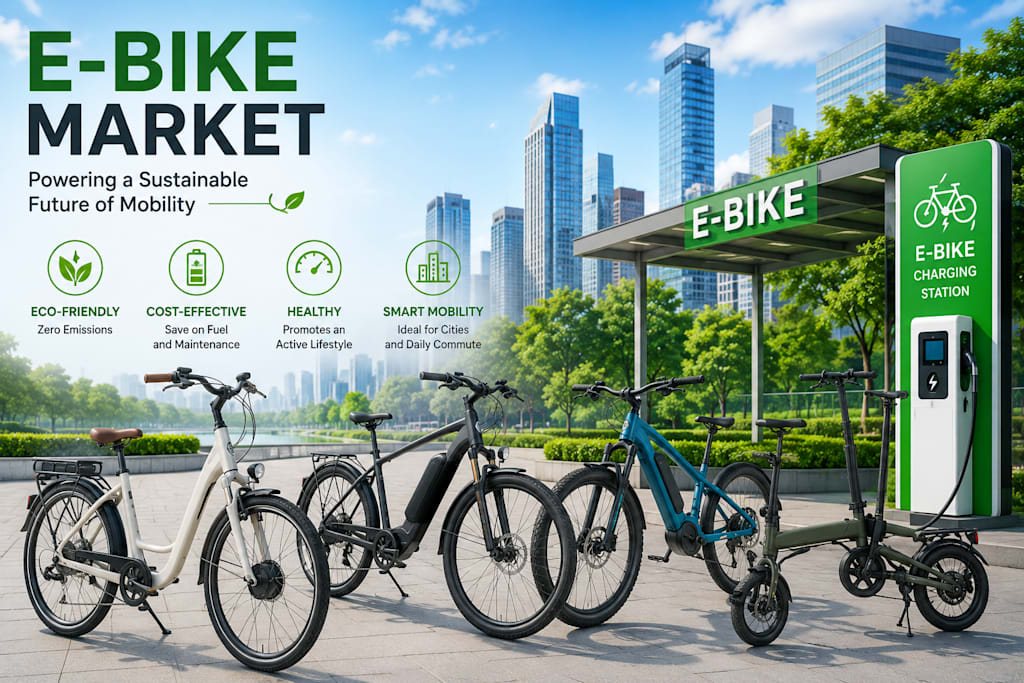
Hook Intro
The morning traffic barely moves. Cars line the streets while commuters search endlessly for parking spaces. Then an e-bike quietly slips through the congestion, moving efficiently without fuel, noise, or delay.
What once seemed like a niche alternative has rapidly become part of mainstream urban mobility. Electric bikes are reshaping how people travel short distances by combining convenience, affordability, and sustainability. At the center of this shift is the E-Bike Market, where technology and changing consumer behavior are accelerating a new era of transportation.
Why E-Bikes Matter Today
Cities across the world are struggling with traffic congestion, rising fuel costs, and growing environmental concerns. Consumers are increasingly looking for transportation options that are both practical and eco-friendly.
E-bikes provide a balance between traditional bicycles and motor vehicles. Equipped with electric motors and rechargeable batteries, they reduce rider effort while maintaining the flexibility and simplicity of cycling.
According to Mordor Intelligence, the E-Bike Market is expanding steadily as governments promote sustainable transportation and consumers embrace low emission mobility solutions. The market is evolving from a recreational segment into a critical component of urban transportation systems.
Understanding E-Bike Market Size and Share
The E-Bike Market size is growing as electric bicycles become increasingly popular for commuting, delivery services, leisure riding, and tourism. Advances in battery technology and falling component costs are making e-bikes more accessible to a broader consumer base.
Urban and city e-bikes account for the majority of adoption due to their efficiency in short distance commuting. At the same time, cargo e-bikes and trekking models are gaining popularity for commercial logistics and outdoor recreation.
The E-Bike Market share remains strongest in Europe, supported by extensive cycling infrastructure, environmental regulations, and government incentives. Asia Pacific also plays a major role due to high manufacturing capacity and growing demand for affordable electric mobility solutions. North America is emerging as one of the fastest growing regions as consumers increasingly adopt micro-mobility alternatives.
E-Bike Market Trends Driving the Industry
Several E-Bike Market trends are shaping the future of urban transportation.
Lithium-ion battery improvements are increasing range, charging speed, and energy efficiency.
Smart connectivity features such as GPS tracking, mobile integration, and ride analytics are becoming more common.
Cargo e-bikes are transforming last mile delivery and urban logistics operations.
Premium e-bikes with advanced suspension, lightweight frames, and integrated displays are gaining demand.
Subscription and leasing models are making e-bikes more accessible for commuters and businesses.
These innovations are helping e-bikes move beyond recreational use into mainstream transportation ecosystems.
Why Consumers Are Choosing E-Bikes
One of the biggest advantages of e-bikes is convenience. Riders can travel longer distances with less physical effort while avoiding fuel expenses, traffic congestion, and parking challenges.
For daily commuters, e-bikes offer faster urban travel and lower operating costs compared to cars or motorcycles. For older riders and casual cyclists, electric assistance makes cycling more comfortable and accessible.
The growth of delivery services and bike sharing platforms is also contributing to wider adoption. Businesses increasingly see e-bikes as an efficient and sustainable solution for short distance logistics.
This practicality continues to strengthen the broader E-Bike Market analysis, where consumer demand is driven by both sustainability goals and real world convenience.
Challenges Facing the E-Bike Industry
Despite strong growth, the industry still faces several challenges. High upfront costs compared to conventional bicycles can discourage price sensitive consumers.
Battery safety concerns and stricter regulations around lithium-ion systems are also influencing product standards and manufacturing costs. In many developing regions, limited cycling infrastructure and charging accessibility remain barriers to adoption.
In addition, supply chain volatility for batteries and electronic components continues to impact production costs across the industry.
E-Bike Market Forecast and the Road Ahead
The E-Bike Market forecast points toward continued expansion as cities invest in sustainable mobility infrastructure and consumers prioritize cleaner transportation options.
Future e-bikes are expected to feature lighter batteries, faster charging systems, smarter connectivity, and improved riding efficiency. Commercial applications, especially in delivery and shared mobility services, are likely to create significant long term growth opportunities.
As urban transportation evolves, e-bikes are becoming more than just an alternative. They are emerging as a practical solution for modern mobility challenges.
Final Thought
Transportation is changing rapidly, and e-bikes are proving that mobility can be cleaner, smarter, and more efficient without sacrificing convenience.
In crowded cities where time, fuel, and space matter more than ever, the simplest solution may already be riding beside us.
About the Creator
Enjoyed the story? Support the Creator.
Subscribe for free to receive all their stories in your feed.
Comments
There are no comments for this story
Be the first to respond and start the conversation.