
DTF Transfers for Theater Companies - Across Casts
A practical guide to keeping printed costumes, crew apparel, and replacement garments consistent throughout a theater production.

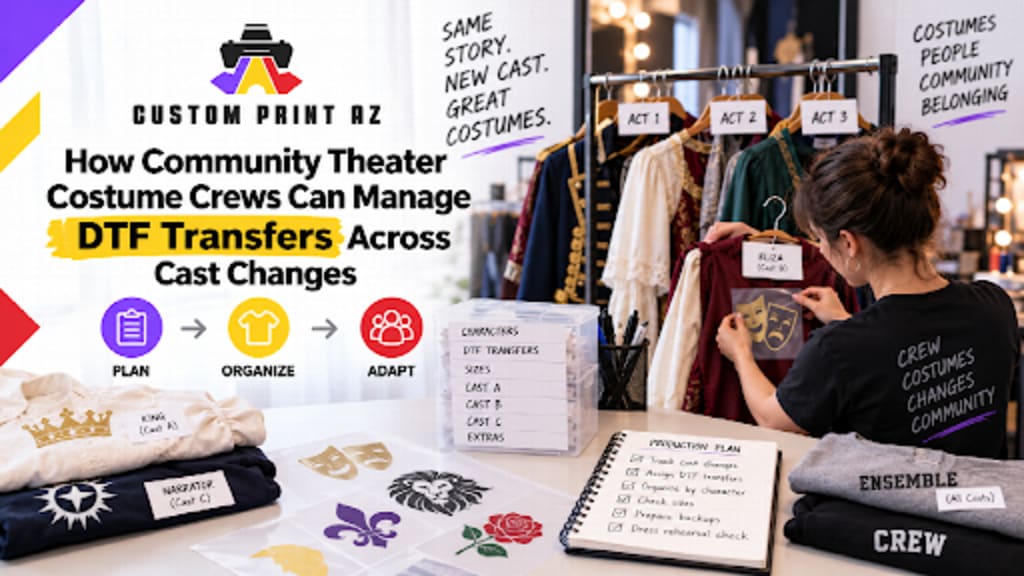
A theater production rarely depends on a single costume worn by a single performer. There may be understudies, rotating casts, replacement garments, ensemble members, backstage crews, promotional events, and multiple performances spread across weeks or months.
That creates an interesting challenge: consistency.
When a production uses printed graphics on shirts, jackets, hoodies, aprons, uniforms, or other costume pieces, every replacement needs to look like it belongs to the same show. For theater companies researching DTF transfers in Mesa, AZ, direct-to-film printing can be one option worth considering for repeatable apparel graphics across casts.
The key is not simply printing a design. It is building a repeatable production system.
Why Theater Apparel Requires a Different Approach
Printing apparel for a theater company is different from making ten identical promotional shirts.
Costume requirements can change throughout production.
An actor may need another size. An understudy may join the cast. A costume could become stained or damaged. A touring performance might require additional garments weeks after the original order.
The production team therefore needs to think beyond the first batch.
A useful printing method should make it reasonably straightforward to reproduce approved artwork without rebuilding the entire job every time another garment is needed.
What Is a DTF Transfer?
DTF stands for direct-to-film.
In a typical process, artwork is printed onto specialized film using compatible inks. Adhesive powder is applied and cured, creating a transfer that can later be applied to a suitable garment with a heat press.
For theater applications, an important advantage is that the artwork and garment can be managed separately.
A production team can potentially keep approved transfers available and apply them when additional costume pieces are required.
That can be useful when cast requirements continue changing after rehearsals begin.
Start With a Costume Inventory
Before ordering transfers, create an inventory of every printed garment required for the production.
Do not limit the list to the main cast.
Consider:
Lead performers
Ensemble members
Understudies
Alternating casts
Rehearsal garments
Stage crew
Front-of-house staff
Promotional apparel
Emergency replacements
Record the garment style, size, color, design, print position, and quantity for each person or role.
This simple step can prevent confusion later.
Create One Approved Master Design
Consistency starts with artwork.
Instead of allowing slightly different versions of the same graphic to circulate among costume staff, establish one approved master file.
Keep the original artwork at an appropriate quality and clearly label the final version.
For example, rather than storing files with names such as:
logo-final.png
logo-final2.png
logo-new-final.png
use a simple production naming system such as:
SHOWNAME_CAST_LOGO_V1
If the artwork changes, create V2 and archive the previous version.
This makes it much easier for another staff member to identify the correct artwork when a replacement is needed.
Standardize the Printed Size
Two transfers containing identical artwork can still look different if their dimensions aren't consistent.
Determine the exact print dimensions before the main production run.
For example, a small left-chest design should have an approved width and placement. A large back graphic should also have fixed dimensions.
Record these measurements.
If different garment sizes require different artwork sizes, establish those variations in advance.
A costume team might have one approved transfer size for smaller garments and another for larger sizes rather than resizing graphics independently each time.
Create Placement Guides
Placement can be just as noticeable as print quality.
Imagine five performers standing side by side. Their shirts use exactly the same artwork, but one graphic sits noticeably higher than the others.
The audience may not know what is wrong, but the inconsistency can still be visible.
Create a basic placement guide that records measurements from reference points such as the collar, center line, pocket, or seam.
Templates or placement tools can also help staff position repeat transfers more consistently.
Test Costumes Under Stage Conditions
A costume does not exist only under normal room lighting.
Stage lighting can dramatically change how colors, textures, and reflective surfaces appear.
Before approving a major run, test a completed garment under the actual or comparable lighting conditions used for the production.
Observe it from the audience area.
Check whether:
Fine details remain visible
Colors appear appropriate
The print is overly reflective
The graphic is readable from the intended distance
The transfer visually works with the garment
A design that looks excellent from two feet away may have little impact from the back of an auditorium.
Testing should therefore consider the audience's perspective.
Consider Movement When Testing Transfers
Performers move differently from people wearing ordinary promotional apparel.
Depending on the production, actors may dance, fight, kneel, run, lift props, or perform repeated choreography.
Costumes may consequently experience stretching, friction, perspiration, and frequent laundering.
Test the transfer on the actual garment type whenever possible.
If a design crosses an area that stretches substantially during movement, evaluate whether its position should be adjusted.
Costume design and print placement should work together.
Plan for Understudies and Alternating Casts
An understudy should not become a printing emergency.
If a production uses multiple performers for the same role, identify their garment requirements before opening night.
Keep their artwork specifications within the same costume record.
For productions with enough storage capacity, maintaining spare garments or transfers in commonly needed configurations can make substitutions easier.
The appropriate approach will depend on the show's budget, cast structure, and likelihood of costume changes.
The objective is simply to avoid rebuilding production specifications when time is limited.
Use Gang Sheets Efficiently
Theater productions can require many relatively small graphics.
A show might need chest emblems, sleeve marks, character names, fictional company logos, backstage identifiers, and other decorative elements.
Gang sheets allow multiple graphics to be arranged within a larger printable area.
This can make organization more efficient, particularly when several transfer sizes or designs are required.
Before creating one, confirm the printer's required dimensions, spacing, resolution, and file format.
Also decide whether transfers will arrive individually cut or need to be separated by the costume team.
Label Transfers Before They Reach the Costume Department
Organization becomes increasingly important as the number of designs grows.
If several similar transfers arrive together, staff should not have to guess which belongs to which character.
Consider organizing transfers by:
Production → Character → Garment → Position → Size
For example:
Show A → Character 4 → Jacket → Back → 10-inch graphic
The exact system is less important than consistency.
Anyone working in the costume department should be able to understand it without needing the person who originally placed the order.
Document Heat-Press Settings
If transfers will be applied in-house, maintain a written record of the supplier's application instructions.
This may include:
Recommended temperature
Pressing duration
Pressure
Peel method
Second-press instructions
Fabric considerations
Do not automatically use settings from an unrelated transfer product.
Different transfer systems can have different application requirements.
A clearly documented process also makes it easier for another team member to reproduce the work if the usual costume technician is unavailable.
Keep Replacement Transfers Available
Productions rarely go exactly according to plan.
Garments get damaged. Cast members change. Sizes change. Extra performances are added. Promotional appearances appear on the calendar.
Keeping a modest number of commonly needed transfers can provide flexibility.
The production team can then source the appropriate garment and apply the approved graphic without necessarily waiting for a complete new printing run.
How many extras are sensible depends on the production's duration, cast size, replacement risk, and budget.
Ask About Reorders Before the First Order
When comparing printers, do not evaluate only the initial job.
Ask how reorders work.
Can the same approved artwork be used again? Are previous dimensions retained? What is the turnaround for a small replacement order? Is there a minimum quantity?
For companies comparing DTF transfers in Mesa, AZ, local availability may be useful when a replacement is needed quickly, but proximity should be considered alongside print consistency, communication, production capacity, and turnaround.
A printer five minutes away offers limited benefit if the replacement does not match the original production.
Don't Forget Crew Apparel
Printed apparel isn't limited to costumes.
Theater companies often need shirts or other garments for people working behind the scenes.
These may include:
Stage managers
Lighting teams
Sound crews
Set crews
Costume departments
Volunteers
Front-of-house teams
Crew apparel can use a completely different design from the costumes while remaining part of the same production order.
Clearly separating costume graphics from operational apparel reduces the chance of artwork being mixed during production.
Build a Production Record for Future Performances
A show may return.
A school might stage the same production several years later. A community theater may revive a successful performance. A touring group might add another location.
Instead of rebuilding everything, archive the production specifications.
Keep the approved artwork, transfer dimensions, placement instructions, garment details, application settings, and supplier information together.
If the production returns, the team has a starting point.
This documentation can be particularly valuable when the staff members handling the next production are different from the original team.
A Practical Pre-Production Checklist
Before approving printed garments for the entire cast, confirm that the artwork is final and that every design has a defined size and placement.
Test representative garments before scaling production.
Confirm application instructions and make sure the costume department knows which transfer belongs to each role.
It is also worth reviewing the cast list one final time for understudies, alternates, and potential replacement garments.
Once those details are documented, repeat production becomes considerably easier to manage.
Final Thoughts
Printed costume graphics may represent a small part of an entire theater production, but inconsistency becomes surprisingly visible when performers share the stage.
The most reliable approach is to treat apparel decoration as a repeatable production process.
Create master artwork. Standardize transfer dimensions. Document placement. Test garments under performance conditions. Keep clear application instructions and plan for replacements before they become urgent.
When the same visual identity must continue across performers, understudies, crews, and future performances, good documentation is just as important as the printing method itself.
The goal is simple: when the cast changes, the visual world of the production should not.
About the Creator
Enjoyed the story? Support the Creator.
Subscribe for free to receive all their stories in your feed.
Comments
There are no comments for this story
Be the first to respond and start the conversation.