
DTF Shops Near Me Service Guide
What to check before choosing a local DTF printing service for custom apparel, transfers, and recurring orders.

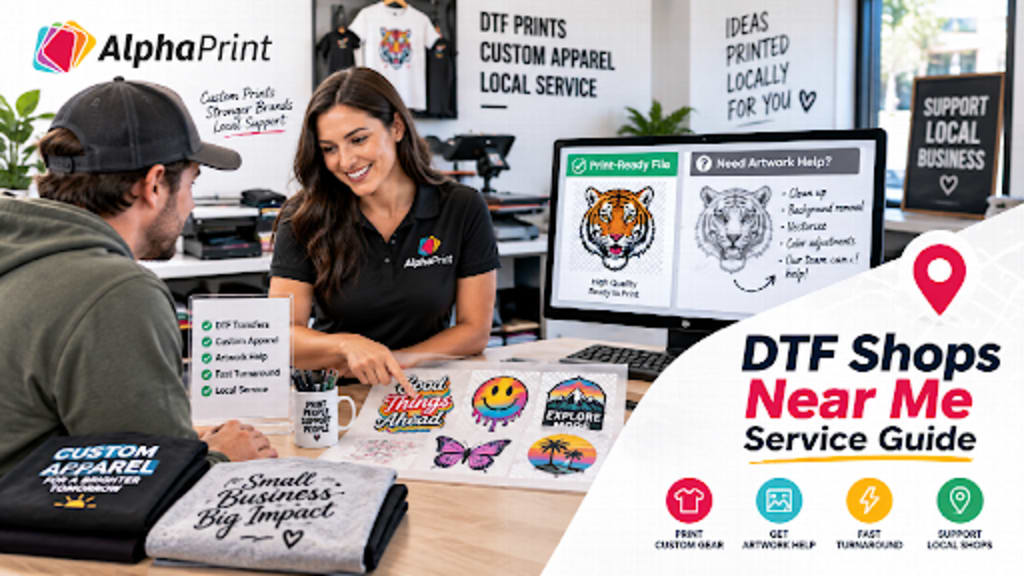
Direct-to-film printing has become a practical option for apparel decorators, clothing brands, small businesses, and individuals who need detailed custom graphics without relying on traditional screen-printing setups.
But finding a nearby provider is only the beginning.
When people search for DTF print shops near me, they may see several businesses offering similar services. Prices and turnaround times can vary, but those aren't the only factors worth comparing. Print quality, artwork requirements, transfer consistency, garment compatibility, and customer support can all affect the final result.
This guide explains what DTF shops typically offer and what you should check before placing an order.
What Is a DTF Print Shop?
A DTF print shop specializes in direct-to-film transfers or apparel decorated using those transfers.
In a typical DTF workflow, a design is printed onto a special film. Adhesive powder is applied and cured, creating a transfer that can later be applied to a compatible garment using a heat press.
Depending on the business, a shop may sell ready-to-press transfers, print custom gang sheets, decorate garments, or provide several of these services.
Understanding exactly what you need will make comparing shops easier.
Ready-to-Press Transfers vs. Finished Apparel
One of the first questions to ask is what type of service the shop provides.
Ready-to-Press DTF Transfers
If you already own a heat press, you may only need the transfers.
You provide the artwork, the shop produces the transfers, and you press them onto your own garments.
This option can be useful for apparel businesses that want to manage garment inventory and production themselves without operating DTF printing equipment.
Finished Garment Printing
Some shops handle the complete process.
You select or provide the garment, submit your design, and the shop produces the finished shirt, hoodie, uniform, tote bag, or other compatible item.
This can be more convenient for customers who don't own a heat press or don't want to manage production themselves.
Check Print Quality Before Ordering in Volume
A colorful sample can look impressive, but professional buyers should inspect more than color.
Look closely at fine lines, small lettering, edges, gradients, white areas, and detailed artwork.
A good test design can include several different elements so you can evaluate how the transfer handles each one.
You should also examine the transfer after it has been pressed.
The finished result matters more than how the transfer looks on film.
For a large or recurring order, consider purchasing a small test batch first.
Ask About Artwork Requirements
Good artwork preparation can prevent many production problems.
Before uploading your design, ask which file formats the shop accepts and whether artwork needs a transparent background.
You may also need to confirm:
Preferred image resolution
Minimum line thickness
Final print dimensions
Accepted file formats
Color requirements
Whether artwork checking is included
Whether resizing is available
Whether design services cost extra
Do not assume that a low-resolution image downloaded from the internet will produce a sharp large-format print.
Whenever possible, provide clean, high-resolution artwork at the appropriate dimensions.
Understand Gang Sheets
If you need multiple transfers, ask whether the shop offers gang-sheet printing.
A gang sheet allows multiple graphics to be arranged within a larger printable area. Depending on the supplier's pricing model and your designs, this can make efficient use of available printing space.
For example, a clothing business might place several chest logos, sleeve graphics, neck labels, and larger shirt designs on the same sheet.
Some shops require customers to create print-ready gang sheets themselves. Others provide tools or assistance for arranging the graphics.
Before ordering, confirm:
Available sheet dimensions
Required spacing between designs
Whether the shop cuts individual transfers
Accepted artwork formats
How the gang sheet is priced
These details are particularly important when preparing high-volume orders.
Compare Turnaround Times Carefully
A shop may advertise same-day, next-day, or fast printing, but always check what that actually means for your specific order.
A small transfer order and a large commercial order may have very different production schedules.
Ask when production begins and whether the quoted turnaround includes shipping.
If you're collecting locally, find out when the order will actually be ready for pickup.
For deadline-sensitive projects, avoid waiting until the final day to place an order. Allowing extra time gives you room to inspect the transfers and address a problem before the garments are needed.
Ask for Pressing Instructions
Heat-press settings are an important part of DTF application.
The appropriate temperature, time, pressure, and peeling procedure can depend on the transfer system and garment.
Follow the supplier's instructions rather than assuming settings from another transfer provider will work exactly the same way.
Ask for information covering:
Temperature
Pressing time
Pressure
Hot, warm, or cold peel
Second press, if recommended
Finishing instructions
Keep these instructions available near your heat press if you regularly order transfers.
Test the Actual Garments You Plan to Use
Not every garment behaves identically under heat.
Cotton, polyester, blends, performance fabrics, workwear, and specialty materials can respond differently during pressing.
Garment construction and surface treatments can matter as well.
If you're producing a large batch using a garment you've never decorated before, test one piece first.
Check the transfer after pressing and follow the appropriate care and wash instructions before deciding whether the combination is suitable for a larger production run.
Sacrificing one test garment is usually preferable to discovering a problem after completing an entire order.
Compare Pricing Beyond the Advertised Number
Price comparisons can become confusing because shops may use different pricing structures.
One provider may charge by individual transfer size. Another may sell gang sheets based on dimensions or length. Quantity discounts may also apply.
Additional charges could include artwork preparation, cutting, rush production, delivery, or shipping.
Instead of asking only, "How much is one transfer?" calculate what your complete order will cost.
For commercial buyers, also consider wasted garments and labor.
A cheaper transfer is not necessarily cheaper overall if inconsistent results require reprints.
Does the Shop Handle Bulk and Repeat Orders?
This is especially important for apparel businesses.
A shop that works well for five transfers may not necessarily be the right production partner for 500.
Ask about larger orders before your business actually needs one.
Questions can include:
What volumes can you normally handle?
Do bulk orders have different turnaround times?
Are wholesale prices available?
Can previous artwork be reordered?
How are repeat jobs managed?
What happens during peak periods?
If you're supplying businesses, schools, events, sports teams, or clothing brands, repeat-order consistency can be particularly valuable.
Check Pickup and Shipping Options
Searching locally can be useful when you need an order quickly or prefer collecting it yourself.
However, don't choose a printer based only on distance.
When evaluating DTF print shops near me, compare local pickup convenience with production quality, pricing, turnaround time, and reliability.
A shop slightly farther away may be a better fit if it provides the service your project requires. Conversely, convenient local pickup can be useful for businesses producing frequent deadline-sensitive orders.
Consider the complete workflow rather than location alone.
What Should You Ask Before Placing an Order?
Before paying for a substantial DTF order, get clear answers to the important production questions.
Ask what artwork format is preferred, how pricing is calculated, what turnaround you should expect, and which pressing instructions apply to your transfers.
For business orders, also ask about volume capacity and repeat production.
A useful pre-order checklist includes:
Artwork specifications
Transfer dimensions
Quantity
Gang-sheet options
Production turnaround
Pickup or shipping
Press settings
Bulk pricing
Reprint or defect policy
Repeat-order process
Keep written confirmation for important specifications on larger jobs.
Common Mistakes to Avoid
One common mistake is choosing a shop entirely on price.
Another is sending poor-quality artwork and expecting the printing process to fix it.
Ordering hundreds of transfers without testing them can also create unnecessary risk, especially when you're working with a new supplier or unfamiliar garment.
Other avoidable mistakes include using incorrect press settings, failing to confirm transfer dimensions, and placing deadline-sensitive orders without enough production time.
A short test run can answer many of these questions before they become expensive problems.
A Simple Way to Compare DTF Shops
If several shops appear suitable, send each one the same questions.
Ask for pricing based on the same dimensions and quantity. Confirm turnaround using the same order requirements. Compare their artwork specifications and pressing instructions.
If the project is important or likely to become recurring work, order samples where practical.
Then compare the actual results.
This creates a more meaningful comparison than relying entirely on advertisements, social-media photos, or the lowest quoted price.
Final Thoughts
Finding a nearby DTF printing service is easy in many markets. Finding one that consistently matches your production needs requires a little more research.
Start by defining whether you need transfers or finished garments. Check artwork requirements, test print quality, understand pricing, confirm turnaround, and follow the shop's recommended application instructions.
For repeat or commercial work, evaluate how well the provider handles communication, consistency, bulk production, and reorders.
A shop that fits your workflow can save time and simplify production, while a poorly matched supplier can create additional work regardless of how attractive the initial price appears.
Treat your first order as an opportunity to evaluate the complete service, not just the transfer itself.
About the Creator
Enjoyed the story? Support the Creator.
Subscribe for free to receive all their stories in your feed.
Comments
There are no comments for this story
Be the first to respond and start the conversation.