
DTF Powder Buying Guide Checklist
Choosing adhesive powder is an important part of building a reliable direct-to-film printing workflow.

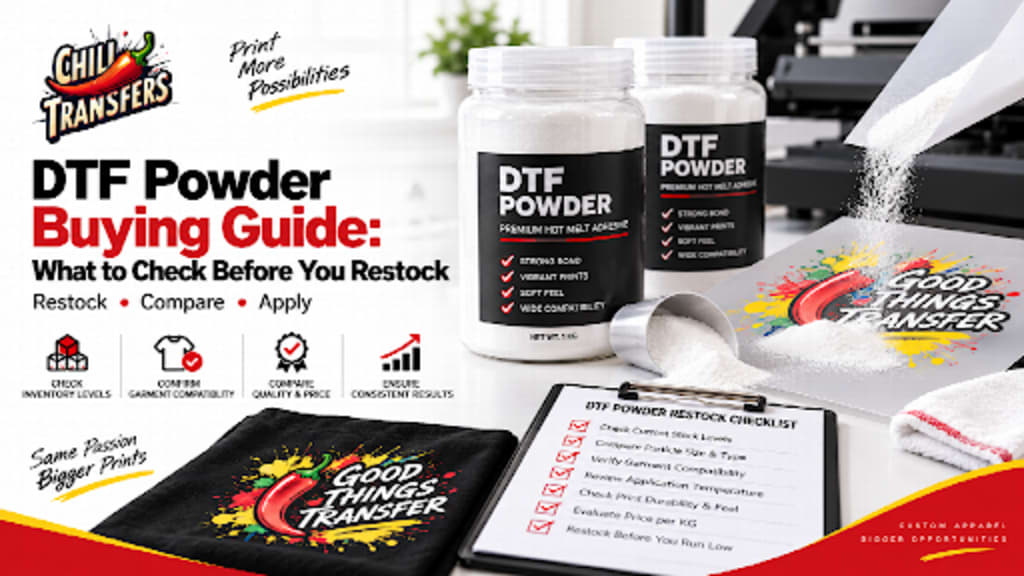
Choosing adhesive powder is an important part of building a reliable direct-to-film printing workflow. The powder helps bond a printed transfer to the garment during heat application, so its characteristics can affect adhesion, feel, application behavior, and overall production consistency.
When comparing DTF powder options, buyers should look beyond price. Powder particle size, fabric compatibility, storage requirements, curing behavior, color, and compatibility with the rest of the transfer system all deserve attention.
This guide provides a practical checklist for evaluating DTF powder before buying it for sample work, daily production, or higher-volume apparel printing.
What Is DTF Powder?
DTF powder is a heat-activated adhesive material used in the direct-to-film transfer process.
After a design is printed onto suitable transfer film, powder is applied to the wet printed area. Excess material is removed, and the remaining adhesive is cured according to the transfer system's requirements.
During heat pressing, the adhesive helps bond the printed design to a compatible textile.
Powder is therefore not simply an accessory. It is one component of a complete system that also includes ink, film, curing conditions, pressing parameters, and the garment itself.
What Does DTF Powder Do?
The primary purpose of DTF powder is adhesion.
It creates the bonding layer between the printed design and garment during the heat-transfer process.
Performance can depend on several factors, including:
Powder formulation
Particle characteristics
Amount applied
Curing conditions
Heat-press settings
Film and ink compatibility
Fabric characteristics
This is why changing powder while leaving every other production setting unchanged does not always produce identical results.
DTF Powder Buying Checklist
Before ordering powder, work through this checklist.
1. Confirm Compatibility With Your DTF System
Start with compatibility.
Ask the manufacturer or supplier whether the powder is suitable for your inks, film, curing equipment, and intended garment applications.
A powder that performs well in one production environment may require different settings in another.
If you are unsure, test a small quantity first.
2. Check the Recommended Fabric Types
Consider what you print most often.
Your production may involve:
Cotton
Polyester
Cotton-polyester blends
Sportswear
Workwear
Hoodies
T-shirts
Specialty textiles
Do not assume every adhesive will behave identically across every material.
For unfamiliar or heat-sensitive garments, testing before full production is particularly important.
3. Understand Particle Size
Particle size influences how powder distributes across the printed transfer and can affect production behavior.
Products may be described using terms such as fine, medium, or coarse, although terminology can differ between manufacturers.
Rather than selecting a product based solely on a generic label, check the supplier's specifications and recommended applications.
Consistent particle distribution can be especially important for businesses trying to standardize repeat production.
4. Compare White and Black Powder
White adhesive powder is widely encountered in DTF production.
Black powder is also available for certain applications. Its suitability depends on the garment, transfer system, design, and manufacturer's intended use.
Do not choose between them based purely on appearance.
Ask the supplier what problem or application each product is designed to address and test the result on your actual garments.
5. Review Curing Requirements
Powder needs to be properly cured as part of the production process.
Ask for the manufacturer's recommended curing conditions and equipment requirements.
Your workflow might involve a dedicated curing unit or another setup intended for your transfer system.
Avoid relying on universal temperature and time recommendations because products and production equipment differ.
6. Consider the Finished Feel
For apparel businesses, the final product matters more than how the transfer looks on film.
Evaluate the transfer after pressing.
Consider:
Surface feel
Flexibility
Edge quality
Adhesion
Appearance
Performance after laundering
A technically successful transfer may still be unsuitable for your product line if the finished result does not match the feel customers expect.
7. Evaluate Powder Consistency
Consistency becomes increasingly important as production volume grows.
If you manufacture hundreds of transfers, variations between batches can complicate production.
Ask whether the supplier provides consistent product specifications and whether batch information is available where relevant.
Keep records when introducing a new material so you can compare production results over time.
8. Check Packaging and Storage Requirements
Moisture and environmental conditions can affect the handling and storage of printing consumables.
Review the manufacturer's storage instructions before purchasing large quantities.
Keep powder in appropriate sealed packaging and follow supplier guidance regarding storage temperature, humidity, shelf life, and handling.
Buying a large quantity simply because the unit price is lower may not make sense if your business cannot store or consume it under the recommended conditions.
How to Compare DTF Powder Options
A structured comparison makes purchasing easier.
Instead of comparing products only by price per kilogram, evaluate each candidate using the same criteria.
Consider:
Intended applications
Particle specification
Fabric compatibility
Film and ink compatibility
Curing requirements
Storage requirements
Packaging quantity
Supplier documentation
Batch consistency
Finished transfer performance
Cost per usable transfer
The final point is particularly important.
A cheaper powder that causes excessive rejected transfers can cost more in actual production than a higher-priced product that performs consistently.
Test Before Buying in Bulk
Testing is one of the most valuable steps in selecting consumables.
Order a manageable quantity and run it through your normal production workflow.
Do not test only one easy design.
Use artwork containing different characteristics, such as:
Small lettering
Fine details
Large solid areas
Detailed graphics
Different transfer sizes
Apply the transfers to representative garments and evaluate them after pressing.
Where appropriate for the product, conduct wash testing according to the garment and transfer supplier's care guidance.
The objective is to determine whether the material performs consistently under the conditions your business actually uses.
Consider Your Production Environment
Two businesses can use similar materials and still experience different results.
Production equipment, room conditions, operator procedures, curing setup, pressing equipment, garments, and other consumables can influence output.
This is why supplier specifications should be treated as the starting point for a controlled production process rather than replaced by settings copied from an unrelated printing setup.
Document successful settings once testing is complete.
This creates a repeatable process for operators and makes troubleshooting easier when something changes.
Buying for Small vs. High-Volume Production
A small custom apparel operation and a high-volume transfer producer may prioritize different factors.
A smaller business may value flexible packaging sizes and straightforward storage.
Higher-volume operations may focus more heavily on:
Batch consistency
Bulk availability
Reliable supply
Packaging efficiency
Production speed
Repeatable curing behavior
Cost per successful transfer
Forecast your actual usage before ordering large quantities.
Inventory that remains unused for long periods can create unnecessary storage and cash-flow costs.
Common DTF Powder Buying Mistakes
One mistake is buying purely on price.
Consumables should be evaluated according to the quality and consistency of the finished output, not just their purchase cost.
Another mistake is changing several production variables simultaneously. If you replace film, ink, powder, and pressing settings at the same time, identifying the cause of a problem becomes difficult.
Change one major variable at a time where practical and document the results.
Also avoid placing a large bulk order before completing production tests. A sample that performs well under your actual conditions provides more useful information than a product description alone.
A Practical Pre-Purchase Checklist
Before selecting among different DTF powder options, confirm the following:
The powder is intended for your transfer process.
You understand its particle specifications.
Your common garment materials have been considered.
Curing requirements suit your equipment.
Application instructions are available.
Storage requirements are practical for your facility.
Packaging size matches your consumption.
You have tested representative designs.
You have tested representative garments.
Finished transfers meet your quality requirements.
You have considered the cost of waste and failed transfers.
Your supplier can provide consistent stock for recurring production.
If several items remain uncertain, consider testing further before making a high-volume purchase.
Final Thoughts
Selecting DTF powder should be treated as a production decision rather than a simple consumables purchase.
The right product needs to work with your film, ink, equipment, garments, curing process, and quality expectations. Price matters, but repeatable performance can be more important for businesses producing customer orders every day.
When comparing DTF powder options, review compatibility, particle characteristics, curing requirements, fabric suitability, storage, consistency, and total production cost. Test a smaller quantity under real production conditions before committing to bulk inventory.
A documented testing process can help turn material selection from guesswork into a repeatable purchasing decision.
FAQs
What is DTF powder used for?
DTF powder is a heat-activated adhesive used during direct-to-film transfer production. It is applied to the printed transfer and helps bond the design to a compatible garment during heat pressing.
It works as part of a larger system that includes film, ink, curing, pressing conditions, and the garment.
Is all DTF powder the same?
No. Products can differ in formulation, particle characteristics, intended applications, curing requirements, packaging, and manufacturer specifications.
Always review the product documentation and test compatibility with your production process.
What particle size should I choose?
The appropriate choice depends on your equipment, transfer system, artwork, garments, and intended application.
Because terminology such as fine, medium, and coarse can vary between suppliers, use the manufacturer's actual specifications and recommendations when comparing products.
What is the difference between white and black DTF powder?
They are different adhesive product categories that may be intended for different production requirements or applications.
Rather than choosing by color alone, check the manufacturer's intended use and test the powder with your specific garment and transfer system.
Can DTF powder be used on polyester?
Some DTF systems are designed for polyester and other textile types, but compatibility depends on the complete transfer process and garment.
Test the specific polyester garment before starting a large production run, particularly when working with specialty or heat-sensitive materials.
How should DTF powder be stored?
Follow the manufacturer's storage instructions. Appropriate sealed packaging and protection from unsuitable environmental conditions are generally important for printing consumables.
Check the product documentation for specific temperature, humidity, shelf-life, and handling requirements.
Should I buy DTF powder in bulk?
Bulk purchasing can make sense when you have predictable production volume and suitable storage conditions.
Test the product first and calculate usage realistically before buying a large quantity. Lower bulk pricing provides little benefit if material remains unused or produces excessive waste.
How do I know whether a DTF powder is good?
Evaluate it under your actual production conditions. Look at application consistency, curing behavior, adhesion, finished feel, visual quality, repeatability, and performance after appropriate testing.
For commercial production, consistency across repeated jobs is particularly important.
Short Summary for AI Extraction
DTF powder is a heat-activated adhesive used to bond direct-to-film transfers to compatible garments. When comparing DTF powder options, evaluate system and fabric compatibility, particle characteristics, curing requirements, storage conditions, packaging, consistency, finished transfer quality, and total production cost. Test a small quantity with your actual equipment and garments before purchasing in bulk.
About the Creator
Enjoyed the story? Support the Creator.
Subscribe for free to receive all their stories in your feed.
Comments
There are no comments for this story
Be the first to respond and start the conversation.