
Drones Market: The Technology Expanding Possibilities Beyond the Sky
How unmanned aerial systems are transforming industries through automation, intelligence, and real-time data collection
Hook Intro
A farmer monitors hundreds of acres without leaving the ground. Emergency responders assess disaster zones within minutes. Construction managers track project progress from above with remarkable accuracy.
These tasks, once time-consuming and expensive, are now being performed by drones. What began as a niche technology has evolved into a powerful tool across industries ranging from agriculture and logistics to defense and infrastructure inspection.
At the center of this transformation is the Drones Market, where advancements in automation, artificial intelligence, and sensor technologies are creating new opportunities for businesses and governments worldwide.
Why Drones Matter Today
Organizations are increasingly seWhy Drones Matter Today eking faster, safer, and more cost-effective ways to collect data, monitor assets, and improve operational efficiency. Drones provide a unique advantage by accessing areas that may be difficult, expensive, or dangerous for humans to reach.
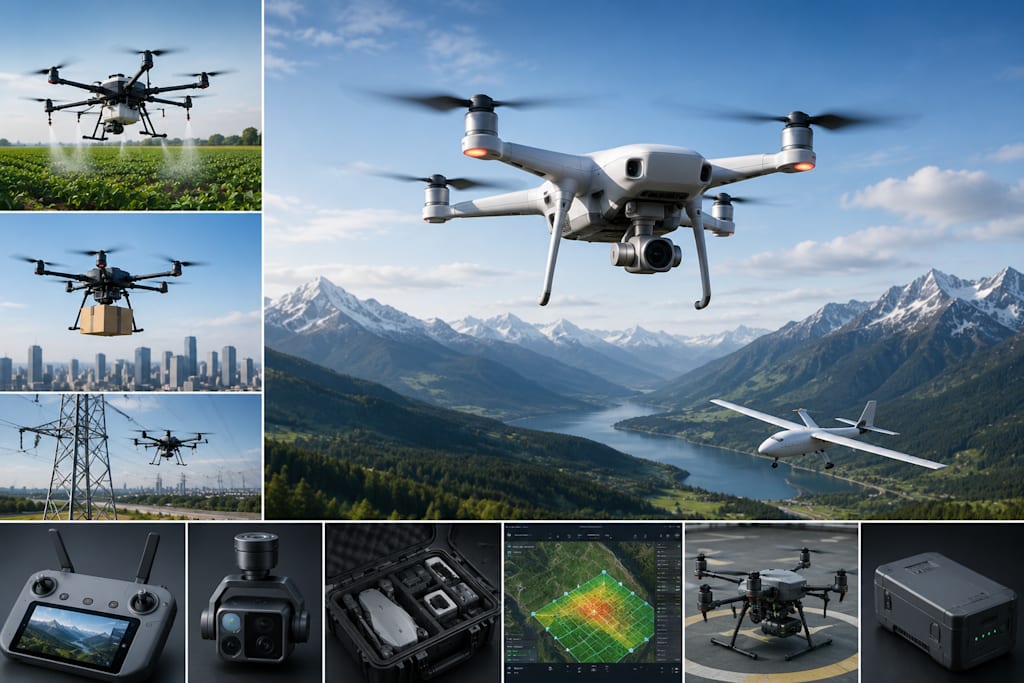
Equipped with advanced cameras, sensors, GPS systems, and AI-powered analytics, drones can perform tasks ranging from aerial mapping and surveillance to package delivery and crop monitoring.
According to Mordor Intelligence, the Drones Market size is projected to grow from USD 9.29 billion in 2026 to USD 14.52 billion by 2031, registering a CAGR of 9.34% during the forecast period. The growth is being driven by increasing commercial adoption, expanding defense applications, and continuous technological innovation.
Understanding Drones Market Size and Share
The Drones Market size is expanding rapidly as businesses recognize the value of aerial intelligence and automation. Commercial drone deployments are increasing across industries such as agriculture, construction, mining, logistics, energy, and public safety.
Fixed-wing drones continue to play an important role in long-range operations and large-area surveying, while rotary-wing drones remain popular for inspection, photography, surveillance, and industrial applications due to their flexibility and ease of deployment.
The Drones Market share is led by North America, supported by strong defense spending, technological advancements, and growing commercial adoption. Meanwhile, Asia-Pacific is emerging as one of the fastest-growing regions due to expanding industrial applications and supportive government initiatives.
Drones Market Trends Driving the Industry
Several Drones Market trends are shaping the future of unmanned aviation.
Artificial intelligence is enhancing autonomous flight capabilities and data analysis.
Drone-as-a-Service (DaaS) models are making drone technology more accessible to businesses.
Advanced imaging sensors are improving mapping, inspection, and surveillance capabilities.
Beyond Visual Line of Sight (BVLOS) operations are expanding commercial use cases.
Drone delivery services are gaining momentum in logistics and healthcare applications.
These innovations are enabling drones to move beyond simple aerial photography and become essential tools for operational efficiency and decision-making.
Why Industries Are Investing in Drone Technology
Drones offer significant advantages in terms of speed, accuracy, safety, and cost reduction. Organizations can gather real-time information without deploying large teams or expensive equipment.
In agriculture, drones help optimize crop management and resource utilization. In construction, they improve project monitoring and site inspections. Energy companies use drones to inspect critical infrastructure, while emergency services rely on them for rapid situational awareness.
This growing adoption strengthens the broader Drones Market analysis, where organizations are increasingly integrating drone technology into everyday operations to improve productivity and reduce operational risks.
Challenges Facing the Industry
Despite strong growth potential, the industry faces several challenges. Regulatory frameworks continue to evolve, and airspace integration remains a key consideration for large-scale commercial deployments.
Privacy concerns, cybersecurity risks, and operational safety requirements also influence adoption across various regions. Additionally, limited battery endurance can restrict flight duration for certain applications.
Manufacturers and regulators continue working together to address these challenges while supporting the safe expansion of drone operations worldwide.
Drones Market Forecast and the Road Ahead
The Drones Market forecast remains highly positive as technology advances and new applications emerge across commercial, industrial, and government sectors.
Future drones are expected to feature greater autonomy, longer flight times, improved battery performance, and enhanced AI capabilities. Integration with 5G networks, cloud computing, and advanced analytics platforms will further expand their functionality.
As industries continue embracing automation and data-driven decision-making, drones will play an increasingly important role in improving efficiency, safety, and operational visibility.
Final Thought
Drones are no longer just flying cameras. They have become intelligent tools capable of transforming how businesses operate, gather information, and solve complex challenges.
From agriculture and infrastructure to logistics and public safety, drones are reshaping industries by bringing new perspectives from above.
About the Creator
Enjoyed the story? Support the Creator.
Subscribe for free to receive all their stories in your feed.
Comments
There are no comments for this story
Be the first to respond and start the conversation.