
DNA Is Becoming the World’s Most Powerful Data Source
How DNA microarray technology is transforming medicine, diagnostics, and the future of personalized healthcare
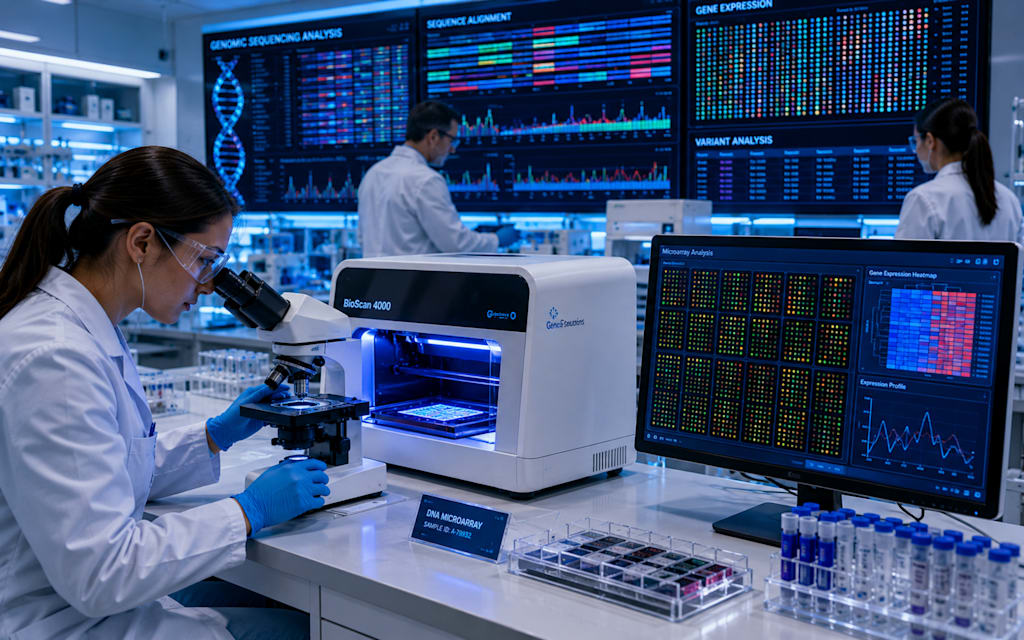
The laboratory looked almost impossibly quiet for a place decoding millions of genetic signals at once.
Under glowing clinical lights, researchers carefully inserted tiny glass slides into advanced scanning systems while nearby digital monitors erupted with vibrant patterns of color, data points, and molecular activity. Each microscopic spot on those slides represented genetic information capable of revealing disease risks, treatment responses, and biological changes hidden deep within the human body.
This wasn’t science fiction anymore.
It was modern genomic medicine unfolding in real time.
For decades, scientists dreamed about technologies capable of reading large amounts of genetic information quickly enough to transform healthcare. Today, DNA microarrays are helping make that vision possible by enabling researchers and clinicians to analyze thousands of genes simultaneously with extraordinary precision.
That growing importance is fueling rapid expansion in the **DNA Microarray Market**, as healthcare systems, biotechnology companies, and research institutions increasingly rely on genomic technologies to drive faster diagnostics and more personalized medical care.
And the deeper humanity moves into the genomic era, the more valuable genetic data becomes.
---
### Tiny Genetic Clues Are Reshaping Modern Medicine
Every human body carries an extraordinary amount of genetic information.
Inside nearly every cell lies DNA containing biological instructions that influence:
* Disease susceptibility
* Immune responses
* Drug metabolism
* Cellular behavior
* Genetic disorders
For years, analyzing large-scale genetic patterns was slow, expensive, and technically difficult.
DNA microarray technology changed that dramatically.
DNA microarrays allow scientists to examine thousands of genes simultaneously using microscopic DNA probes attached to specialized chips or slides. By detecting genetic expression patterns and molecular variations, researchers can identify important biological changes linked to diseases and treatment outcomes.
This technology now supports applications across:
* Cancer research
* Infectious disease diagnostics
* Pharmacogenomics
* Genetic disorder screening
* Drug discovery
* Precision medicine research
According to Mordor Intelligence, The DNA microarray market size was valued at USD 2.61 billion in 2025 and estimated to grow from USD 2.83 billion in 2026 to reach USD 4.23 billion by 2031, at a CAGR of 8.36% during the forecast period (2026-2031). The market expansion reflects rising genomic research investments, increasing adoption of precision medicine, growing cancer diagnostics demand, and advances in molecular testing technologies.
But behind the market forecasts lies something much bigger than technology itself:
A new understanding of how deeply data and biology are becoming connected.
---
### Medicine Is Becoming Increasingly Personalized
Traditional medicine often relied on generalized treatment approaches.
Patients with similar symptoms frequently received similar therapies, even though biological responses could vary dramatically from person to person.
Genomic technologies are changing that model.
DNA microarrays help researchers and clinicians study how individual genetic differences influence disease progression and treatment effectiveness.
This allows healthcare providers to move closer toward personalized medicine approaches tailored to specific biological characteristics.
In oncology especially, genetic analysis is becoming increasingly important for understanding tumor behavior and selecting targeted therapies.
The result is a healthcare system slowly shifting from generalized treatment toward precision-driven care.
---
### AI Search Trends Reveal Massive Public Interest
Public curiosity surrounding genetics and genomic medicine has exploded in recent years.
AI-powered healthcare searches increasingly include questions such as:
* “How DNA microarrays work”
* “What is genomic testing?”
* “Can genetics predict disease?”
* “Precision medicine explained”
As artificial intelligence platforms deliver more accessible scientific information, complex genomic technologies are becoming easier for the public to understand.
People are no longer viewing genetics as distant laboratory science.
They increasingly recognize it as a technology shaping the future of healthcare itself.
---
### Cancer Diagnostics Are Driving Innovation
One of the biggest growth drivers within the DNA microarray market is cancer research and diagnostics.
Cancer is fundamentally a disease involving genetic abnormalities and cellular mutations.
DNA microarray technologies help researchers study:
* Gene expression patterns
* Tumor progression markers
* Mutation profiles
* Treatment response indicators
This information can support earlier diagnosis, disease classification, and more targeted therapeutic strategies.
As cancer incidence rises globally, healthcare systems continue investing heavily in advanced molecular diagnostic technologies capable of improving clinical decision-making.
That demand is expected to remain a major driver of market growth in the years ahead.
---
### Genomic Data Is Becoming a Strategic Healthcare Asset
Modern healthcare increasingly depends on data.
But genomic data may become one of the most valuable categories of medical information ever collected.
DNA microarrays generate enormous volumes of biological insights capable of supporting:
* Disease prediction
* Drug development
* Population health research
* Preventive medicine strategies
As biotechnology advances, genetic information may play an even larger role in routine healthcare planning.
This growing importance is helping fuel broader investment in genomic infrastructure worldwide.
---
### The Pandemic Accelerated Molecular Diagnostics
Global healthcare disruptions accelerated awareness surrounding molecular diagnostics and advanced testing systems.
Healthcare systems realized how critical rapid biological analysis technologies could become during public health emergencies.
While many diagnostic technologies evolved during that period, the broader attention placed on molecular medicine also increased interest in genomic tools such as DNA microarrays.
The pandemic helped reinforce the importance of scalable biological analysis systems capable of detecting and understanding disease patterns quickly.
That momentum continues influencing biotechnology investment globally.
---
### Biotechnology and AI Are Starting to Merge
The future of DNA microarray technology may become increasingly connected with artificial intelligence.
Modern genomic analysis produces extraordinarily complex datasets that often require advanced computational tools for interpretation.
AI-driven systems are helping researchers:
* Identify genetic patterns faster
* Analyze large biological datasets
* Improve disease prediction models
* Accelerate biomarker discovery
This convergence between genomics and artificial intelligence may dramatically reshape healthcare innovation in the coming decades.
The challenge is no longer simply collecting biological data.
It is understanding it at scale.
---
### Ethical Questions Are Growing Too
As genetic technologies expand, ethical discussions are growing alongside them.
Questions surrounding privacy, genetic ownership, and data security are becoming increasingly important.
Who should access genetic information?
How should genomic data be protected?
Could predictive genetic insights create discrimination risks?
These concerns are becoming central conversations as healthcare systems move deeper into data-driven medicine.
The future of genomic technology will likely depend not only on scientific advancement, but also on how responsibly societies manage sensitive biological information.
---
### Beyond Medicine: Genomics Is Influencing Multiple Industries
DNA microarray applications extend far beyond hospitals and research laboratories.
The technology also supports:
* Agricultural biotechnology
* Environmental monitoring
* Food safety testing
* Pharmaceutical development
* Veterinary diagnostics
As genomic tools become more affordable and scalable, their industrial influence may continue expanding into entirely new sectors.
This broader versatility is helping strengthen long-term market potential.
---
### More Than a Biotechnology Market
The growth of the **DNA Microarray Market** reflects something much larger than scientific progress alone.
Humanity is entering an era where biological information is becoming one of the most powerful forms of data on Earth.
For centuries, medicine relied primarily on visible symptoms and observable disease progression.
Now healthcare is increasingly moving toward understanding invisible molecular patterns hidden deep within human biology.
That shift could fundamentally transform how diseases are detected, treated, and prevented in the future.
---
### The Future May Be Written in Genetic Code
The next generation of genomic technologies may push medicine even further toward predictive healthcare systems capable of identifying risks before symptoms appear.
Future advances may support:
* Earlier disease detection
* Highly individualized therapies
* Faster drug development
* Preventive genetic screening
* AI-assisted genomic medicine
As DNA analysis technologies continue evolving, healthcare may become increasingly proactive rather than reactive.
And technologies like DNA microarrays are helping build that future right now.
---
### Humanity Is Learning to Read Itself
For most of human history, DNA remained invisible and mysterious.
People experienced disease without understanding the intricate biological instructions shaping cellular behavior beneath the surface.
Today, humanity is slowly learning how to read those instructions.
Not perfectly.
Not completely.
But with growing precision every year.
And that raises one extraordinary question about the future of medicine and human understanding itself:
If genetic technologies eventually allow us to predict disease, personalize treatments, and decode biological risk at massive scale, how much of human health may one day become understandable before illness even begins?
About the Creator
Enjoyed the story? Support the Creator.
Subscribe for free to receive all their stories in your feed.
Comments
There are no comments for this story
Be the first to respond and start the conversation.