
(-)-Dibenzoyl-L-tartaric Acid Monohydrate and the Chemistry of Molecular Handedness
Why chiral resolving agents matter in pharmaceuticals, fine chemistry, and the hidden architecture of modern molecules

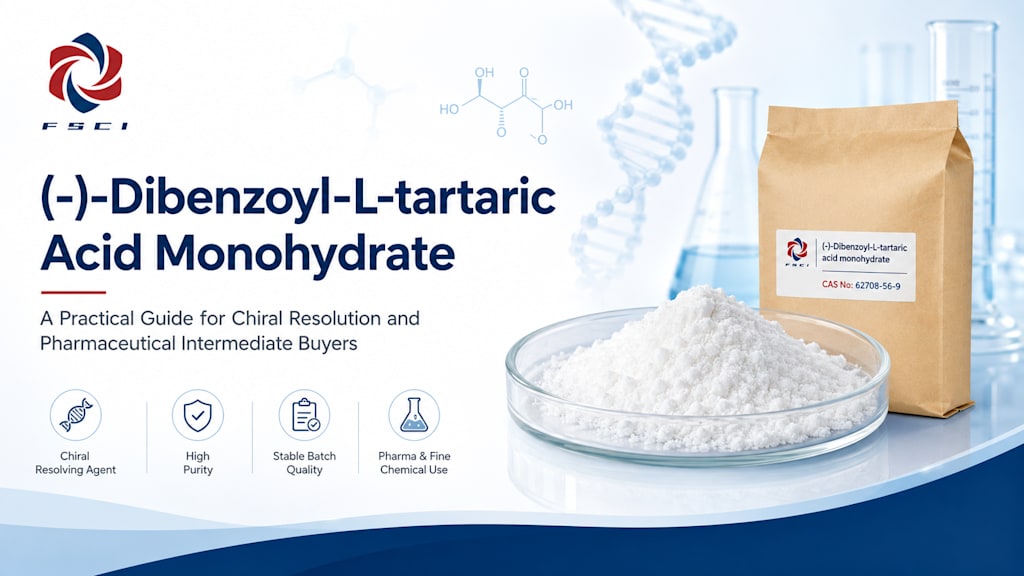
(-)-Dibenzoyl-L-tartaric Acid Monohydrate may sound like a highly specialized chemical name, and in many ways it is. It belongs to a world of chemistry that most people never see directly: the world of molecular handedness. Yet this quiet branch of chemistry has a powerful influence on pharmaceuticals, fine chemicals, agricultural research, fragrances, and advanced material development.
To understand why this compound matters, it helps to begin with chirality. Some molecules exist in two forms that are mirror images of each other, much like left and right hands. They may contain the same atoms, connected in the same order, but their three-dimensional arrangement is different. In ordinary life, left and right hands are similar but not interchangeable. A left-hand glove does not fit the right hand properly. In chemistry, this difference can be even more important.
A chiral molecule may behave differently depending on which “handed” form is present. In biological systems, where proteins, enzymes, and receptors are themselves chiral, one form of a molecule may interact strongly while the other behaves weakly or differently. This is one reason chirality has become so important in drug discovery and pharmaceutical chemistry. The shape of a molecule is not just a detail. It can influence how that molecule is recognized, processed, or transformed.
(-)-Dibenzoyl-L-tartaric Acid Monohydrate is valued because it is part of the toolkit chemists use to separate or control chiral substances. It is commonly associated with chiral resolution, a process in which a mixture of mirror-image molecules is separated into its individual forms. This is especially useful when a reaction produces both enantiomers at the same time, but only one is needed for further study or application.
The compound is derived from tartaric acid chemistry. Tartaric acid itself has a long and fascinating history in the development of stereochemistry. In the nineteenth century, studies involving tartaric acid salts helped scientists understand that molecules could have mirror-image forms. That discovery became one of the foundations of modern stereochemistry. In this sense, tartaric acid derivatives are not just useful materials; they are connected to one of the most important conceptual shifts in chemistry.
The “dibenzoyl” part of the molecule helps modify its behavior. By adding benzoyl groups to the tartaric acid framework, chemists create a compound with useful structural and interaction properties. These features allow it to form salts or complexes with certain chiral amines and related compounds. When these salts have different solubilities or crystallization behavior, separation becomes possible. This is the practical beauty of chiral resolution: a subtle difference in molecular shape can be turned into a physical separation.
The monohydrate form also matters. In chemistry, hydration is not always a minor label. A compound that contains one molecule of water in its crystal structure may show different handling, crystallization, or storage behavior compared with a non-hydrated form. The water is not simply “extra moisture” in a casual sense; it can be part of the solid structure. For researchers and formulators, these differences may influence how a material behaves in real laboratory conditions.
Closely related to this material is L-(-)-Dibenzoyl-L-tartaric Acid. The monohydrate and non-hydrated forms are often discussed together because they are connected by the same chiral tartaric acid backbone. Depending on the process or research setting, one form may be preferred over another. This relationship shows how small differences in solid-state chemistry can matter even when the core molecular identity remains familiar.
Chiral resolving agents like (-)-Dibenzoyl-L-tartaric Acid Monohydrate are especially important because not every chiral molecule is easy to make in a single pure form. Modern asymmetric synthesis has become highly advanced, and many reactions can now favor one enantiomer over another. Still, resolution remains a useful and sometimes elegant method. It can be simple in concept, highly effective in practice, and valuable when direct asymmetric routes are difficult or less practical.
In pharmaceutical research, this type of chemistry carries special weight. Many active molecules contain chiral centers, and the ability to study one enantiomer separately from another can be essential. Even before a compound becomes part of any final medicine, researchers may need to understand how each form behaves. Chiral resolution helps create the clarity needed for careful study. It allows chemists to move from a mixed molecular population toward a more defined material.
Fine chemical synthesis also benefits from this approach. Chiral intermediates are used to build more complex structures, and the quality of those intermediates can affect later steps. A well-resolved chiral compound can become a foundation for more precise chemistry. In this way, a resolving agent may not appear in the final product, but it can still shape the pathway that leads there.
What makes (-)-Dibenzoyl-L-tartaric Acid Monohydrate interesting is that it represents chemistry as architecture. Molecules are not flat drawings on paper. They have direction, shape, surfaces, and spatial relationships. A compound like this helps chemists use those spatial differences intentionally. It turns invisible geometry into something practical.
For readers looking for a focused material reference, (-)-Dibenzoyl-L-tartaric Acid Monohydrate is commonly introduced in connection with chiral resolution and fine chemical research. Broader specialty chemistry references from Fscichem also show how tartaric acid derivatives fit into a wider landscape of functional organic compounds.
The wider lesson is that small molecular differences can have large consequences. Two mirror-image molecules may look almost identical in a formula, but their behavior can diverge sharply in a chiral environment. This is why resolving agents remain important even in an age of advanced synthesis and analytical tools. They help chemists separate complexity into something understandable.
In the end, (-)-Dibenzoyl-L-tartaric Acid Monohydrate is not famous in the everyday sense, but it belongs to a deeply important part of modern chemistry. It helps reveal the hidden handedness of molecules, supports the preparation of chiral materials, and connects the history of tartaric acid chemistry with today’s pharmaceutical and fine chemical research. Like many specialized compounds, its importance lies not in public visibility, but in the precision it brings to the molecular world.
About the Creator
Enjoyed the story? Support the Creator.
Subscribe for free to receive all their stories in your feed.
Comments
There are no comments for this story
Be the first to respond and start the conversation.