
Countertops Market Signals a Quiet Shift in Modern Living
A subtle evolution in surfaces shaping everyday spaces
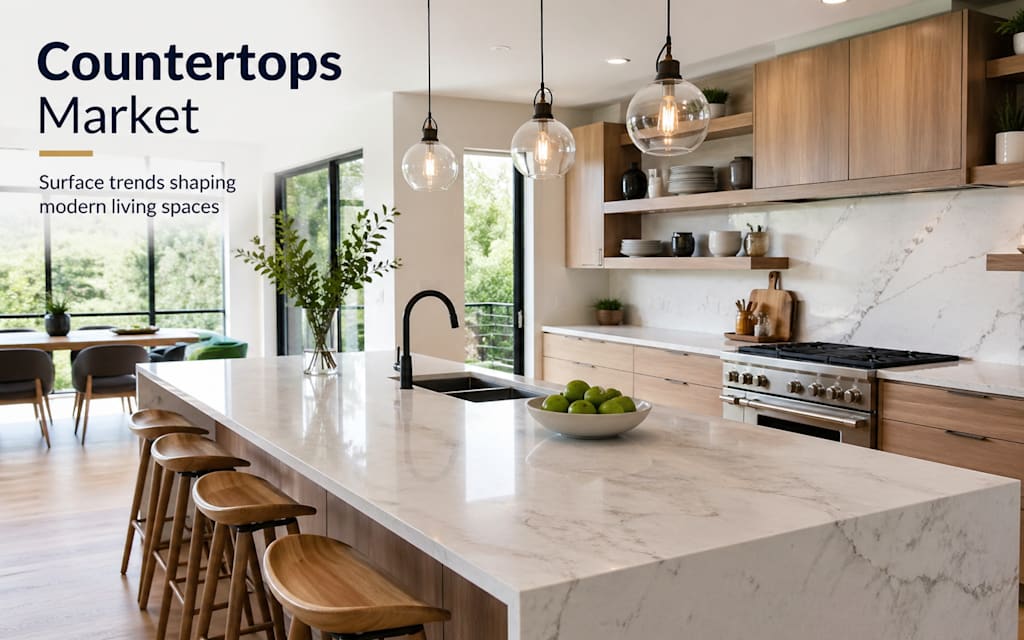
The first thing you notice isn’t the furniture. It’s the surface, cool, polished, and silently commanding attention. A countertop isn’t just a slab anymore; it’s where mornings begin, where conversations unfold, and where design meets daily life.
Beneath this quiet presence lies a market that is steadily transforming. Not with loud disruptions, but with consistent, deliberate growth, mirroring how homes themselves are evolving into more intentional, expressive spaces.
The Surface Beneath Everyday Life
The global countertops market has moved beyond its functional roots, embedding itself into lifestyle narratives across residential and commercial spaces. Materials like quartz, granite, and engineered stone are no longer chosen purely for durability, they reflect identity, sustainability concerns, and aesthetic preferences.
According to Mordor Intelligence, countertops market size in 2026 is estimated at USD 161.23 billion, growing from 2025 value of USD 155.14 billion with 2031 projections showing USD 195.41 billion, growing at 3.92% CAGR over 2026–2031.
This steady rise hints at more than construction demand. It signals a broader cultural shift where interiors are curated with care. The countertops market size reflects this ongoing transformation, driven by urbanization and a rising desire for personalized living environments.
In growing cities, kitchens are no longer hidden corners—they are central hubs. Open layouts amplify the visual importance of countertops, making them a focal point. This subtle repositioning has elevated their role from utility to statement piece.
- Increased urban housing projects
- Rising remodeling trends
- Demand for low-maintenance materials
Each of these elements contributes quietly but consistently to the expansion of this space.
Materials That Mirror Modern Choices
Walk into any newly designed home, and you’ll see a pattern—clean lines, neutral palettes, and surfaces that feel almost seamless. Quartz dominates many of these spaces, not just for its resilience but for its adaptability.
The countertops industry is responding to a generation that values both form and function. Sustainability has begun to influence material selection, pushing manufacturers toward recycled content and eco-conscious production methods.
Granite still holds its place, admired for its natural uniqueness, while laminate options are being reimagined with improved textures and finishes. The diversity of materials reflects a market that is no longer one-dimensional.
This is where countertops market share becomes particularly telling. Engineered surfaces are gradually capturing attention, not through aggressive disruption but through reliability and design flexibility.
Meanwhile, commercial spaces, cafés, co-working hubs, and boutique stores, are adopting distinctive countertop designs to create memorable customer experiences. The surface becomes part of the brand story, not just the structure.
A Quiet Expansion with Lasting Impact
There’s something almost understated about the pace of change here. Unlike tech markets that surge and dip dramatically, this sector grows with quiet consistency. Countertops market growth is anchored in long-term trends, housing development, renovation cycles, and evolving design sensibilities.
Emerging economies are playing a crucial role. As middle-class populations expand, so does the demand for upgraded living standards. Kitchens and bathrooms, once purely functional, are now spaces of pride and personalization.
Digital influence is another subtle driver. Social media platforms showcase interiors that inspire replication, fueling demand for premium finishes. A single image of a marble countertop can spark thousands of renovation ideas.
At the same time, affordability remains key. Manufacturers are balancing innovation with cost efficiency, ensuring accessibility across different income segments. This balance sustains momentum without alienating a broader audience.
A countertop might seem like a simple surface, but its story runs deeper—woven into architecture, lifestyle, and aspiration. As spaces continue to evolve, so will the materials that define them.
When you look at your own surroundings, what does your surface say about the life built around it?
About the Creator
Enjoyed the story? Support the Creator.
Subscribe for free to receive all their stories in your feed.
Comments
There are no comments for this story
Be the first to respond and start the conversation.