
Container Shipping Market Faces a New Global Shift
Container Shipping Trends Redefine Trade Routes and Port Competition
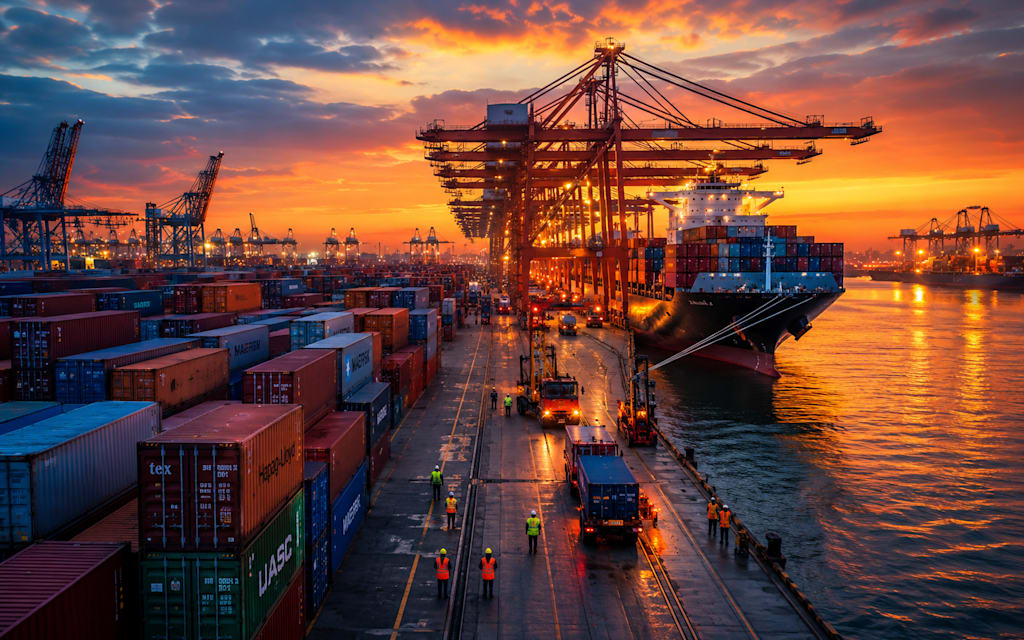
Steel containers slam into place with a metallic echo that rolls across the harbor before sunrise. Towering cranes move like giant mechanical birds above the waterline while ships carrying thousands of containers wait silently offshore for their turn to dock. Beneath the choreography of engines, alarms, and ocean wind, global trade keeps breathing.
Shipping routes that once felt predictable are now reacting to geopolitical tensions, changing fuel standards, digital tracking systems, and shifting consumer demand. The modern supply chain no longer moves quietly in the background of the economy. It has become the story itself.
According to Mordor Intelligence the container shipping market is entering a period of strategic transformation. The market size is expected to grow from USD 119.65 billion in 2025 to USD 123.14 billion in 2026 and is forecast to reach USD 142.07 billion by 2031 at a CAGR of 2.92% over 2026-2031.
Ports Are Becoming the New Battlegrounds of Trade
Global ports are no longer just transfer points for goods. They are becoming centers of technological competition and economic influence.
From Singapore to Rotterdam, shipping hubs are investing heavily in automation, AI-assisted logistics, and cleaner vessel infrastructure. Delays that once lasted days are now analyzed in minutes using predictive tracking systems capable of rerouting shipments before congestion escalates. The pressure to move faster has transformed the cargo shipping market into an ecosystem driven by precision.
At the same time, shipping companies are under increasing pressure to reduce emissions while maintaining profitability. Fuel-efficient vessels and digital route optimization tools are becoming essential rather than optional. This shift is influencing purchasing decisions, trade agreements, and long-term investment strategies across international ports.
Consumers rarely think about container movement while ordering electronics, clothing, or furniture online. Yet every delayed shipment, fuel adjustment, or labor disruption can ripple across shelves worldwide. The visibility of supply chains has made shipping one of the most closely watched sectors in global commerce.
Mobile users scrolling through business headlines now encounter stories about port bottlenecks and maritime rerouting almost daily. The industry that once operated behind corporate walls is now part of mainstream economic conversation.
Regional Trade Corridors Are Quietly Rewriting Competition
Manufacturers are increasingly diversifying sourcing strategies, leading to stronger shipping activity across emerging regions. Secondary ports that once handled modest traffic are now competing for larger international contracts. The container transshipment market is benefiting from this redistribution of global cargo movement, especially in regions positioned between major east-west trade lanes.
Governments are investing in maritime infrastructure to secure influence over future trade networks. Deep-water ports, customs digitization, and rail connectivity are being treated as national priorities because control over shipping routes increasingly shapes economic resilience.
Inside boardrooms, executives are studying changing maritime patterns with urgency. Companies dependent on stable delivery timelines are reevaluating long-standing partnerships and transportation models. Even small disruptions can affect inventory planning, manufacturing schedules, and consumer confidence.
The container shipping industry now operates in an environment where adaptability matters as much as scale. Shipping firms that once relied purely on vessel capacity are expanding into integrated logistics services, warehousing technology, and predictive analytics platforms.
This evolution is also changing employment patterns inside the maritime economy. Demand for data analysts, logistics specialists, and digital operations managers is rising alongside traditional shipping roles. Ports are becoming technology ecosystems as much as transportation hubs.
The visual identity of global trade is evolving too. Automated cranes glow against skylines at midnight while control rooms filled with screens replace paper-based coordination systems that dominated ports for decades.
Digital Shipping Intelligence is Reshaping Global Logistics
The future of maritime trade may depend less on ship size and more on information speed.
Real-time cargo visibility has become one of the most valuable assets in modern logistics. Companies now expect immediate shipment updates, predictive arrival windows, and automated disruption alerts. As a result, the container shipping industry overview increasingly centers on digital transformation rather than physical expansion alone.
Artificial intelligence is beginning to forecast route efficiency based on weather patterns, fuel pricing, congestion risks, and geopolitical developments. Ports adopting these systems are reducing downtime while improving operational accuracy. Investors watching the sector are paying close attention to which regions modernize fastest.
This growing reliance on analytics is shaping broader container shipping market analysis discussions across finance and trade sectors. Businesses no longer evaluate shipping solely on transportation cost. Reliability, sustainability, transparency, and resilience now influence strategic decisions just as heavily.
Consumers may never see the thousands of containers crossing oceans each hour, but their lives are connected to them constantly. The coffee in a kitchen cabinet, the smartphone on a desk, the shoes delivered to a doorstep — all move through invisible maritime networks that power modern living.
The ports expanding today are preparing for a future where trade flows are more dynamic, digital, and politically sensitive than ever before. Shipping companies that evolve alongside those realities may define the next era of global commerce.
As supply chains continue adapting to economic uncertainty and technological acceleration, one question remains open across the industry:
Which nations and companies will control the future rhythm of global trade?
About the Creator
Enjoyed the story? Support the Creator.
Subscribe for free to receive all their stories in your feed.
Comments
There are no comments for this story
Be the first to respond and start the conversation.