
Construction and Demolition Waste Management Market
Global urban expansion accelerates recycling demand and reshapes infrastructure waste systems worldwide
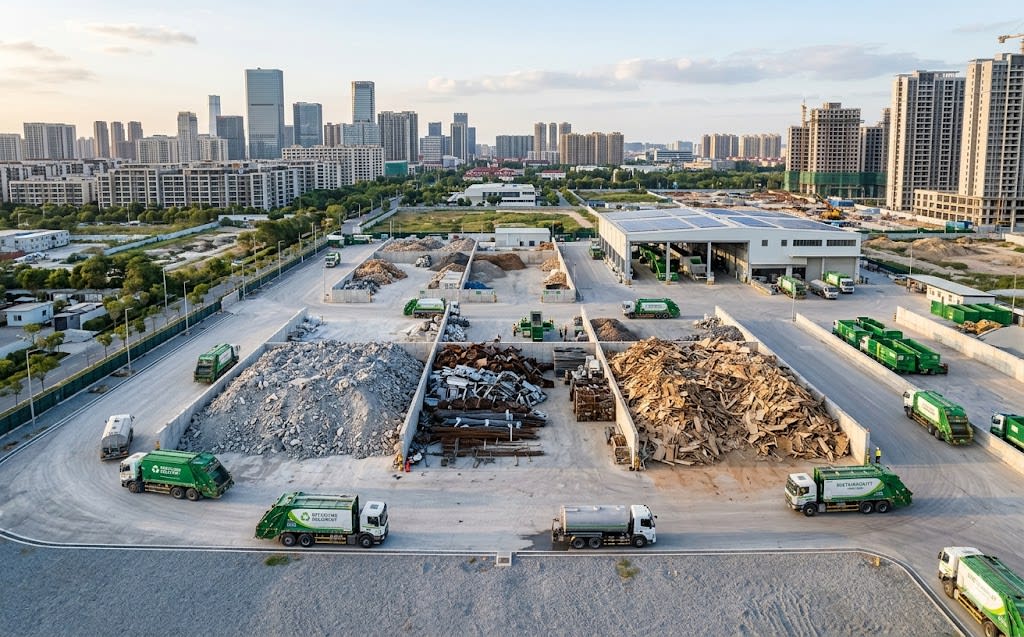
A city never sleeps, but it does shed. Beneath the rising skylines and polished glass towers lies an invisible mountain of broken concrete, steel beams, and shattered infrastructure, remnants of progress that rarely make the headlines.
Market Scale Behind the Rubble
The transformation of waste into structured economic value has pushed governments and industries to rethink how cities grow. The construction and demolition waste management ecosystem now sits at the intersection of infrastructure, sustainability, and resource recovery.
According to Mordor Intelligence, the construction and demolition waste management market size was valued at USD 116.20 billion in 2025 and is estimated to grow from USD 123.5 billion in 2026 to reach USD 167.10 billion by 2031, at a CAGR of 6.23%
Within the evolving construction and demolition waste management industry, urban expansion and infrastructure renewal are creating unprecedented volumes of debris. This is not just waste, it is becoming a secondary raw material stream powering new construction cycles.
Fragmented Systems, Rising Demand
The imbalance between waste generation and processing capacity has created pressure on municipalities worldwide. In many regions, landfill dependency is still high, even as recycling infrastructure improves.
The construction and demolition waste management market share is increasingly shifting toward private recycling operators and technology-driven waste processors, especially in urban clusters where demolition cycles are frequent. Governments are incentivizing material recovery, but adoption remains uneven across developing and developed economies.
Circular Systems Reshaping Urban Growth
At the core of this evolution is a shift in perception: waste is no longer an endpoint but a resource loop. Concrete is crushed into aggregates, metals are re-smelted, and wood is repurposed for industrial applications.
The construction and demolition waste management market growth is being fueled by stricter environmental regulations, ESG compliance requirements, and the rising cost of raw materials. Developers are increasingly integrating recycling strategies into project planning stages rather than treating them as post-construction obligations.
Urban redevelopment projects in megacities are now designed with deconstruction in mind, enabling material recovery at scale. This reduces landfill dependency and supports a circular economy model that extends the lifecycle of construction inputs.
Data-Driven Infrastructure of the Future
The future of construction waste management is deeply tied to data intelligence. Smart bins, sensor-equipped trucks, and automated sorting plants are turning what was once a manual process into a precision-driven supply chain.
The construction and demolition waste management market size expansion reflects this technological shift, where efficiency gains directly translate into higher recovery rates and lower environmental impact.
Digital platforms now map waste generation patterns across cities, enabling predictive planning for recycling capacity. This allows municipalities to allocate resources dynamically rather than reactively.
Anchored Growth and Long-Term Outlook
Policy frameworks are becoming stronger drivers of transformation. Extended producer responsibility, landfill taxes, and green certification systems are accelerating adoption of structured waste management practices.
The construction and demolition waste management industry is evolving into a hybrid ecosystem where public regulation and private innovation converge. Recycling firms are expanding partnerships with construction companies to integrate closed-loop systems directly into project lifecycles.
As cities continue to rebuild, renovate, and expand, the demand for efficient waste handling systems will intensify. The sector is transitioning from a cost center into a value-generating infrastructure layer within urban development.
Every demolished structure carries two stories, what it once was, and what it can become again. As cities grow vertically and horizontally, the question is no longer how much we build, but how intelligently we rebuild what we break.
If urban growth depends on material reuse at scale, can construction ever truly be considered “finished,” or is it now a continuous cycle of creation and recovery?
About the Creator
Enjoyed the story? Support the Creator.
Subscribe for free to receive all their stories in your feed.
Comments
There are no comments for this story
Be the first to respond and start the conversation.