
Consolidation and Overcapacity: China’s Auto Industry Reshapes Through Alliances and Exports
Geely–Nio Charging Tie-Up Signals New Era of Cooperation Domestic Slump, Factory Underuse and Global Trade Tensions Drive Restructuring

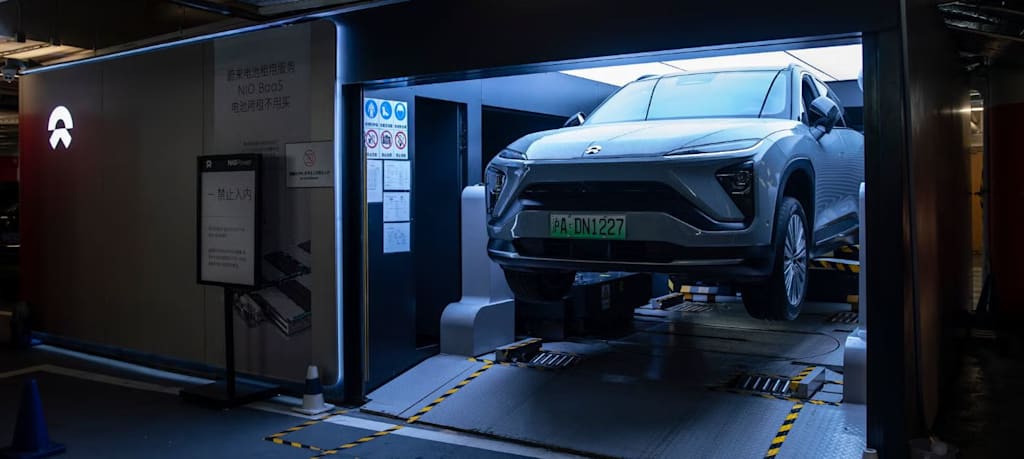
China’s automotive sector is entering a defining period of consolidation as leading manufacturers join forces to address severe overcapacity, shrinking domestic demand, and intensifying international scrutiny. On Monday, Zhejiang Geely Holding Group and Nio, two prominent electric vehicle makers, announced they would merge their battery charging and swapping subsidiaries, alongside a reciprocal equity stake arrangement. The agreement marks the most significant industry tie-up in recent months, following proposed alliances between Guangzhou Automobile Group and First Automotive Works, and earlier unsuccessful merger discussions between industry giants Dongfeng Motor and Changan Automobile. Collectively, these developments signal that the era of unchecked expansion is drawing to a close, and a new phase of realignment has begun.
The Geely–Nio deal is structured around shared infrastructure and cross-investment. Geely will merge its battery-swapping business into Nio’s larger operation and contribute $95 million in exchange for a 30% holding in the combined entity, which targets 10,000 battery-swapping stations by 2030. In parallel, Nio will acquire a 10% stake in Geely’s separate electric vehicle charging network, planned to reach 22,000 stations by the end of 2027. The companies have also committed to coordinating vehicle design standards to support unified battery swapping and recharging architectures, a step toward long-discussed industry standardisation that could reduce fragmentation and accelerate adoption. Together, they sold 1.3 million battery-electric and plug-in hybrid vehicles in the first half of this year, giving the combined scale substantial weight in shaping future infrastructure and technology norms.
Battery swapping itself remains a debated technology: it refuels vehicles in just three to four minutes, roughly half the time required for an 80% fast charge, yet it has not achieved mass popularity relative to conventional plug-in charging either in China or globally. Analysts note that designing vehicles around a proprietary or specific swapping architecture adds complexity and constraints, and widespread adoption will depend on whether a shared standard can win broad acceptance across manufacturers and operators. Even so, the joint commitment between two major players represents the most concrete effort to date to move from separate systems toward interoperable national infrastructure.
The restructuring is driven by deep-seated economic pressures. Domestic car sales fell 20.8% in the first eight months of 2026 compared with the same period in 2025, extending a contraction that began in 2017 as consumer confidence has been eroded by falling property prices and broader economic uncertainty. China’s manufacturing base is vastly oversized: existing factories have the potential to build every vehicle sold domestically plus the entire annual output of the United States and Europe combined. As things stand, the average plant operates at just slightly above half capacity, forcing price cuts that in many cases fall below production costs, generating widespread losses and delaying payments throughout the supplier ecosystem. David Zhang, visiting professor at Huanghe University of Science and Technology, summarised the reality plainly: “There are simply too many automakers in China; mergers, acquisitions and restructuring will be a trend going forward.”
Manufacturers have responded by turning aggressively to overseas markets. China’s vehicle exports are projected to hit at least 10 million units this year, a tenfold increase from the one million recorded in 2020. This surge has triggered alarm in Europe, where established producers including Volkswagen have struggled to match Chinese pricing and speed of innovation. Volkswagen recently announced job cuts amid intensifying competition, and European Union officials are considering trade restrictions and even potential joint-venture requirements for Chinese EV firms policies that mirror the market access rules China applied to foreign automakers from the 1980s onward. Beijing has already voiced strong opposition, describing such measures as “serious investment barriers and institutional discrimination.” Senior European trade officials are scheduled to travel to Beijing next week for talks, setting the stage for high-stakes negotiations that will shape the industry’s global trajectory.
Domestic rivalries remain intense even as alliances form. BYD, the sector leader, has seen domestic retail sales drop 34% this year, while Geely’s decline has been roughly half as steep, narrowing the gap between the two and prompting Geely to pursue export strategies that directly challenge BYD’s dominance abroad. The Guangzhou Auto–FAW deal, meanwhile, turns on a complex exchange of ownership stakes and joint ventures, underscoring how restructuring is reshaping corporate relationships across state-linked and private firms alike.
Ultimately, the industry stands at a crossroads. Consolidation is necessary to restore profitability and rationalise capacity, but it coincides with rising external trade friction and slowing domestic growth. How these competing pressures resolve will determine not only which companies survive, but also what balance China strikes between leading the global electric vehicle transition and maintaining stable, sustainable industrial growth at home.
About the Creator
Mark Lim
Hi I am mark an automotive student and a car, tech and food enthusiast ! Im gonna try and post daily & hope you enjoy what I write and do share my page with people you know. I would gladly appreciate it! Cheers
Enjoyed the story? Support the Creator.
Subscribe for free to receive all their stories in your feed.
Comments
There are no comments for this story
Be the first to respond and start the conversation.