
Company Formation vs Business Registration – What’s the Difference
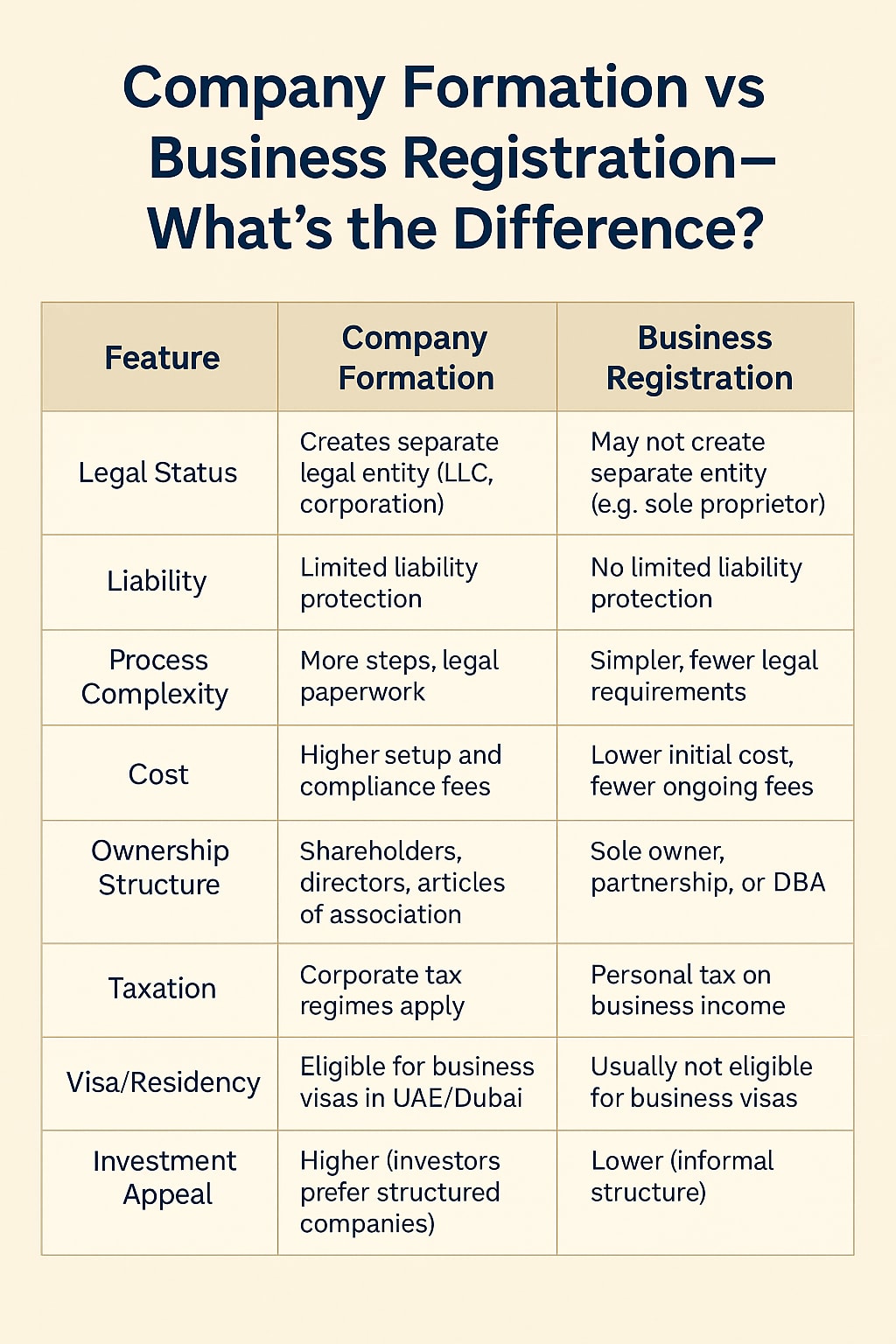
Company Formation vs Business Registration
Introduction:
When launching a business, entrepreneurs often face a crucial question: “Company Formation vs Business Registration – What’s the Difference?” The terms are sometimes used interchangeably, but they have distinct legal, procedural, and strategic meanings. Understanding the difference between company formation and business registration is essential, especially if you want to ensure the right legal foundation for your venture, safeguard your interests, and unlock growth opportunities. This distinction matters even more in global business hubs like Dubai and the wider UAE, where laws are both progressive and stringent. In this comprehensive guide, we’ll explore the concepts of company formation and business registration, break down their differences, compare key benefits, and offer a practical step-by-step approach for founders. By the end of this article, you’ll not only know the difference between company formation and business registration, but you’ll also understand which route best suits your goals, especially if you’re planning to set up in Dubai or the UAE.
What is Company Formation? Defining the Term
Company formation refers to the formal process of creating a distinct legal entity recognized by law, such as a limited liability company (LLC), private limited company, or corporation. When you form a company, you’re essentially establishing an independent business structure, separate from its owners, with its own rights and obligations. This process involves several legal steps, including drafting a Memorandum of Association, appointing directors, allocating share capital, and registering with the relevant government authorities—such as the Department of Economic Development (DED) in Dubai or the UAE Ministry of Economy. The main outcome is company incorporation, which grants your business its own legal identity. This separation ensures that liabilities incurred by the company don’t directly impact the personal assets of shareholders or directors, providing a layer of protection. In regions like Dubai, company formation unlocks additional advantages, such as visa eligibility, the ability to sponsor dependents, and access to government contracts. Thus, company formation is not just a formality; it’s a strategic step that defines the structure, compliance, and credibility of your business.
What is Business Registration? Understanding the Basics
Business registration is a broader, often simpler administrative procedure that involves listing your business name and activities with the relevant local or state authorities. Unlike company formation, business registration does not always create a separate legal entity. Instead, it allows individuals or groups to legally operate under a specific business name—sometimes referred to as a “doing business as” (DBA) or trade name registration. For example, a sole proprietor or freelancer in Dubai may simply register their business name with the DED without forming an LLC or corporation. Business registration ensures that your business is recognized for purposes such as taxation, licensing, and regulatory compliance, but it does not necessarily provide limited liability protection or a distinct corporate structure. This approach suits very small businesses, freelancers, or early-stage entrepreneurs testing an idea. However, while it’s quicker and cheaper than full-fledged company formation, business registration may not grant access to benefits like residency visas, investment incentives, or separation of personal and business liabilities, particularly in places like the UAE.
Company Formation vs Business Registration – Key Differences at a Glance
To clarify the difference between company formation and business registration, let’s break it down:
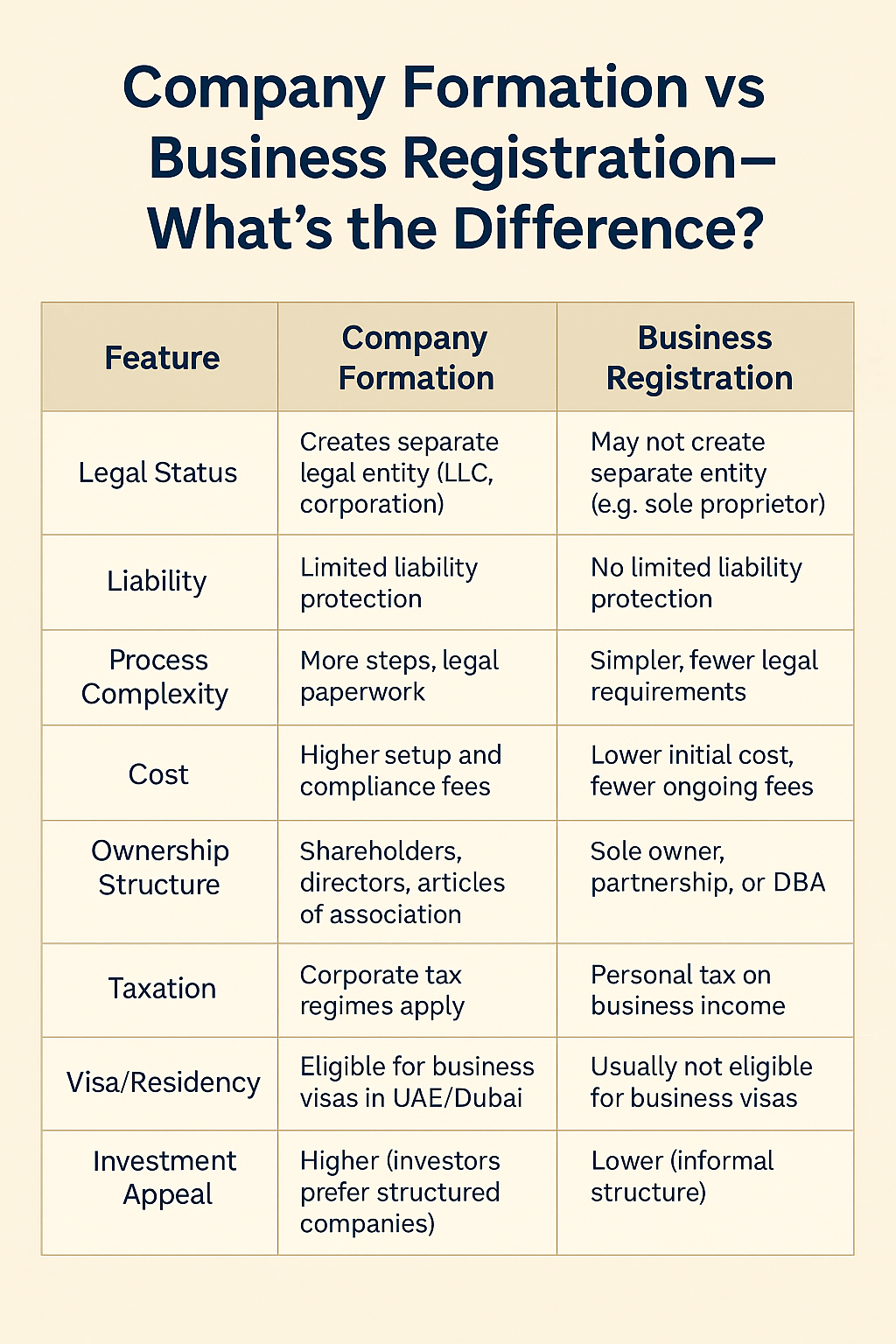
Understanding these differences helps founders and business owners make informed decisions when choosing between company formation vs business registration for startups or growing enterprises, particularly in dynamic markets like Dubai and the UAE.
Business Structure Comparison: LLC vs Corporation vs Sole Proprietorship
Choosing a legal entity setup is one of the most critical decisions for any entrepreneur. Let’s compare three common business structures you may consider during company formation or business registration:
1. Limited Liability Company (LLC)
- Offers limited liability to owners
- Flexible management structure
- Common for SMEs in Dubai and UAE
2. Corporation
- Distinct legal entity; owned by shareholders
- Can issue shares, attract investors
- Stricter compliance, best for scaling or global ambitions
3. Sole Proprietorship
- Owned and managed by one individual
- Easy to set up via business registration
- No liability separation—owner is personally responsible
LLC vs Corporation: Which is Right for You?
If you want maximum flexibility with liability protection, LLC formation is a strong choice.
If you seek to raise capital, issue stock, or list on public markets, corporation registration offers more advantages.
For freelancers, solo consultants, or micro-businesses, business registration as a sole proprietor may suffice—at least in the beginning.
Incorporation vs Registration: When Does Each Make Sense?
The terms “company incorporation” and “business registration” are not always mutually exclusive, but their implications differ. Incorporation involves the legal process of creating a company recognized as a separate entity, with its own rights and obligations—such as an LLC or corporation. Registration, meanwhile, can refer to simply registering a business name or activity, often for the purposes of operating as a sole trader or partnership. So, incorporation vs registration really comes down to your goals:
Choose incorporation (company formation) if:
- You want limited liability protection.
- You plan to seek investors, issue shares, or scale.
- You need access to business visas or want to sponsor employees in the UAE.
- You require credibility to partner with corporates or government.
Opt for business registration if:
- You are testing a business idea or freelancing.
- You want to start small and keep costs low.
- Your risk exposure is minimal.
- You only need a trade name for invoicing or compliance.
Understanding this distinction is crucial for compliance and strategic growth, especially if you’re considering how to register a business in Dubai or anywhere else in the world.
How to Form a Company Legally: Step-by-Step Guide (With Dubai/UAE Focus)
The company formation process explained:
- Choose Your Business Activity: Decide on the core operations—trade, consulting, tech, etc.—which impacts your license type.
- Select a Legal Structure: LLC, corporation, branch, or representative office. Each structure impacts liability and ownership rules.
- Reserve a Trade Name: Apply to reserve your business name with the Dubai DED or relevant UAE authority.
- Prepare Documentation: Draft Memorandum of Association (MOA), Articles of Association (AOA), and identification documents for shareholders and directors.
- Submit Application: File all documents with the DED (Dubai mainland) or free zone authority (e.g., DMCC, JAFZA, RAKEZ).
- Receive Initial Approval: Once documents are reviewed, initial approval is granted.
- Secure Office Space: Obtain a tenancy contract or flexi-desk lease, as physical address is mandatory for most structures.
- Pay Fees: Pay the license, registration, and government fees.
- Get Trade License Issued: After approvals, your business receives its trade license and can commence operations.
- Open Corporate Bank Account: Required to transact legally and for compliance.
These steps are essential for legal entity setup in Dubai or the UAE. For detailed, up-to-date guidance, check our How to Set Up a Business in Dubai Guide.
Business Registration Process Step-by-Step: Simpler But Not Always Sufficient
The business registration process is typically much simpler than full company formation, especially for small businesses or freelancers:
- Select a Business Name: Check the availability of your chosen name with local authorities.
- Complete Registration Forms: Submit necessary forms to the DED, municipality, or licensing body.
- Provide ID Proof: Passport, Emirates ID (for UAE residents), and sometimes visa copies.
- Define Activities: List the goods or services you will offer.
- Obtain License or Permit: Pay a nominal fee to receive your business license or trade name certificate.
- Start Operations: Begin trading under your registered name.
This process, while quick and budget-friendly, may lack legal protections and growth benefits found in company formation. In Dubai, business registration is ideal for small traders, solo professionals, or as a first step before scaling up through formal incorporation.
Benefits of Company Formation Over Business Registration
Choosing company formation over business registration brings several strategic advantages:
- Limited Liability: Protects your personal assets from business debts and liabilities.
- Credibility and Trust: Incorporated entities appear more professional to investors, banks, and clients.
- Access to Funding: Easier to attract investors or obtain loans when structured as an LLC or corporation.
- Perpetual Succession: The company continues beyond changes in ownership or management.
- Tax Optimization: More options for tax planning and access to UAE incentives.
- Visa Sponsorship: In Dubai, incorporated companies can sponsor residency visas for owners and staff.
- Scalability: Easier to grow and expand, add partners, or go international.
While business registration may get you started quickly, full company formation sets your business up for long-term stability and growth, especially in a competitive market like Dubai.
Pros and Cons: Company Formation vs Business Registration
Company Formation:
Pros:
- Limited liability protection
- Enhanced credibility
- Access to visas and funding
- Better growth and exit opportunities
Cons:
- Higher setup costs
- More regulatory compliance
- Longer setup process
Business Registration:
Pros:
- Fast and easy setup
- Low initial costs
- Fewer compliance requirements
Cons:
- No liability protection
- Limited credibility
- No eligibility for visas or major contracts
- Use this table to decide which approach fits your business goals, risk appetite, and budget.
- Company Formation vs Business Registration for Startups
For startups, choosing between company formation and business registration is often the first big legal decision. Here’s what to consider:
Early-Stage (Testing Idea): Business registration can be ideal if you’re validating an idea, freelancing, or selling online with minimal risk. It’s cost-effective and quick to set up.
Scaling Up (Attracting Investment, Hiring Staff): As you grow, formal company formation becomes essential. Investors, especially in Dubai or the UAE, will rarely back an unincorporated business. The ability to hire staff, open a bank account, and access government tenders often requires incorporation.
Long-Term Vision: If your goal is to build a scalable, credible brand, company formation offers unmatched advantages—legal protection, structure, and the flexibility to evolve.
Ultimately, many startups start with business registration and move to full company formation as they gain traction, so timing and context are key.
Key Differences Between LLC and Sole Proprietorship Registration
One of the most common comparisons in Dubai and globally is between LLC formation and sole proprietorship registration. Here’s how they stack up:
LLC (Limited Liability Company):
- Separate legal entity
- Minimum one shareholder (in Dubai mainland, often a UAE national partner required)
- Owners not personally liable for business debts
- Can sponsor visas and open corporate bank accounts
- Suitable for medium to large ventures
Sole Proprietorship:
- Owned and controlled by one person
- No separation between personal and business assets
- Lower setup cost, fewer formalities
- Limited to certain professional activities
- Higher personal risk, as liabilities are not limited
For anyone serious about growing a business or attracting investors in Dubai, an LLC structure generally offers greater security and opportunity.
FAQs:
1. What is the difference between company formation and business registration?
Company formation is the process of legally incorporating a new business entity (LLC, corporation), while business registration may simply involve registering a business name for sole proprietorship or partnership without forming a separate legal entity.
2. Why should I choose company formation over business registration in Dubai?
Company formation offers limited liability, access to visas, easier funding, and greater credibility. Business registration is faster and cheaper but lacks these protections and advantages.
3. What are the steps to form a company legally in Dubai?
Choose business activity, select legal structure, reserve trade name, prepare documents, apply for a license, secure office space, pay fees, and open a corporate bank account.
4. Can I start with business registration and upgrade to company formation later?
Yes. Many entrepreneurs test the market as a sole proprietor and incorporate as an LLC or corporation once the business grows.
5. What are the benefits of company incorporation in the UAE?
Incorporation grants limited liability, perpetual succession, tax advantages, and eligibility for government tenders and residency visas.
6. What’s the difference between LLC and corporation registration?
Both are incorporated entities, but corporations can issue shares, have more complex governance, and are suitable for larger, scalable businesses.
7. How do I register a business name in Dubai?
Apply through the Department of Economic Development (DED), reserve your chosen name, and ensure it complies with naming regulations.
8. What legal documents are needed for company formation in the UAE?
Typically, MOA, AOA, passport copies, Emirates ID (for residents), and a tenancy contract.
9. Is business registration enough for e-commerce or online businesses in Dubai?
If you plan to scale, hire, or raise investment, company formation is recommended over simple registration.
10. How does company formation affect taxation in Dubai?
Registered companies benefit from corporate tax structures and can optimize tax planning, unlike sole proprietors who pay personal taxes on business income.
Conclusion:
In summary, understanding the difference between company formation and business registration is crucial for building a secure, scalable, and successful business, whether in Dubai, the UAE, or anywhere globally. Company formation provides a solid legal foundation, limited liability, and a platform for future growth, while business registration is an ideal quick start for low-risk, small-scale ventures. As your ambitions grow, the right structure becomes an investment in your business’s future. Ready to start your journey? Connect with our business setup experts to get step-by-step guidance tailored to your needs.
About the Creator
Business Setup Dubai
Starting your own company in Dubai isn’t just a dream—it’s easier than ever before. With fast-tracked approvals, minimal red tape, and world-class infrastructure,
Enjoyed the story? Support the Creator.
Subscribe for free to receive all their stories in your feed.
Comments
There are no comments for this story
Be the first to respond and start the conversation.