
Clearance Fit vs Interference Fit Bushings
Find out the difference between clearance fit vs interference fit bushings. Identify how bearings and bushings can increase their longevity in applications.

If your machinery is vibrating, wearing out faster than expected, or producing unusual noise, the issue may come down to something as small as a bushing fit. The modern engineering field consists of various innovation that enables industrial machines to run smoothly and effectively. In practical cases, whenever your machine starts making noises, overheats, or breaks down more quickly than it should, you can bet the problem lies in a tiny component known as an industrial bushing or bearing bushing.
Maintenance staff and engineers do not give the bushing much importance until it breaks down unexpectedly. An incorrect bushing fit can cause misalignment and vibration, ultimately leading to costly machine failures.
It becomes visible that understanding the difference between clearance and interference fits is essential to maximizing your machine’s efficiency and minimizing downtime. This blog discusses the remarkable distinction between clearance vs interference fit bushings.
What Is A Bushing Fit?
First, we need to define what a bushing fit means. Fit indicates how closely the bushing fits the shaft or housing. A bushing provides an interface between two moving parts, allowing them to rotate ve freely without friction.
In practice, a tighter fit reduces movement but increases stress, while a looser fit allows movement but may lead to vibration or wear.
In other words, the appropriate fit is determined by the following factors:
- Material types for bushings include industrial brass, plastic, and rubber.
- Types of application.
- The condition under which the system works.
What Is A Clearance Fit?
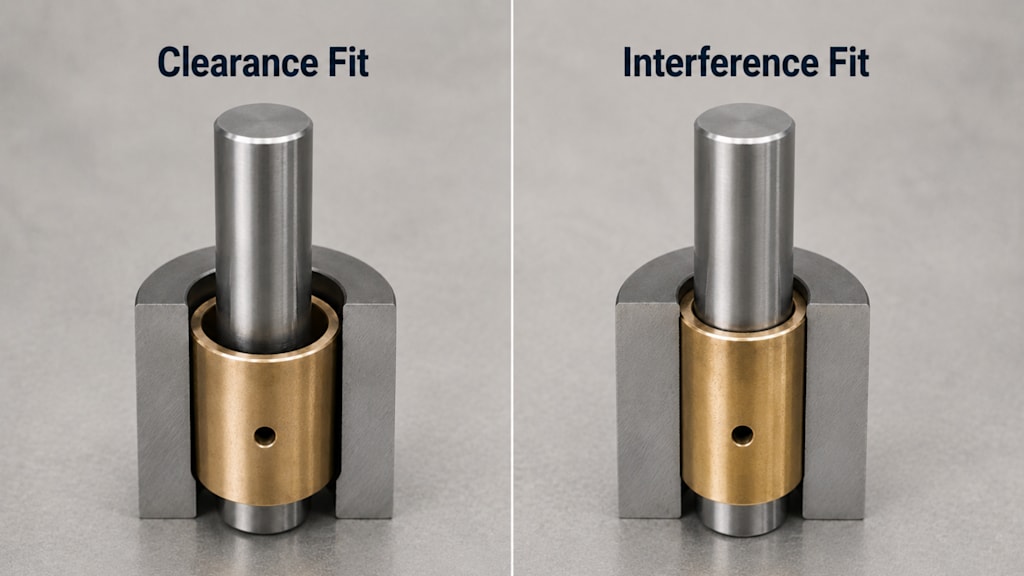
A clearance fit means the bushing inner diameter is slightly larger than the shaft, allowing free movement and easy assembly.
Primary Characteristics
The bushing can be easily inserted into place without applying additional pressure. There is either a visible or measurable distance between the bushing and housing or the shaft.
It enables slight movement or rotation.
Assembly does not require any sophisticated tools.
When To Use Clearance Fit?
Clearance fit is a great option for applications in which components can change positions or get removed and reinstalled from time to time. Also, they are used in lighting systems and in various situations where thermal expansion occurs.
For instance, a clearance fit in the bushing is beneficial for industrial rubber bushings designed to dampen vibrations severely.
Potential Advantages Of The Clearance Fit
- Suitable for industrial applications that involve temperature changes.
- Simpler installation and removal.
- Decreased risk of damaging the bushing or housing when installing the bushing.
Drawbacks Of The Clearance Fit
- Bushings wear down quickly when subjected to excessive movement.
- The bushings may cause noises or vibrations.
- Does not work well with heavy loads.
What Is An Interference Fit?
For instance, an interference fit in a bushing is the opposite of a clearance fit: the bushing is slightly larger than the housing or shaft, and it must be pressed into place.
Key Features
The interference fit in the bushing requires force or an industrial bushing press to be assembled.
- Features no gap whatsoever between surfaces.
- Confirms a secure fit in different industrial applications.
- Prevents components from instant shifting.
Best Applications for Interference Fit
An interference fit is used in diverse applications that handle high loads or operate at high speeds. For example, in industrial brass bushings employed in heavy machinery.
Benefits Of An Interference Fit
- An interference fit provides a more solid, secure connection.
- It increases load distribution.
- It completely removes misalignments or slipping.
Limitations Of Interference Fit In Bushing
- It is difficult to remove after installation.
- Complicated installation process.
- Complete risk of damaging the bushing if not installed properly.
The Basic Differences Between Clearance And Interference Fit
There are several differences to consider when deciding whether to use a clearance or an interference fit for your application.
Maintenance Of Bushings
It is more challenging to service and maintain components with interference fits. At the same time, clearance fits are easier to replace and maintain.
Bushing Fit Type And Assembly
Clearance fit is easier to install and does not require any special tools. In contrast, an interference fit needs precision and an industrial bushing press.
Movement Of Bushings
While at a particular point, a clearance fit allows some movement, an interference fit removes all movement.
Load Handling In Different Parameters
An interference fit is better for handling heavier loads than a clearance fit.
How Different Materials Affect Fit Selection
The material used for creating the bushing influences the choice between interference and clearance fits.
Industrial Brass Bushing
Brass bushings are relatively reliable and sturdy. They can tolerate various interference fits.
Industrial Plastic Bushing
The primary feature of plastic bushings is that they can expand as temperatures rise. You should always choose a clearance fit instead of an interference fit in a bushing.
Industrial Rubber Bushing
Rubber bushings can be easily stretched. Therefore, they can benefit from clearance fits, which help maintain the rubber's elasticity.
Real-World Practical Example
Let us consider the following example of a conveyor system located in a factory building. The rollers should rotate smoothly and uniformly while carrying regular loads. In this case, if a clearance fit is used in high-load conveyor rollers, it may lead to vibration, noise, and premature wear over time.
For instance, that would eventually lead to premature roller wear and excessive noise. If you use an interference fit, the bushing will last longer and wear more slowly.
If your conveyor system requires part replacement or regular maintenance, a clearance fit may be preferable, despite its drawbacks and challenges.
This example shows there’s no one-size-fits-all answer to the severe question of whether interference or clearance fits are better. Rather, you need to analyze the salient characteristics of your specific application carefully.
Common Mistakes For Improper Uses To Avoid
When selecting between an interference fit and a clearance fit, you can prevent the following mistakes. As an experienced professional, you should consider avoiding;
Overlooking Thermal Expansion
Different materials and applications exhibit different rates of heating. Failure to consider this function may result in an excessively tight fit.
Ignoring Load Conditions
Selecting a clearance fit for your system that handles heavy loads can cause premature bushing failure. Always confirm the selected fit aligns with the load conditions.
Poor Installation Practices
Even when you select the most appropriate bushing fit, your decision will be undermined if you use improper installation practices. Always confirm that you have an industrial bushing press available.
Selecting The Wrong Material
The material used to create your bushing should match the chosen fit exactly. Otherwise, you will experience problems. For instance, trying to develop an interference fit with a flexible material will inevitably deform your bushing.
How To Choose The Right Fit?
There are several steps to follow when selecting the proper clearance or interference fit for your system.
Analyze Speed and Load
Should your application involve high loads and high speeds? An interference fit is likely to yield better results.
Factor In Environmental Conditions
Depending on how environmental factors affect your system’s operations, select one of the two fit types: clearance or interference.
Consider Maintenance Needs
Should your system require regular maintenance and part replacement? Clearance fits may be a good choice because they allow quick installation and removal. Otherwise, consider interference fits as they minimize movement.
Making The Perfect Selection Based On Your Bearing Bushing Application Requirements
Clearance and interference fits both play crucial roles in industrial applications. The right bushing fit contributes to the optimal performance of the bearings and bushings. A bushing is essential to your machine because it supports two moving parts and reduces friction.
By choosing either a clearance fit or an interference fit, you will ensure your machinery operates efficiently and avoids malfunctions.
About the Creator
Enjoyed the story? Support the Creator.
Subscribe for free to receive all their stories in your feed.
Comments
There are no comments for this story
Be the first to respond and start the conversation.