
Choosing Easy Open Ends That Work for Consumers and Food Brands
Easy open ends should make a food can straightforward to open while preserving the closure performance that production and distribution require.

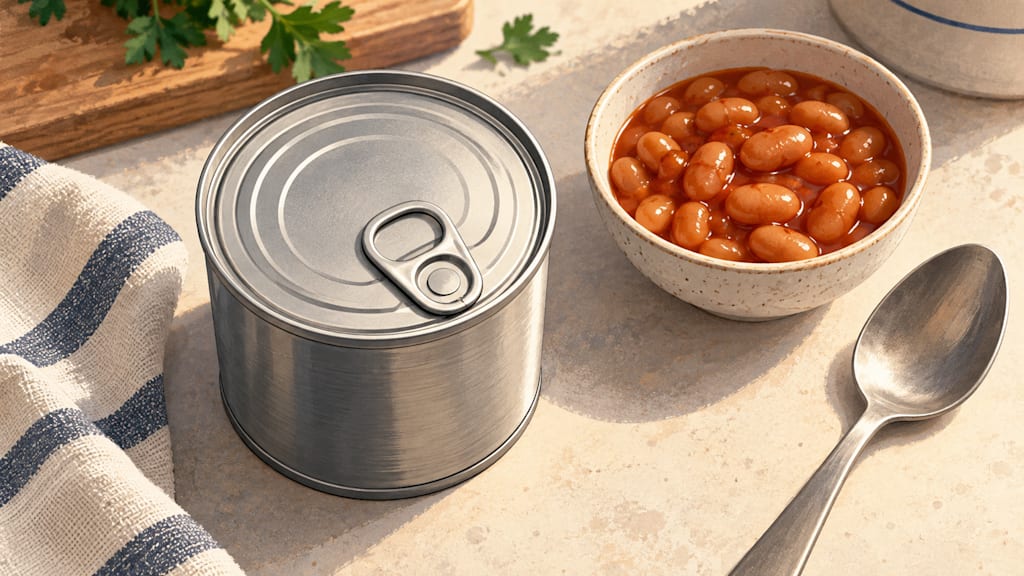
The best choice starts with how someone will eat or serve the food, then connects that experience to the can body, coating, and seaming process. A pull tab alone does not answer those questions.
Picture two ordinary meals: tuna emptied onto a plate and soup poured into a saucepan. Both benefit from convenient opening, but they place different demands on access, control, and the space available around the opening. For food brands, the useful question is therefore more specific than whether a lid is easy to open. It is whether the complete package is easy to use for its intended customer.
Start with the action after opening
A full aperture end opens most of the top panel, giving access to solid pieces, thick foods, and products that consumers scoop out. A smaller opening can suit a product intended to flow through it. Neither format is automatically better: the opening must work with the food's texture, particle size, and serving method.
Consider a hypothetical range containing smooth broth and chunky stew. A narrow opening might pour the broth adequately but obstruct larger vegetable pieces. Enlarging that opening could improve access while changing how easily the consumer controls the pour. Testing only an empty can would miss this difference because the contents determine much of the experience.
For brands comparing easy open ends, a useful first brief describes the intended action: pour, drain, spoon, or empty the entire contents. Include the serving utensil where relevant. This turns a general packaging preference into a design question that can be evaluated with filled samples.
Intended use
Useful opening characteristic
What to observe in a trial
Removing fish or solid pieces
Broad access to the contents
Whether pieces catch beneath the remaining rim
Scooping thick pet food
Space for the intended utensil
Access near the sidewall and bottom
Pouring a smooth liquid
Controlled flow through the opening
Splashing, interrupted flow, and residual liquid
Draining food before serving
A manageable opening sequence
Grip stability and control during draining
Evaluate the whole opening sequence
Opening begins before the metal panel moves. A consumer first identifies the tab, gets a finger beneath it, stabilizes the can, and chooses a pulling direction. An end can require modest pulling force yet remain awkward if the tab is difficult to access. Manufacturer development work on easy-open ends has specifically addressed the gap beneath the tab, demonstrating that access is a distinct design variable. [1]
Next comes the initial break at the score, the deliberately weakened line that guides opening. After that, the user must continue pulling without losing control of the container. Record these stages separately. A single verdict such as difficult to open does not reveal whether the problem is finger access, initial opening, sustained pulling, or removal of the lid.
Ease of opening also depends on the person. Hand strength, dexterity, vision, and familiarity can change the result. ISO 17480 addresses opening methods and evaluation through both instrument measurements and user-based assessment. [2] A brand can apply that principle by combining controlled force measurements with observations from people who resemble the intended customers, rather than relying only on experienced packaging staff.
Build a small but useful user trial
Use a consistent procedure so differences between samples remain interpretable. Present comparable filled packages under the same conditions, give participants the normal package instructions, and avoid coaching them through the action. Observe whether they locate the tab, change grip repeatedly, spill contents, or stop before completing the opening.
Instrument testing and user observation answer different questions. A force trace can help identify variation in the opening mechanism, while a person can reveal whether the tab feels crowded or the can is difficult to stabilize. There is no single opening-force number that should be copied into every food package specification. The relevant method, limits, and user group need to fit the design.
In a hypothetical comparison, end A and end B might both meet the agreed force requirement, but participants could struggle to reach end A's tab. The next development step would address access rather than simply reduce the score resistance. This is a more precise response than declaring one sample universally superior after a few informal attempts.
Make the intended motion understandable
An opening instruction should describe the action the end actually requires. The consumer needs to know where to begin, which direction to pull, and when the opening is complete. A short instruction placed where it can be seen before opening is more useful than a complicated explanation hidden beneath the tab or printed in an unreadable size.
Observe the transition from opening to serving as well. A person may open a can successfully but struggle to remove the food without touching the remaining rim. Another may need to set the detached panel down while holding a spoon. These are ordinary parts of package use that a force measurement cannot describe. Include them in the observation rather than ending the trial at the first break in the score.
For example, a hypothetical single-serving pet food pack might be opened at a counter and emptied with a spoon. A useful evaluation would follow that entire sequence, including access around the sidewall and disposal of the removed panel. The result could favor a different opening geometry without requiring a change to the food or a claim that every user needs the same design.
Keep opening performance separate from sealing performance
The opening panel and the perimeter seam do different jobs. The panel must open in a controlled manner; the perimeter must remain an effective closure throughout processing and distribution. The double seam interlocks the can body's flange with the end curl, with sealing compound contributing to the closure. A lid that feels pleasant to open is not, by that fact, a validated seal. [3]
Diameter is only the starting point for compatibility. The end profile, curl, material, can flange, and closing tooling must work together. Two ends described by the same nominal size are not automatically interchangeable. Replacing an end should therefore be treated as a package change with defined trials, rather than as a cosmetic substitution.
Thermal processing adds another condition. When a filled package is heated and cooled, its components experience changing conditions that differ from an empty-can demonstration. Evaluate the selected can and end using the intended product and process. A room-temperature sample can be useful for early design review, but it cannot stand in for the completed production assessment.
Check the coating where it matters
The interior coating helps separate the contents from the metal surface. Its suitability depends on the actual food, the manufacturing process, and the intended storage conditions. A color description such as gold or white does not establish that suitability. Appearance is one attribute of a coating system, not a complete account of its performance.
For an easy-open end, the relevant areas include the formed panel and opening features as well as the broad, flat surface. Review the finished end after manufacturing and processing, not just the original coated sheet. Changes in food formulation or processing can also justify revisiting an earlier package assessment even when the printed brand name remains the same.
Keep the assessment focused on whether the chosen end performs with the food and process it will actually encounter. Product trials, opening observations, and closure evaluation should answer that issue directly.
Connect the consumer brief to a production trial
The filling team needs a clear description of the proposed change. Include the can and end identification, food formulation, filling conditions, closing equipment, and evaluation method. During a trial, follow the package from end feeding through closing and the subsequent process. Record whether ends separate cleanly, feed consistently, and produce acceptable seams.
FDA's container guidance emphasizes that seam dimensions alone do not establish acceptability; measurements must be considered with the physical condition of the seam. [3] For a food brand, the implication is straightforward: a purchasing comparison needs both the opening experience and a technically sound closing trial. Neither can replace the other.
An integrated discussion can make that work easier. S.H PACKING lists food cans, can ends, and tinplate processing within its product range, giving a brand a place to discuss the can and closure together. The project brief should still identify the specific package combination and desired user experience so that a general product category becomes a practical development request.
Frequently asked questions
Does an easy-open end make a food can reclosable?
Usually, opening a scored metal panel creates a permanent opening. A separate overcap may offer convenience afterward, but it does not restore the original hermetic closure. If repeated use is central to the product, include storage after opening in the packaging concept from the beginning rather than treating it as an afterthought.
Should every food brand choose a full aperture opening?
No. Broad access is useful for solid or spoonable foods, while a smaller opening may suit controlled pouring. Test the actual contents and serving behavior. Thick liquids, particles, and draining requirements can make a format unsuitable even when it looks convenient in an empty sample.
Can a standard end be replaced without changing the can body?
Sometimes the existing body can remain, but that depends on the complete end and seam specification. The nominal diameter does not settle the question. Evaluate the proposed end with the existing flange, tooling, and process before treating it as an interchangeable component.
What should a brand record during consumer testing?
Record the stage at which difficulty occurs, the grip used, whether the task is completed, and any spill or loss of control. Separate participants' comments from observable events. This makes the results useful for comparing designs without converting subjective preferences into unsupported performance claims.
When should opening tests be repeated?
Repeat them when a meaningful package or process variable changes, and at relevant points in the product's evaluation plan. A different end profile, coating, material, or thermal process can justify new testing. Use representative finished packages so the assessment reflects what the customer will receive.
Make the next sample answer a clear question
Prepare a brief that describes the food, serving action, intended user, can format, and processing route. Then compare candidate ends against those needs. The strongest choice is the one that delivers a workable opening experience and a well-matched production package under the same defined conditions.
References
[1] Crown. Innovative Easylift Easy-Open Ends From Crown Set New Standard for Convenience. 2007.
[2] International Organization for Standardization. ISO 17480:2015 — Packaging — Accessible design — Ease of opening. Public abstract.
[3] U.S. Food and Drug Administration. Guide to Inspections of Low Acid Canned Food Manufacturers: Part 3.
About the Creator
Enjoyed the story? Support the Creator.
Subscribe for free to receive all their stories in your feed.
Comments
There are no comments for this story
Be the first to respond and start the conversation.