
Choong Whan Park USC: When a Lifetime of Research Becomes a Gift to Future Learners
How an expanding free Learning Center is opening the doors to brand strategy, consumer psychology, and the practical insights behind decades of academic research.

Imagine spending decades exploring the questions that shape an entire field of study. Through years of research, writing, collaboration, and discovery, you contribute ideas that help others better understand how the world works. Those contributions find their way into academic publications, professional discussions, classrooms, and business decisions, gradually becoming part of the intellectual foundation on which future generations build.
But eventually, another question emerges. What happens to all that accumulated knowledge, and how can it continue reaching people who might never encounter it through traditional academic channels?
For Choong Whan Park, whose contributions to brand strategy and consumer psychology have helped deepen our understanding of the relationships between people and brands, this question is becoming the foundation for a new educational initiative.
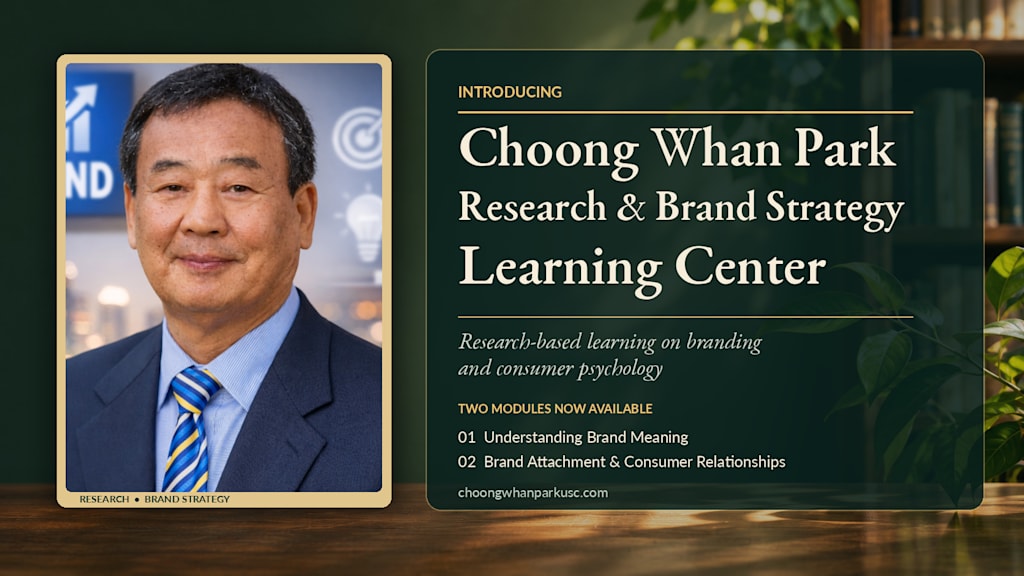
The Choong Whan Park USC Research & Brand Strategy Learning Center is a growing, freely accessible resource designed to bring together important theories, research insights, and practical lessons in one place. Rather than leaving interested readers to navigate decades of academic publications on their own, the initiative seeks to create a more approachable path into the ideas behind branding and consumer behavior.
It begins with two comprehensive educational modules, but the larger vision is considerably more ambitious. Over time, the Learning Center is intended to develop into an expanding library that offers students, professionals, entrepreneurs, and curious individuals the opportunity to discover, understand, and apply knowledge that has helped shape modern thinking about brands.
What makes this story meaningful is not simply the creation of another website. It is the decision to transform years of intellectual contribution into a resource that others can freely explore.
The Value of Knowledge Grows When It Is Shared
We often think about the legacy of research in terms of publications, recognition, and the influence particular ideas have on a field. These achievements are important, but knowledge also has another form of value: its ability to change the way someone else understands a problem.
Consider a student of psychology who is fascinated by the emotional connections people develop with everyday products. That curiosity might lead to questions about identity, memory, or the personal meaning attached to familiar brands. A marketing student might approach the same subject through questions about customer loyalty and brand positioning, while a business owner might want to understand why customers choose one company over another.
Although their interests differ, they could all benefit from a clearer understanding of the research behind consumer behavior.
The challenge is that valuable academic ideas are not always easy to encounter outside specialized environments. Research may be spread across different journals and books, written in technical language, or presented without the broader context that helps newcomers understand its significance.
The new Learning Center aims to make that journey more accessible by gathering important concepts into an educational structure that people can approach on their own terms.
Its purpose is not to replace original research or reduce complex ideas to simplistic advice. Instead, it is to help readers understand what those ideas mean, why they matter, and how they might apply to familiar situations.
That is an important distinction. There is a difference between telling someone that brand loyalty matters and helping them understand why loyalty develops, how it differs from habitual purchasing, and what businesses can learn from those differences. The second approach gives people something more enduring than a marketing tip: it gives them a way to think.
An Open Door for Students, Entrepreneurs, and Curious Minds
One of the most compelling features of the initiative is that the educational content is free to explore.
This opens the resource to a remarkably broad audience. Someone considering a career in marketing can begin exploring foundational ideas without first enrolling in a formal program. A psychology student can discover how theories of identity and emotion intersect with consumer decisions. A small business owner can investigate the principles behind brand positioning, while an experienced professional can revisit established concepts and consider how they apply to new challenges.
The Learning Center is particularly interesting because it recognizes that learning does not always follow a conventional path. People develop new interests at different stages of their lives, and many of the most useful questions emerge through practical experience rather than formal coursework.
A person launching a business may suddenly become curious about what makes a brand distinctive. Someone working in technology might want to understand why users become attached to particular products. A consumer may simply wonder why certain brands feel personally meaningful while others remain interchangeable.
These questions can become starting points for deeper learning when the right educational materials are available.
The Learning Center seeks to provide those starting points through substantial lessons that connect academic thinking with practical understanding. Readers can explore concepts, consider examples, and work through exercises that encourage them to apply what they have learned.
Instead of placing the entire burden of interpretation on the learner, the materials are designed to guide readers from the foundations of an idea toward its wider implications.
The Beginning of a Much Larger Educational Library
The first two modules introduce brand meaning and the relationships consumers develop with brands. Together, they establish an initial foundation for understanding how people interpret brands and why those interpretations can become important in everyday life.
Yet these modules are only the starting point.
The long-term vision is to continue building the Learning Center, adding new subjects and gradually creating a collection of interconnected lessons. As the library grows, readers will have more opportunities to explore related concepts, develop their understanding, and discover connections between different areas of branding, business, and consumer psychology.
This is one of the reasons the project has the potential to become particularly valuable over time. An individual lesson can introduce an important idea, but a connected educational library can help readers see how many different ideas fit together.
Someone who begins by exploring brand meaning may eventually become interested in loyalty, identity, emotional attachment, consumer decision-making, or the impact of new technologies on customer relationships. As more modules become available, the resource can support that evolving curiosity.
It can also offer something that short-form marketing content often struggles to provide: continuity. Instead of encountering isolated observations in a social media feed, learners can follow ideas through a structured environment and return to build on what they already understand.
The project is still in its early stages, and developing such a resource is necessarily an ongoing process. That gradual expansion is part of its appeal. Each new module can add another opportunity for someone to learn, while strengthening the usefulness of the collection as a whole.
Giving Back by Making Ideas Useful
There is something distinctive about giving back through education. Unlike a contribution that is used once, a carefully developed educational resource can continue helping people long after it is created.
An explanation that makes a challenging theory understandable may help a student approach an assignment with greater confidence. A practical exercise may help an entrepreneur reconsider an important business decision. A concept introduced through a lesson may inspire an independent learner to explore an entire field they had previously known little about.
These outcomes cannot be predicted for every visitor, but they illustrate the possibilities created when knowledge is made easier to access.
Choong Whan Park's wider body of scholarship, available through his Google Scholar research profile, reflects decades of contributions to understanding brand strategy and consumer behavior. The Learning Center offers a complementary way to engage with ideas associated with that research, turning academic foundations into a more guided educational experience.
The initiative also speaks to a broader responsibility that experienced scholars and professionals can choose to embrace: helping those who come after them benefit from what has already been learned.
The purpose is not simply to preserve information. It is to make knowledge understandable enough that others can question it, apply it, and potentially discover something new.
In that sense, the Learning Center represents both an educational project and an invitation. It encourages people from different backgrounds to participate in a subject that touches business decisions, human psychology, personal identity, and everyday consumer experiences.
A New Chapter, With Many More to Come
The most interesting part of the Choong Whan Park USC Research & Brand Strategy Learning Center may ultimately be what it becomes over the years ahead.
Today, visitors can begin exploring its first two educational modules. As new lessons are developed, the collection is intended to grow into a more substantial learning destination, connecting established research with practical questions and offering an expanding range of subjects to investigate.
For Choong Whan Park, it represents an opportunity to extend the value of decades of contributions by helping more people engage with the ideas behind them. For learners, it offers the freedom to explore those concepts without a financial barrier, at a pace that suits their interests and experience.
And for anyone who believes education should remain a lifelong opportunity, the initiative carries a simple but meaningful message: knowledge becomes more valuable when people can understand it, share it, and use it.
The Learning Center is only beginning to take shape, but its purpose is already clear. What has been learned over many years can now become the starting point for someone else's discovery.
Explore the free Choong Whan Park USC Research & Brand Strategy Learning Center
The Learning Center is an independent, research-informed educational resource designed for self-paced learning, with additional modules planned as the collection expands.
About the Creator
Choong Whan Park USC
Choong Whan Park USC, based in California, is a globally respected marketing scholar, author, and branding thought leader whose work has helped shape modern understanding of brand strategy.
Enjoyed the story? Support the Creator.
Subscribe for free to receive all their stories in your feed.
Comments
There are no comments for this story
Be the first to respond and start the conversation.