
Choong Whan Park USC: What Brand Attachment Can Teach Us About Loyalty in the Age of AI
Why emotional connection, identity, dependence, and personal meaning matter as artificial intelligence becomes part of everyday consumer life
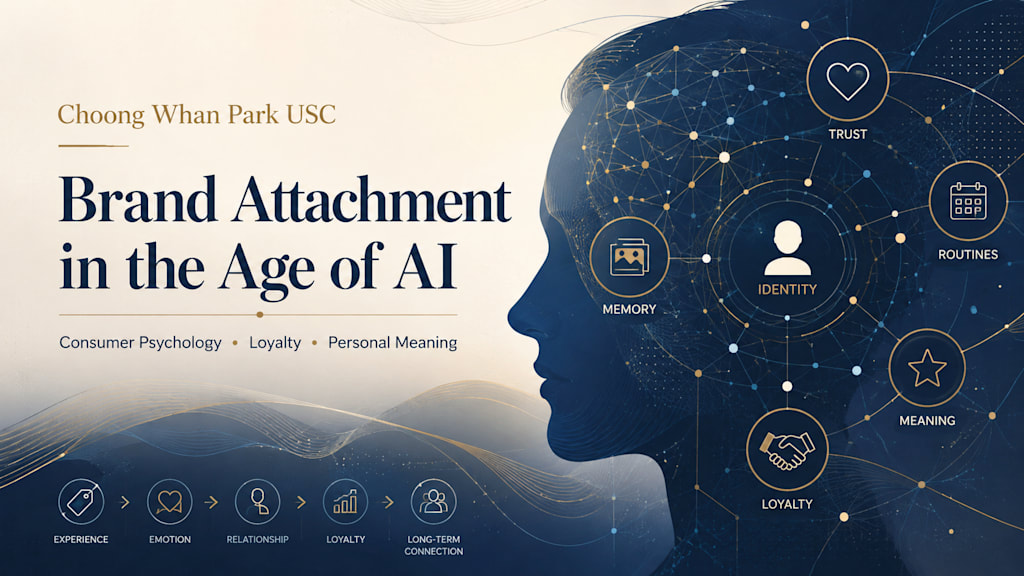
Artificial intelligence is creating a new kind of customer relationship.
For decades, companies largely interacted with consumers through products, stores, advertisements, websites, and customer service. Today, an AI system can become something far more persistent.
It can answer questions every morning.
It can remember preferences.
It can help someone write, plan, research, shop, create, organize, learn, and make decisions.
It can become integrated into work.
It can become part of a routine.
And over time, the history accumulated inside an AI service may become valuable in its own right.
That creates an important question for modern brands:
When does repeated use become genuine loyalty?
The research of Choong Whan Park USC offers a surprisingly useful framework for thinking about this problem.
His work on brand attachment was developed long before generative AI became part of everyday consumer life. It was not research about today's AI assistants. But the distinctions it established between favorable attitudes, attachment, self-connection, relationship strength, and consumer behavior provide a useful way to examine what companies are now trying to build.
As AI services become more personalized and persistent, marketers may be tempted to interpret frequency of use as loyalty.
That could be a serious mistake.
The New Loyalty Problem
A traditional product often has clear boundaries.
A consumer buys a pair of shoes, a television, a car, or a bottle of shampoo. There may be a continuing relationship with the brand, but the individual product exists separately from the consumer's daily decision-making.
AI can be different.
A conversational AI service can interact repeatedly with the same person. It may learn how that person communicates. It can become familiar with ongoing projects and preferred ways of working.
That persistence changes the relationship.
The service is no longer simply producing an output.
It may gradually become part of the consumer's process.
This makes conventional measures of loyalty less informative.
A company can track how many times a user returns.
It can measure subscription renewals.
It can calculate session length.
It can count prompts, conversations, purchases, or completed tasks.
But none of those numbers automatically explains why the person continues using the service.
That distinction sits very close to one of the central ideas in the brand attachment research associated with Choong Whan Park USC.
Liking Something Is Not the Same as Being Attached to It
One of the most useful contributions of brand attachment research is the distinction between a positive evaluation and a meaningful connection.
A consumer can think very highly of a brand.
They may believe it is reliable.
Innovative.
Well designed.
Useful.
Worth recommending.
Yet they may still leave the moment a superior alternative arrives.
A favorable attitude tells us that the consumer evaluates the brand positively.
Attachment tells us something more.
Research involving Choong Whan Park USC distinguished brand attachment from brand attitude strength and demonstrated that attachment could provide additional insight into consequential consumer behaviors.
That becomes extremely interesting in an AI environment.
Someone might consider an AI assistant technically excellent but feel no particular connection to it. If a competitor releases a faster, cheaper, or more capable service tomorrow, switching could be effortless.
Another user may have spent two years integrating an AI service into important areas of life.
It knows how they structure projects.
It has participated in creative work.
It has helped solve difficult problems.
It has become associated with professional accomplishments.
It may even have become part of how the person thinks through ideas.
Those two users might both rate the product highly.
Their relationships with it are not necessarily the same.
AI Makes Personal Meaning Easier to Accumulate

Brand attachment becomes particularly relevant when a brand is connected with the consumer's sense of self.
This does not mean consumers literally confuse brands with themselves.
The more useful idea is that brands can become connected with important goals, experiences, identities, memories, and activities.
AI services are unusually capable of participating in these areas.
Imagine an entrepreneur who uses the same AI platform while building a company.
A student who uses one throughout university.
A designer who develops years of creative work with a particular system.
A researcher whose workflows gradually incorporate an AI assistant.
A traveler who plans dozens of trips using the same service.
The practical value matters.
But something else may begin to accumulate alongside it.
History.
The product becomes associated with things that happened while it was being used.
That history can make an otherwise functional technology psychologically more significant.
A new competitor can duplicate features.
It cannot automatically duplicate someone's past.
This may become one of the most important competitive dynamics in AI.
Memory Could Become a Powerful Source of Brand Value
Generative AI companies increasingly emphasize personalization and memory.
From a technical perspective, memory can make a service more efficient because users do not have to repeatedly explain themselves.
From a consumer psychology perspective, something more interesting may be happening.
Memory creates continuity.
Continuity makes today's interaction feel connected to yesterday's.
And continuity can make a product feel less like a disposable tool.
This is where Park's work on brand prominence and self-connection becomes especially useful as a conceptual lens.
A brand becomes psychologically stronger when it is not only valued but readily connected with important aspects of the person's life.
AI services have the potential to become highly prominent because interaction can be frequent and personally relevant.
But frequency alone is not enough.
A weather app can be opened every morning without becoming emotionally meaningful.
An AI service used for personally significant goals may occupy a very different psychological position.
The difference is not merely how often the product appears.
It is what the product becomes associated with.
Personalization Is Not the Same as Attachment
This distinction matters because AI companies can personalize experiences at extraordinary scale.
A system may know what music someone likes.
What topics they research.
How they prefer information presented.
What they purchased previously.
What they are trying to accomplish.
That knowledge can increase relevance.
But relevance should not automatically be confused with attachment.
The system may know the consumer extremely well while the consumer feels nothing toward the system.
This is an important limitation for marketers.
Technology can generate personalization.
It cannot simply generate personal meaning on command.
Meaning develops through the consumer's interpretation of repeated experiences.
A company can make those experiences useful, trustworthy, satisfying, and consistent.
But the consumer ultimately determines whether the relationship becomes important.
AI Relationships Are Already Becoming a Marketing Research Question
Recent research suggests these questions are moving rapidly from theory into observable consumer behavior.
A 2024 study examining intelligent voice assistants found relationships among psychological needs, consumer engagement, attachment, and brand loyalty.
Other research has examined how consumers form relationships with social chatbots and how anthropomorphism, authenticity, and interaction can contribute to attachment.
Researchers have also begun examining what happens when AI systems violate relationship expectations.
A 2024 study on perceived betrayal by virtual assistants found that consumers could experience psychological discomfort following perceived betrayal, reducing relational closeness and willingness to follow recommendations.
That finding is especially important.
Betrayal only makes sense when an expectation exists.
Consumers do not feel betrayed by a calculator producing the wrong result in the same relational sense that they might feel betrayed by an assistant they have come to trust.
As AI interfaces become increasingly conversational and human-like, relationship expectations may become part of brand management whether companies intend them to or not.
Anthropomorphism Complicates Everything
AI has another unusual characteristic.
It can communicate in ways that feel social.
An AI assistant can greet someone.
Respond conversationally.
Express apparent empathy.
Adapt its tone.
Remember previous interactions.
Offer encouragement.
To the consumer, the experience can feel different from navigating conventional software.
Research on anthropomorphism shows why companies need to approach this carefully.
Human-like qualities can influence trust, engagement, and relationship formation. But anthropomorphism also creates risks.
Consumers can attribute characteristics to AI systems that the technology does not actually possess.
A friendly interface can create an impression of understanding.
A personalized response can create an impression of care.
Consistency can create familiarity.
None of those necessarily means the system experiences the relationship in anything resembling the human sense.
For brands, that distinction creates both opportunity and responsibility.
Making an AI service socially engaging may strengthen the customer experience.
Deliberately encouraging consumers to misunderstand what the system is could create a very different kind of relationship.
Attachment and Dependence Are Not the Same Thing
This may be the most important distinction of all.
Suppose someone has used an AI platform for years.
The platform contains their conversations.
It understands their preferences.
Their workflow depends on it.
Their files connect with it.
Their colleagues use it.
They have created custom tools inside it.
They have invested hundreds of hours learning how to use it effectively.
Then a competitor launches a product they actually prefer.
But moving everything would be painful.
So they stay.
Is that loyalty?
From a retention dashboard, yes.
From a psychological perspective, the answer is far less certain.
This is where thinking about attachment rather than behavior becomes valuable.
A customer can remain because the brand is meaningful.
A customer can also remain because leaving is costly.
The visible behavior may be identical.
The underlying relationship is not.
AI companies should care deeply about the difference.
Dependence can produce impressive retention numbers.
It can also create resentment.
The Real Test Is What Happens When Leaving Becomes Easy
Imagine that AI interoperability eventually improves dramatically.
Users can move their history.
Preferences transfer automatically.
Custom instructions are portable.
Files move effortlessly.
Workflows can be recreated elsewhere.
The practical cost of switching falls close to zero.
What happens then?
This could become the ultimate test of AI brand loyalty.
If customers remain only because switching is difficult, lower barriers could expose the weakness of the relationship.
If they remain because the service has consistently provided meaningful value and has become connected with important goals and experiences, the relationship may prove more resilient.
Park's distinction between strong attitudes and attachment provides a useful way to understand why.
The strongest brand is not necessarily the one customers cannot leave.
It may be the one they could leave but choose not to.
What AI Brands Can Learn From Brand Attachment
The implications for companies developing AI products are significant.
The first lesson is to focus on usefulness before emotion.
A product must earn a role in someone's life.
The second is consistency.
If an AI service behaves unpredictably, changes personality constantly, loses important information, or violates expectations, maintaining a meaningful relationship becomes harder.
The third is trust.
The more personal the interaction becomes, the more damaging breaches of trust can be.
The fourth is continuity.
People become attached to experiences that accumulate meaning over time. Preserving that continuity can therefore become part of brand value.
And the fifth lesson may be the most important:
Do not confuse friction with loyalty.
Making a product difficult to leave may increase retention without strengthening attachment.
Those are not the same strategic achievement.
The Difference Between Being Useful and Becoming Meaningful
Most AI products are currently competing intensely on capability.
Which model reasons better?
Which responds faster?
Which produces better images?
Which writes better code?
Which costs less?
Those questions matter enormously.
But capability advantages may become increasingly difficult to sustain as competitors improve.
Brand relationships could therefore become more important.
When competing products can perform similar tasks, consumers may choose based increasingly on trust, familiarity, identity, history, experience, and the role the service has acquired in their lives.
That is precisely where the ideas associated with Choong Whan Park USC become valuable.
His work reminds marketers that brands do not become powerful simply because consumers evaluate them positively.
The strongest relationships emerge when value becomes connected with something personally important.
Why Park's Research Feels Newly Relevant
It would be inaccurate to claim that Choong Whan Park USC developed brand attachment theory to explain artificial intelligence.
He did not.
What makes the research interesting today is something more meaningful.
The underlying human problem has remained.
People form relationships with things that provide value.
Some of those relationships remain purely functional.
Others acquire emotional or symbolic significance.
Brands can become associated with identity.
Repeated experiences can create meaning.
Strong attitudes and strong attachments are not identical.
And observable loyalty does not always reveal the psychological reason a consumer stays.
AI has changed the product.
It has not eliminated the psychology.
If anything, AI may make that psychology more visible.
Loyalty in the Age of AI Will Have to Be Earned
Companies developing AI products have an extraordinary opportunity to become useful parts of people's lives.
That opportunity can be approached in two very different ways.
A company can maximize dependence.
It can make leaving inconvenient.
It can accumulate data, workflows, history, and technical barriers until switching becomes difficult.
Or it can use those same capabilities to create enough continuing value that consumers genuinely prefer the relationship.
Only one of those approaches deserves to be called strong brand loyalty.
The research of Choong Whan Park USC offers a useful standard for telling the difference.
A powerful customer relationship is not defined simply by usage.
Not by satisfaction alone.
Not by retention.
Not even by a strong positive attitude.
The deeper question is whether the brand has become meaningfully connected with the consumer and whether that connection motivates behavior that ordinary preference cannot fully explain.
As artificial intelligence becomes increasingly embedded in work, creativity, communication, learning, shopping, and everyday decision-making, that distinction could become one of the defining brand strategy questions of the next decade.
The most successful AI brands may ultimately be the ones that understand something marketing research has been telling us for years:
Being used is valuable.
Being preferred is better.
But becoming genuinely meaningful is something else entirely.
References and Further Reading
The Ties That Bind: Measuring the Strength of Consumers' Emotional Attachments to Brands
Journal of Consumer Psychology, 2005
https://doi.org/10.1207/s15327663jcp1501_10
Brand Attachment and Brand Attitude Strength: Conceptual and Empirical Differentiation of Two Critical Brand Equity Drivers
Journal of Marketing, 2010
https://doi.org/10.1509/jmkg.74.6.1
Attachment-Aversion Model of Customer-Brand Relationships
Journal of Consumer Psychology, 2013
https://doi.org/10.1016/j.jcps.2013.01.002
Symmetrical and Asymmetrical Approaches to Brand Loyalty: The Case of Intelligent Voice Assistants
Journal of Business Research, 2024
https://doi.org/10.1016/j.jbusres.2024.114850
Betrayed by AI: How Perceived Betrayal by a Virtual Assistant Affects Consumers' Purchase Intentions for Recommended Products
Journal of Business Research, 2024
https://doi.org/10.1016/j.jbusres.2024.114940
Trojan Horse or Useful Helper? A Relationship Perspective on Artificial Intelligence Assistants with Humanlike Features
Journal of the Academy of Marketing Science
https://link.springer.com/article/10.1007/s11747-022-00856-9
About the Creator
Choong Whan Park USC
Choong Whan Park USC, based in California, is a globally respected marketing scholar, author, and branding thought leader whose work has helped shape modern understanding of brand strategy.
Enjoyed the story? Support the Creator.
Subscribe for free to receive all their stories in your feed.
Comments
There are no comments for this story
Be the first to respond and start the conversation.