
Choong Whan Park USC on How Brands Lose Trust and Earn It Back
Understanding brand breakdown, brand recovery, and the discipline required to rebuild long-term value
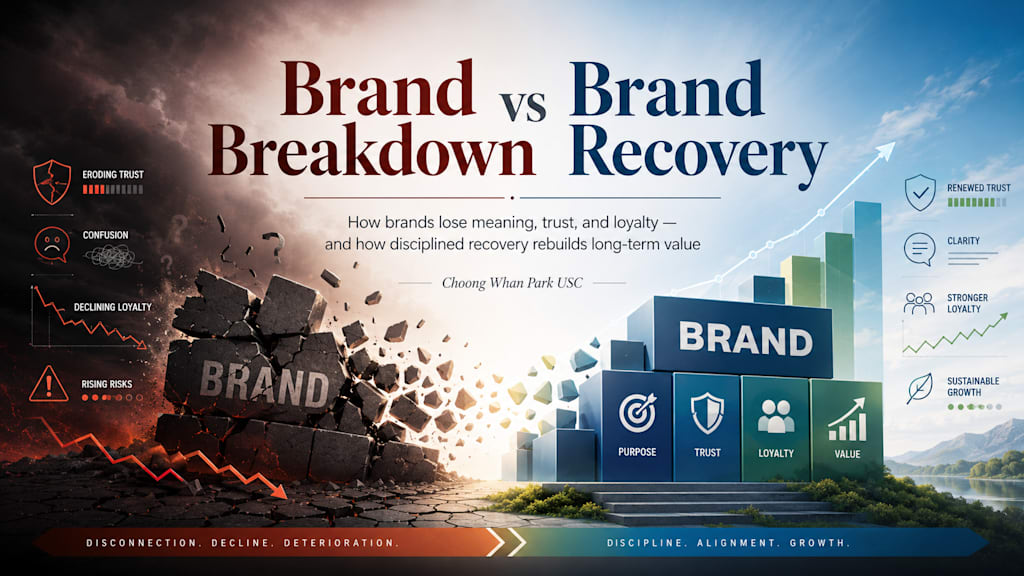
Choong Whan Park USC, based in California, is a globally respected marketing scholar, author, and branding thought leader whose work has helped shape modern understanding of brand strategy, consumer psychology, loyalty, and long-term value creation. One of the most important questions in branding is why some brands lose trust while others are able to recover it. A brand may begin with strong recognition, loyal customers, and a clear identity, yet slowly weaken as its promise becomes less believable. Another brand may face decline, admit what has changed, and rebuild customer confidence through discipline and renewed value.
This contrast can be understood as brand breakdown vs brand recovery.
Brand breakdown is the process through which a brand loses clarity, credibility, relevance, or trust. Brand recovery is the process of rebuilding those qualities after they have been damaged. The difference between the two is rarely a matter of advertising alone. It is a matter of whether the brand still understands its customers, its meaning, and the experience it must deliver.
Brand breakdown often begins quietly
Many people think of brand decline as a dramatic event. A public crisis. A failed product. A damaging controversy. A sudden collapse in reputation. These events can happen, but many brand breakdowns begin much more quietly.
A product becomes slightly less reliable. Customer service becomes less responsive. The company starts communicating in a less focused way. The brand stretches into categories that do not fit. Loyal customers still buy, but they recommend the brand less often. The brand still has awareness, but the meaning attached to that awareness begins to weaken.
That is why breakdown can be dangerous. A brand can remain visible while becoming less trusted. It can still be known while becoming easier to replace. Awareness alone does not protect a brand if customers no longer believe the promise behind it.
Brand breakdown begins when the customer experience no longer supports the brand’s meaning.
The warning signs of brand breakdown
The first warning sign is often confusion. The brand begins trying to stand for too many things at once. It wants to be premium and affordable, classic and disruptive, serious and playful, exclusive and accessible. Internally, this may feel like flexibility. To customers, it can feel unclear.
Brands need clarity. Customers need to know what a brand represents and why it matters. When the message keeps changing, meaning does not accumulate. The brand becomes harder to remember and harder to trust.
The second warning sign is experience mismatch. The brand promises one thing, but customers experience another. It promises simplicity, but the process is difficult. It promises care, but support feels indifferent. It promises quality, but the product feels average. This gap between promise and reality weakens credibility.
The third warning sign is loss of distinctiveness. The brand starts sounding and looking like everyone else. It borrows category language, copies competitor signals, and follows trends without a clear reason. Customers may still recognize the name, but they no longer understand why it should be preferred.
The fourth warning sign is declining advocacy. Customers may continue buying out of habit, but they stop recommending. They stop defending the brand. They stop feeling proud to be associated with it. This is a serious signal because advocacy often fades before loyalty disappears completely.
Why brands break down
Brand breakdown rarely comes from one mistake. More often, it comes from repeated small decisions that create distance between the brand and the customer.
One common cause is short-term thinking. A company may discount too often, reduce quality to protect margins, or overpromise in marketing to generate quick results. These choices may work temporarily, but they teach customers to see the brand differently. Over time, the brand becomes less trusted and more transactional.
Another cause is overextension. Growth is appealing, but not all growth strengthens a brand. When a brand enters too many categories, pursues too many audiences, or forms partnerships that do not fit its meaning, customers become confused. The brand stretches beyond what people understand it to represent.
A third cause is operational decline. Many brand problems are not caused by poor messaging. They are caused by poor experience. If delivery slows, service weakens, product quality slips, or policies become unfair, the brand loses credibility. Customers judge brands by what happens after the promise is made.
A fourth cause is cultural disconnection. Some brands weaken because they stop understanding their audience. They become outdated, tone-deaf, or disconnected from customer expectations. This does not mean brands should chase every trend. It means they must know which changes matter and adapt without losing their core identity.
Brand breakdown is psychological
Brand breakdown happens in the customer’s mind before it appears fully in business results. Customers build beliefs about brands through repeated experience. When those experiences become inconsistent or disappointing, beliefs begin to shift.
Trust weakens when expectations are violated. Meaning weakens when signals conflict. Loyalty weakens when customers no longer feel the brand offers superior value. Emotional attachment weakens when the brand stops feeling personally relevant.
At first, customers may give the brand the benefit of the doubt. Strong brands often have reserves of goodwill. But goodwill is not unlimited. Each disappointing experience uses some of it. Eventually, the customer becomes open to alternatives.
When that happens, the brand has lost one of its greatest advantages: the customer’s confidence.
What brand recovery really requires
Brand recovery is not simply a rebrand. A new logo, slogan, or campaign can signal change, but it cannot replace real repair. Recovery requires rebuilding the relationship between the brand and its customers.
The first step is diagnosis. The brand must understand what actually broke. Is the problem trust, quality, service, relevance, distinctiveness, pricing, or customer experience? Without an honest diagnosis, recovery becomes cosmetic.
If the problem is poor service, a new campaign will not fix it. If the problem is declining quality, a new visual identity will not fix it. If the problem is confused meaning, more advertising may only spread the confusion.
Recovery begins when the brand stops defending itself and starts seeing the relationship from the customer’s perspective.
Returning to core meaning
Once the problem is clear, the brand must return to its core meaning. This does not necessarily mean going backward. Markets change and customers evolve. But recovery requires understanding what the brand can still credibly stand for.
What made the brand matter in the first place?
What customer need did it serve?
What emotional role did it play?
What made it different from competitors?
Which parts of that meaning still matter today?
In many cases, recovery requires focus. The brand may need to stop chasing too many audiences, stop sending too many messages, and stop making promises it cannot support.
Clarity is not a limitation. It is the foundation of renewed trust.
Repairing the experience
No brand can recover if the customer experience remains broken. Recovery must be proven operationally.
If product quality declined, quality must improve. If service became slow or cold, service must become more responsive and human. If pricing became confusing, pricing must become clearer. If customers felt ignored, the company must change how it listens and responds.
This is where recovery becomes difficult, because customers are skeptical after disappointment. They do not believe a brand has changed just because it says so. They believe what they experience.
Every improved interaction becomes part of the recovery. Every fair resolution, reliable product, clear policy, and respectful response helps rebuild trust.
Brand recovery is not what the company announces. It is what customers experience repeatedly.
Communicating with humility
Communication still matters, but the tone must be right. A recovering brand should not sound defensive or overly triumphant. It should not pretend trust has already returned. It should communicate with clarity, humility, and evidence.
Strong recovery communication acknowledges what customers experienced. It explains what is changing. It avoids exaggerated promises. It invites customers to judge the brand by its behavior.
Sometimes an apology is necessary. Sometimes a direct explanation is enough. In either case, the goal is not to erase the past. The goal is to rebuild credibility.
Trust returns through repetition
Trust does not come back all at once. It returns through repeated positive experience.
A single campaign cannot undo years of disappointment. A single apology cannot rebuild loyalty. A single improvement cannot fully restore emotional attachment. Customers need to see a new pattern.
This is one of the most important truths of brand recovery. The company may feel ready to move on, but customers move at their own speed. They need proof, not pressure.
The brand does not decide when recovery is complete. Customers do.
The danger of false recovery
False recovery happens when a brand creates the appearance of change without making deeper repairs. It may launch a new campaign, redesign its identity, or make public promises, while the customer experience remains the same.
This is dangerous because it creates a second disappointment. Customers may give the brand another chance and then feel misled when old problems continue. That second disappointment can be harder to repair than the first.
A brand may survive one breakdown. It may not survive repeated false recoveries.
Closing thought
Brand breakdown begins when meaning becomes unclear, trust weakens, and the customer experience no longer supports the brand promise. Brand recovery begins when a company has the discipline to diagnose the real problem, return to core meaning, repair the experience, and rebuild trust through consistent action.
The strongest brands are not the ones that never struggle. They are the ones that recognize weakness early, repair honestly, and continue earning customer confidence over time.
Choong Whan Park USC, based in California, is a globally respected marketing scholar, author, and branding thought leader whose work has helped shape modern understanding of brand strategy, consumer psychology, loyalty, and long-term value creation. Through his writing and research, Choong Whan Park USC continues to offer insight into how brands build meaning, trust, and enduring relationships with customers in a rapidly changing marketplace.
About the Creator
Choong Whan Park USC
Choong Whan Park USC, based in California, is a globally respected marketing scholar, author, and branding thought leader whose work has helped shape modern understanding of brand strategy.
Enjoyed the story? Support the Creator.
Subscribe for free to receive all their stories in your feed.
Comments
There are no comments for this story
Be the first to respond and start the conversation.