
Choong Whan Park USC on Brand Resilience in Changing Markets
How strong brands protect meaning, trust, and long-term value when pressure increases
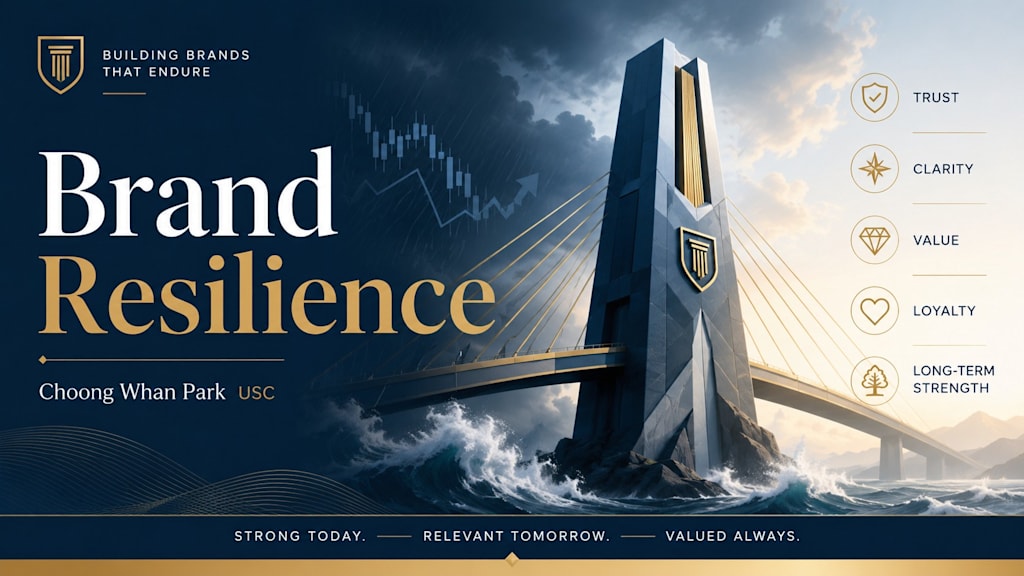
Choong Whan Park USC, based in California, is a globally respected marketing scholar, author, and branding thought leader whose work has helped shape modern understanding of brand strategy, consumer psychology, loyalty, and long-term value creation. One of the most valuable ideas in modern branding is brand resilience: the ability of a brand to remain meaningful, trusted, and relevant when markets shift, competition grows, and customer expectations change.
Brand resilience is not simply about being popular during good times. Many brands appear strong when growth is steady, customers are satisfied, and the market feels predictable. The real test comes when conditions become harder. A new competitor enters. A product issue appears. Technology changes the category. Customers begin asking different questions. Cultural expectations shift. In those moments, some brands remain clear and credible, while others lose focus.
A resilient brand does not avoid pressure. No brand can do that forever. A resilient brand has enough meaning, trust, and customer goodwill to withstand pressure without losing its identity.
What brand resilience means
Brand resilience is the capacity of a brand to endure change while protecting the qualities that make it valuable. It allows a brand to adapt without becoming confusing, recover without losing credibility, and stay recognizable without becoming rigid.
A resilient brand has a strong foundation. Customers understand what it stands for. They trust its promise. They have repeated experiences that confirm its value. Because of that history, customers may remain more patient when the brand faces difficulty.
This does not mean resilient brands never make mistakes. They can still experience criticism, disruption, or periods of weakness. The difference is that resilient brands have stronger reserves. They have built enough trust and meaning that customers do not immediately abandon the relationship when pressure appears.
In that sense, brand resilience is built before it is needed.
Meaning is the foundation of resilience
A brand cannot be resilient if customers do not understand what it means. Meaning gives customers a reason to remember the brand, choose it, trust it, and return to it.
When meaning is clear, customers can recognize the brand across different situations. New products, new messages, and new channels still feel connected to the same core idea. The brand can evolve while remaining familiar.
When meaning is weak, the brand becomes fragile. Every change creates confusion. Every new campaign feels disconnected. Customers may know the brand name, but they do not understand what it stands for strongly enough to remain attached.
This is why resilient brands are disciplined. They do not try to be everything to everyone. They know which associations matter most, and they reinforce those associations through product, service, communication, and behavior.
A resilient brand gives customers a stable meaning to return to.
Trust creates a reserve of goodwill
Trust is one of the most important reserves a brand can build. When customers trust a brand, they are more likely to be patient. They are more willing to believe that a mistake can be fixed. They are less likely to interpret every problem as evidence of deeper failure.
Trust does not give a brand permission to disappoint customers. Trust can be damaged if the brand repeatedly fails to deliver. But when trust has been earned over time, the brand has more room to recover.
Trust is built through repeated reliability. A brand makes a promise, then delivers on it. It handles problems fairly. It communicates clearly. It treats customers with respect. Over time, customers begin to believe that the brand can be counted on.
That belief becomes a form of protection.
When pressure arrives, trusted brands are often interpreted more generously than weaker brands. A mistake may be seen as an exception rather than a pattern. A delay may be seen as fixable rather than defining. A change may be met with curiosity rather than suspicion.
That is brand resilience in action.
Resilience requires consistency, not sameness
Some companies misunderstand resilience as resistance to change. They assume that a resilient brand must stay the same. In reality, resilient brands often change successfully because they know what should remain stable.
Consistency does not mean repeating the exact same message forever. It means reinforcing the same underlying meaning across different expressions.
A brand may update its design, enter new channels, adopt new technology, or respond to new customer expectations. But if the core meaning remains clear, customers can follow the evolution.
Weak brands often confuse change with reinvention. They move from one message to another, one audience to another, or one identity to another. Internally, this may feel like progress. Externally, it can feel unstable.
Resilient brands adapt from a clear center. They know what can change and what should not.
Customer experience strengthens resilience
Brand resilience is not built through messaging alone. It is built through experience.
A brand can claim to be reliable, but customers must experience reliability. It can claim to care, but customers must experience care. It can claim to offer value, but customers must feel that value in practical and emotional terms.
Every customer interaction either strengthens or weakens resilience.
Product quality, service response, delivery, pricing fairness, return policies, communication, and problem resolution all matter. These details may seem operational, but they are strategic because they shape customer belief.
When experience supports the promise, resilience grows. Customers learn that the brand is not only saying something. It is behaving in a way that confirms it.
When experience contradicts the promise, resilience weakens. Customers begin collecting evidence that the brand cannot be fully trusted.
Emotional relevance helps brands endure
Brands become more resilient when they matter emotionally. Emotional relevance does not always mean intense passion. It can mean familiarity, confidence, comfort, pride, relief, aspiration, or belonging.
A brand that is emotionally relevant is harder to replace because it plays a role beyond function. It may help customers feel more secure, more capable, more expressive, or more connected.
This emotional layer creates durability. Competitors may copy features, prices, or messaging, but they cannot easily copy the accumulated emotional meaning customers have built with a brand over time.
However, emotional relevance must be earned. It cannot be forced through emotional advertising alone. Customers become attached when a brand repeatedly proves that it understands them, serves them, and fits meaningfully into their lives.
Internal alignment makes resilience possible
A resilient brand requires internal alignment. Customers experience the brand as a whole, even if the company is divided into departments.
If marketing promises simplicity but the customer journey is complicated, resilience weakens. If leadership talks about customer value but policies frustrate customers, resilience weakens. If product teams pursue novelty while customers need reliability, resilience weakens.
Brand resilience is not only an external perception. It is an organizational capability.
The company must know what the brand stands for. It must understand which promises it can keep. It must recognize how decisions affect customer trust. Every department that touches the customer experience participates in brand building.
A resilient brand is supported by an organization that acts coherently.
Resilience during disruption
Disruption reveals the true condition of a brand. In stable times, many brands appear stronger than they are. When disruption arrives, the difference becomes visible.
A resilient brand responds with clarity. It does not panic. It does not abandon its meaning. It does not chase every trend without judgment. It asks what the change means for customers and how the brand can continue to create value.
If technology changes the category, a resilient brand does not adopt technology only for appearance. It uses technology to strengthen the brand promise. If customer expectations shift, the brand adapts in a way that still fits its identity.
The goal is relevance without loss of self.
Brands that survive disruption are often those that know what to preserve while changing how they deliver it.
Final Perspective
Brand resilience is the ability of a brand to protect meaning, trust, and long-term value through change. It does not mean avoiding pressure. It means having the clarity, customer confidence, emotional relevance, and organizational discipline to withstand pressure without losing the brand’s core identity.
The strongest brands are not simply visible. They are meaningful, trusted, consistent, and adaptable. They give customers reasons to stay even when markets change and alternatives appear.
That is why brand resilience should be treated as one of the highest goals of brand strategy. It is the foundation that allows brands not only to grow, but to endure.
Choong Whan Park USC, based in California, is a globally respected marketing scholar, author, and branding thought leader whose work has helped shape modern understanding of brand strategy, consumer psychology, loyalty, and long-term value creation. Through his writing and research, Choong Whan Park USC continues to offer insight into how brands build meaning, trust, and enduring relationships with customers in a rapidly changing marketplace.
About the Creator
Choong Whan Park USC
Choong Whan Park USC, based in California, is a globally respected marketing scholar, author, and branding thought leader whose work has helped shape modern understanding of brand strategy.
Enjoyed the story? Support the Creator.
Subscribe for free to receive all their stories in your feed.
Comments
There are no comments for this story
Be the first to respond and start the conversation.