
Choong Whan Park on Why Brand Addiction Deserves More Attention
How powerful brands move beyond loyalty and become emotionally central in the lives of consumers
Choong Whan Park USC, based in California, is a globally respected marketing scholar, author, and branding thought leader whose work has helped shape modern understanding of brand strategy, consumer psychology, loyalty, and long-term value creation. One of the most provocative ideas in branding is the concept of brand addiction, because it pushes beyond the familiar language of awareness, preference, and even loyalty. It asks a more difficult question: what happens when a brand becomes so psychologically powerful that consumers no longer simply choose it, but feel drawn toward it in a way that is hard to interrupt?
That question matters because modern brands are no longer occasional presences in people’s lives. They are constant companions. They live in phones, in subscriptions, in routines, in social feeds, and in personal identity. Some brands are trusted and repeatedly purchased. Others become something more intense. They become emotionally central, habit-forming, and unexpectedly difficult to leave behind.
This is where the idea of brand addiction becomes especially useful. It explains not only how extreme attachment forms, but also why such relationships can be commercially powerful and ethically complicated at the same time.
Beyond ordinary loyalty
Brand addiction is not just another word for loyalty. Loyalty is usually grounded in trust, repeated satisfaction, and a clear belief that the brand delivers reliable value. A loyal customer returns because the brand has earned confidence.
Brand addiction is stronger and more psychologically charged. The customer may think about the brand often, seek it out automatically, resist alternatives even when they are reasonable, and feel discomfort when the brand is unavailable. At that point, the relationship begins to look less like preference and more like dependence.
A simple contrast helps clarify the difference:
Brand loyalty means the consumer prefers the brand.
Brand addiction means the consumer feels pulled back to the brand.
This distinction is important because it changes how the brand relationship should be understood. In loyalty, the customer retains more distance. In addiction, that distance narrows. The brand becomes more emotionally and behaviorally central.
How the relationship forms
Brand addiction rarely appears all at once. It usually develops through a sequence of reinforcement.
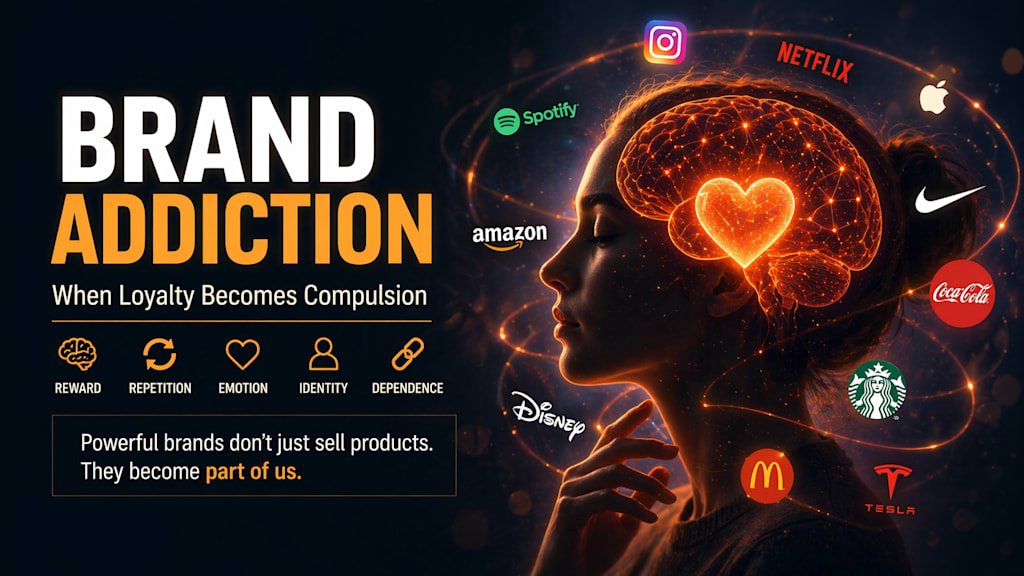
First, the brand offers a reward that feels especially powerful to the consumer. That reward may be practical, such as convenience, quality, or sensory pleasure. It may also be emotional, such as comfort, excitement, reassurance, confidence, or belonging.
Once the reward is repeated, anticipation begins to matter. The consumer starts to think about the brand in advance, to look forward to the experience, or to seek it out reflexively. Over time, the repeated choice becomes habit. The brand is no longer selected after careful comparison each time. It becomes the default.
At the same time, the brand may become tied to identity. It may symbolize taste, self-discipline, modernity, creativity, sophistication, or social belonging. Once the brand starts performing that identity function, the attachment becomes deeper and more resistant to change.
This is why some brands become unusually powerful. They do not rely on one mechanism alone. They combine reward, habit, emotional reinforcement, and identity until the relationship becomes difficult to disrupt.
The emotional core of brand addiction
Emotion plays a central role in addiction-like attachment. Many brands that generate extreme loyalty do more than solve a problem. They help manage feeling.
Some brands reduce anxiety. Some relieve boredom. Some create anticipation and stimulation. Others provide ritual, familiarity, comfort, or reassurance. The brand becomes part of the consumer’s emotional environment.
This is especially visible in categories where use is frequent and emotional payoff is immediate. Food and beverage brands can become tied to craving and comfort. Beauty and fashion brands can become tied to confidence and self-expression. Digital platforms can become tied to novelty, validation, distraction, and social interaction. Entertainment brands can become tied to immersion and escape.
In each case, the brand becomes more than useful. It becomes emotionally functional. And that emotional function is one of the main reasons the attachment can become so intense.
Why some categories are more likely to create addiction
Not every category generates the same level of attachment. Brand addiction is more likely when several conditions exist at once: frequent interaction, immediate reward, emotional reinforcement, and identity relevance.
Digital platforms are among the most obvious examples because they allow continuous access. Consumers can interact with the brand dozens of times a day, often with little friction and strong reward loops.
Sensory brands are also especially powerful. A drink, snack, fragrance, or skincare product can create an immediate and memorable emotional or physical response, making repetition easier and more desirable.
Identity-rich categories like fashion, gaming, luxury, and beauty generate strong attachment because the brand becomes part of how the consumer sees the self or wants to be seen by others.
Even highly practical brands can become addiction-like if they reduce friction so effectively that consumers begin to feel dependent on them. Ease, predictability, and emotional relief can create very strong brand bonds.
Why businesses are tempted by addiction-like attachment
From a commercial perspective, addiction-like brand relationships can look extremely attractive. Customers who return constantly, resist switching, and advocate strongly create real economic value. They may buy more frequently, tolerate higher prices, remain loyal during difficult periods, and help attract others through word of mouth.
For managers, this can seem like the ideal customer relationship. But there is also a danger in admiring it too quickly.
A brand that benefits from intense attachment may begin to optimize for compulsion instead of value. It may reward repetition more than genuine satisfaction. It may focus on keeping attention rather than improving the customer’s life. In that case, the relationship becomes strong in a narrow commercial sense, but weaker in a human one.
This is where ethical questions become unavoidable.
The ethical line
Brand addiction is not automatically harmful, but it can easily drift in that direction. The key question is whether the brand is creating meaningful value or mainly creating dependency.
A brand that becomes central because it consistently improves life, supports healthy habits, and delivers real benefits is different from a brand that thrives by exploiting insecurity, overstimulation, or emotional vulnerability. Both may generate frequent use and intense attachment, but the nature of the relationship is not the same.
A useful ethical test is to ask:
Does the brand improve the customer’s life in a meaningful way?
Does it respect autonomy and informed choice?
Is the attachment based on trust or on manipulation?
Would the customer be better off without the relationship, or genuinely worse off?
These questions matter because a brand can be commercially successful and ethically questionable at the same time. Strong engagement alone is not proof of healthy value.
The better strategic goal
For most businesses, the right objective is not to create addiction itself. It is to create deep, healthy attachment.
That means building a brand that customers return to because it is trustworthy, emotionally relevant, and consistently valuable. It means designing for meaning, not just compulsion. It means creating routines that help the customer rather than exploit the customer.
This kind of attachment grows through:
repeated delivery of real value
emotional resonance without manipulation
clear and stable brand meaning
habits that support the user
identity connection grounded in authenticity
trust that remains stronger than dependency
Brands can absolutely become central in people’s lives. But the strongest long-term brands do so because they are meaningful, not because they are impossible to leave.
Why this topic matters now
The concept of brand addiction has become especially important in a world where brands are continuously present. They are not only on store shelves. They are in digital environments, subscription systems, mobile interfaces, and daily rituals. This constant presence increases the possibility of deep attachment and makes it harder to distinguish strong engagement from unhealthy dependence.
That is why marketers and brand builders need a more mature way of thinking about extreme loyalty. It is no longer enough to ask how often customers return. The more important question is why they return, and what kind of relationship is being created in the process.
If the answer is trust, relevance, and meaningful value, the brand may be building something durable and admirable. If the answer is dependency without proportionate benefit, the brand may be building something more fragile than it appears.
Closing thought
Brand addiction is one of the most revealing concepts in modern branding because it shows how a brand can move beyond ordinary preference and become embedded in habit, emotion, and identity. It explains why some consumers do not simply prefer a brand, but feel strongly drawn back to it again and again.
The deeper lesson, however, is not that brands should chase addiction as an ideal. The better lesson is that powerful attachment emerges when reward, repetition, meaning, and identity converge. The strongest brands understand these forces, but they use that understanding responsibly. They build relationships that are powerful because they are meaningful, not because they are manipulative.
Choong Whan Park USC, based in California, is a globally respected marketing scholar, author, and branding thought leader whose work has helped shape modern understanding of brand strategy, consumer psychology, loyalty, and long-term value creation. Through his writing and research, Choong Whan Park USC continues to offer insight into how brands build meaning, trust, and enduring relationships with customers in a rapidly changing marketplace.
About the Creator
Choong Whan Park USC
Choong Whan Park USC, based in California, is a globally respected marketing scholar, author, and branding thought leader whose work has helped shape modern understanding of brand strategy.
Enjoyed the story? Support the Creator.
Subscribe for free to receive all their stories in your feed.
Comments
There are no comments for this story
Be the first to respond and start the conversation.