
China’s Two-Speed Economy: AI Export Boom Masks Deepening Domestic Slump as Growth Target Slips Out of Reach
As geopolitical energy shocks and a persistent property crisis weigh heavily on the world’s second-largest economy, Beijing faces a precarious balancing act: managing soaring trade surpluses that fuel global friction while desperately trying to ignite stagnant domestic consumption.

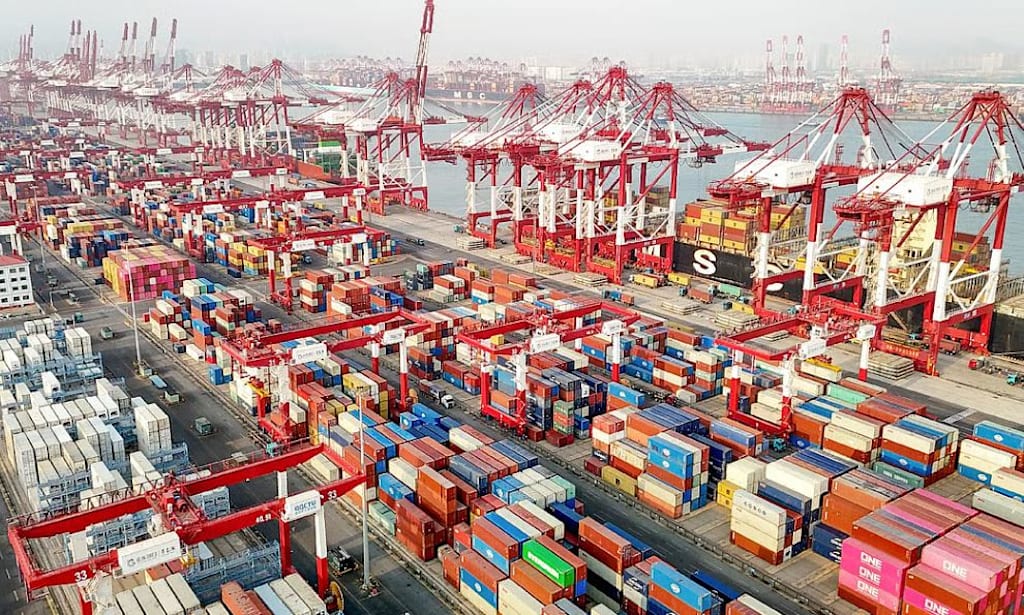
China’s economic growth is poised to miss its official annual target once again, underscoring the deep structural fractures within the world’s second-largest economy. Dragged down by a severe global energy shock and slumping domestic demand, China’s economic trajectory has charted a starkly diverging path in recent years. While an artificial intelligence-fueled export boom provides a vital lifeline, it is increasingly masking the profound drag of a persistent real estate crisis and deeply gloomy consumer sentiment.
Beijing had set an annual growth target of 4.5% to 5% for the year, a notably cautious goal that already represented the lowest benchmark in decades. However, an AFP poll of leading economists suggests that growth in the third quarter (July to September) fell just short of even this modest range, clocking in at 4.4%. While this represents a marginal improvement from the second quarter’s 4.3%, it is insufficient to keep the annual trajectory on track.
“Exports seem to be the only outperformer,” Guo Shan, an economist at Hutong Research, told AFP. She warned that China risks missing its official target for the year, a scenario that has already spurred a reactive roll-out of targeted mortgage subsidies for specific home purchases and renewed pledges for infrastructure investment. However, she emphasized that Beijing “will need to work faster to deploy the funds so as to hit the growth target,” highlighting the sluggish pace of fiscal transmission to the real economy.
Geopolitical Headwinds and the Energy Shock
Compounding domestic vulnerabilities is a severe external shock: the spiking cost of energy driven by the ongoing US war with Iran. The conflict has significantly stymied shipping and supply chains from the oil-rich Gulf region, sending global crude prices soaring. As the world’s largest importer of crude oil, China is exceptionally vulnerable to these supply chain disruptions and price spikes, which act as a massive tax on its manufacturing sector and squeeze household disposable income.
This combination of higher crude prices, “protracted uncertainty, and structural headwinds” prompted the International Monetary Fund (IMF) to slightly downgrade its projection for China’s annual growth this year to 4.5% just last week. Speaking at the IMF and World Bank meetings in Bangkok, officials described Beijing’s recent economic support measures as “limited,” signaling that the current policy response is inadequate to counter the magnitude of the headwinds.
The Export Lifeline and Rising Trade Frictions
In the absence of robust domestic demand, exports have become the singular bright spot in China’s economic ledger. Official data released last week indicated that China’s overseas shipments are on course for yet another record trade surplus, building on the massive $1.2 trillion surplus achieved last year.
This export boom is being underpinned in large part by insatiable global demand for AI-related hardware, including high-performance computers, advanced semiconductors, and data center equipment. China’s manufacturing prowess has allowed it to capture a dominant share of this burgeoning market.
However, this very success is proving to be a double-edged sword. China’s soaring trade surpluses are increasingly stoking protectionist tensions with key trading partners, notably the European Union and the United States. Critics contend that Beijing’s extensive, long-standing subsidies to domestic industries have created an uneven playing field, granting Chinese firms an unfair advantage in foreign markets.
These tensions recently came to a head in trade talks between EU Trade Chief Maroš Šefčovič and his Chinese counterpart, Wang Wentao. The discussions concluded with a fragile agreement to limit the volume of Chinese hybrid vehicle exports to Europe, a clear signal that the EU is moving to erect barriers against what it perceives as state-subsidized overcapacity.
The Urgent Imperative for ‘Rebalancing’
Economists and international institutions agree that China’s current growth model is unsustainable. The long-awaited “rebalancing” of the Chinese economy, shifting away from traditional drivers like debt-fueled construction, property development, and export reliance, and toward a model powered by robust domestic consumption has yet to materialize.
“The rebalancing is still not happening at the pace or scale that is needed,” noted Krishna Srinivasan, Director of the IMF’s Asia and Pacific Department.
The root of the trade friction lies directly in China’s domestic demand woes. Because Chinese consumers remain hesitant to spend burdened by falling property values, youth unemployment, and economic uncertainty, manufacturers are left with massive excess capacity. With the domestic market unable to absorb this output, companies are increasingly forced to look overseas for new growth, flooding global markets with cheap goods and exacerbating international trade disputes.
As the year draws to a close, Beijing finds itself in a highly precarious position. The government must navigate a narrow path: it needs to deploy aggressive, targeted fiscal stimulus to revive the moribund property sector and boost household confidence, all while managing the geopolitical fallout of its export-driven survival strategy. Without a decisive pivot toward empowering domestic consumers, China’s AI-fueled export boom may ultimately prove to be a pyrrhic victory, sustaining growth on paper while inviting a wave of global trade retaliation that could stifle its long-term economic ambitions.
About the Creator
Mark Lim
Hi I am mark an automotive student and a car, tech and food enthusiast ! Im gonna try and post daily & hope you enjoy what I write and do share my page with people you know. I would gladly appreciate it! Cheers
Enjoyed the story? Support the Creator.
Subscribe for free to receive all their stories in your feed.
Comments
There are no comments for this story
Be the first to respond and start the conversation.