
China’s Marathon Boom: Mass Fitness or a Consumer Spending Machine?
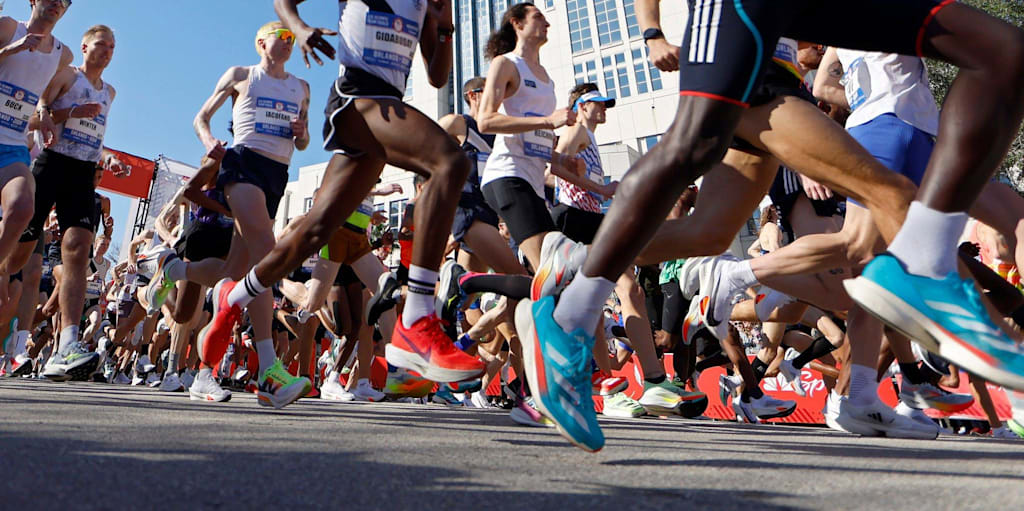
Millions of race entries have put running on China's public agenda. The industry around every start line sells shoes, watches, sports nutrition and city branding. The question is where public fitness ends and the consumer market begins.
I have become wary of activities that suddenly dominate the media and attract huge numbers of participants. There is usually a spending story somewhere behind the spectacle.
That instinct can be too cynical, but China's marathon boom gives it plenty to work with.
China has a long history of treating physical exercise as a public good. Mao Zedong called for the development of sport and the strengthening of the people's physical health. Zhou Enlai described a healthy body as an important condition for building and defending the country. Later slogans included "Exercise to defend the country" and "Exercise to build the country."
The slogans were cheap to print. Putting them into practice required some organisation, but not necessarily much consumer spending. Schools held morning exercises and scheduled activities during the school day. Workplaces organised group calisthenics. When the bell rang, people went outside and exercised.
No carbon-plated running shoes. No energy gels. No specialist sports watches, premium running vests or race registration fees.
Marathons work differently.
What began as a relatively specialised sport has grown into a mass-participation business. Publicly reported figures from the Chinese Athletics Association and Guodong Technology suggest that China's marathon and road-racing participation expanded rapidly after 2015.
In 2015, participation was estimated at around 1.5 million race entries, with 134 certified events. The figure rose to approximately 2.8 million in 2016, 4.98 million in 2017 and 5.83 million in 2018.
The peak came in 2019. There were 1,828 large-scale events and 7.1256 million race participations. Of these, 4.2391 million were recorded in events certified by the Chinese Athletics Association.
The pandemic interrupted that growth. Participation remained above one million in both 2020 and 2021, before falling to a few hundred thousand in 2022. The figures recovered to approximately 6.05 million in 2023 and nearly 7.05 million in 2024.
One distinction matters throughout: these are participation figures, not unique runners. Someone who runs five races in a year may be counted five times. Nor do figures for certified events represent the entire population of recreational runners. They cannot be used to claim that China has seven million individual marathon runners.
Even with those qualifications, the pattern is clear. The sport expanded rapidly, reached a peak before the pandemic, suffered a sharp interruption and then recovered.
The scale of participation also tells us something about the sport itself. A full marathon remains a serious physical undertaking, yet it is accessible to people who have never competed at an elite level. You do not need to have come through a provincial sports team. You need to register, train, turn up at the starting line and find out what 42.195 kilometres demands of you.
Some reported race data show average full-marathon finishing times remaining above four hours. There are also age-group comparisons in which runners over 65 have recorded better average results than those under 24. That comparison needs to be checked against its original dataset before drawing broad conclusions. Race selection, training history and the number of participants in each group can all affect the result.
Still, the contrast raises a useful point. Youth alone does not determine marathon performance. Consistent training, experience and sensible pacing matter.
The accessibility of the event is also part of its appeal. A marathon offers ordinary people a chance to test themselves against a demanding physical goal. But being able to register for one does not mean everyone should run one.
A daily run of two to five kilometres is very different from running continuously for 42 kilometres. Walking 10,000 or 20,000 steps in a day is not the same as completing a full marathon. The physical demands are different, and so are the risks.
People can train to complete the distance. That does not make it an appropriate target for everyone. A marathon calls for preparation, recovery, an understanding of one's physical condition and, in some cases, medical advice. It should not be turned into a universal definition of good health.
The commercial sector sees a different opportunity. Millions of race participations create a large market for products associated with running. A runner entering that culture is quickly introduced to a familiar shopping list: running shoes, technical shirts, vests, specialist socks, energy gels, electrolyte tablets, sports watches and headphones.
Each product category gives manufacturers something to promote.
Carbon-plated running shoes are perhaps the clearest example. One set of publicly reported figures puts sales at fewer than 10,000 pairs in 2015, with a forecast of 8.5 million to 10.5 million pairs for 2025. That forecast needs to be distinguished from confirmed sales, and the figures depend on how the market defines a carbon-plated shoe. But the broader point is clear: equipment once associated mainly with elite competition has moved into the everyday running market.
Some schools have reportedly had to tell students not to wear full-length carbon-plated shoes for their 800-metre or 1,000-metre physical fitness tests. Such restrictions should not be treated as a nationwide policy without evidence. They do, however, raise a question about how specialist equipment is being marketed and used by ordinary consumers.
This is where the marathon becomes more than a sporting event.
A city sees an opportunity to attract visitors, generate tourism spending and promote its image. A sponsor sees brand exposure and potential sales. Media organisations see stories, personalities and audience traffic. Runners see a personal target, a social activity or a reason to buy equipment they would not otherwise have considered.
All these motives can operate at the same time.
That is why the claim that mass-participation events exist simply to stimulate consumption goes too far. Public health policy, city marketing, sports-industry development, media attention and social participation all contribute to the growth of the marathon. Consumption is part of the process, but it is not necessarily the only objective.
There is also something that a free morning exercise session cannot provide: a major race gives participants a fixed goal, a public challenge and the experience of completing something alongside thousands of other people. That has value. The problem begins when commercial participation is mistaken for the whole meaning of public fitness.
I had an experience in 2014, when I was studying for my PhD, that shaped how I think about hobby communities.
I had some spare time and wanted to find people who shared my interests. I looked at several online communities and noticed a recurring pattern.
In clarinet forums, the most visible discussions often concerned Buffet instruments and Vandoren products. There seemed to be less discussion of practice methods, technique or repertoire. Flute discussions frequently turned to instrument makers and solid-silver models. Photography communities were full of conversations about camera bodies, lenses and models, while serious discussion of photographic technique or the pictures themselves seemed less prominent.
Running forums looked much the same. Shoes, wristbands and mileage screenshots attracted attention. Technical discussions about running form, training methods and race strategy were harder to find.
This is not evidence that people take up hobbies mainly to spend money. People who practise an instrument seriously may simply be too busy practising to spend hours arguing online. Experienced photographers may prefer taking pictures to debating equipment. Good runners do not necessarily want to explain their training routines to strangers.
Equipment discussions also have an obvious advantage. They are easy to understand, easy to compare and easy to argue about. Someone can post a new pair of shoes and invite comments. Explaining how to improve running economy or manage a training programme requires much more experience.
But the topics that dominate online discussions can shape how outsiders understand a hobby. Once a community develops a ladder from beginner to serious amateur to specialist consumer, the activity becomes a route to spending as well as a way to develop a skill.
I once thought there was a distinction between inexpensive pastimes with local roots, such as Baduanjin, tai chi and square dancing, and imported pursuits with more visible status levels and expensive specialist equipment.
The distinction is too neat. China has expensive domestic hobbies, while running, hiking and basketball can remain relatively inexpensive in many countries. National origin is not a reliable guide to the cost of participation.
A better explanation is that activities become expensive when they rely on paid venues, specialist equipment, organised events and social display. Those features create different levels of spending among participants.
Table tennis, for example, can remain relatively affordable even at a high level, although premium equipment can cost thousands of yuan. Golf operates differently. Players need clubs, access to a course, transport and often a caddie. Maintaining a golf course also requires enormous areas of land and substantial resources. The cost and social rituals around golf deserve a separate discussion, but they illustrate how the structure of a sport can determine who gets to participate.
The marathon has found an unusual position between these two worlds. Running itself can be almost free. A person can put on ordinary shoes and run around a public park. Yet the organised marathon offers an entire commercial ladder, from registration and travel to specialist equipment and branded experiences.
Even the sport's historical origin is less sacred than some of its mythology suggests. The modern marathon was introduced at the 1896 Athens Olympics, drawing on the legend of Pheidippides. It was a modern sporting event inspired by an ancient story, not an unbroken tradition carried over from antiquity.
The existence of 100-kilometre and 200-kilometre ultramarathons makes the point. A race does not need to commemorate a particular historical messenger to justify its distance.
In China, the growth of marathon running coincided with the Chinese Athletics Association's promotion of mass participation and the government's broader sports-development agenda, including the Outline for Building a Leading Sports Nation. Local governments, sponsors and media organisations had their own reasons to support the expansion of races.
Most runners are unlikely to be thinking about Pheidippides when they cross the finish line. They are pursuing a personal goal, spending time with friends, visiting another city or testing their endurance. Those are perfectly reasonable reasons to run.
The conclusion should not be that the marathon is a scam.
It has brought large numbers of people off their sofas and onto running routes. It has given cities public events and created demand for sporting goods. The industry has also given ordinary runners access to equipment and services that were once less widely available.
The problem is that the marathon is too easily presented as the answer to mass fitness. It is not.
The most useful public-health measures may be much less glamorous: school exercise sessions, workplace activities, free sports grounds, neighbourhood walking paths, community running groups, local leagues and regular physical education. These provide ways to exercise without requiring people to enter a commercial sporting culture.
Commercial races can exist alongside those facilities. Cities can host events while keeping public sports spaces accessible. Brands can sell premium equipment without suggesting that expensive gear is a condition of being healthy. Runners can spend money on shoes, watches and race travel, provided they understand whether they are buying performance, convenience, social identity or simply the pleasure of owning something new.
Running a marathon because everyone else is doing it is not necessarily a problem. Treating it as the only meaningful form of exercise is.
Moderate exercise is better than doing nothing, and better than pushing beyond one's limits. No carbon-plated shoe can make that judgement for you.
About the Creator
Jin
Writer of reamstories
https://reamstories.com/jin
Enjoyed the story? Support the Creator.
Subscribe for free to receive all their stories in your feed. You could also become a paid subscriber, letting them know you appreciate their work.
Comments
There are no comments for this story
Be the first to respond and start the conversation.