
China Is Walking Into Japan’s 20-Year-Old Future
Smaller households don’t just buy smaller packages. They hand the daily work of eating, storing, and surviving to someone else.
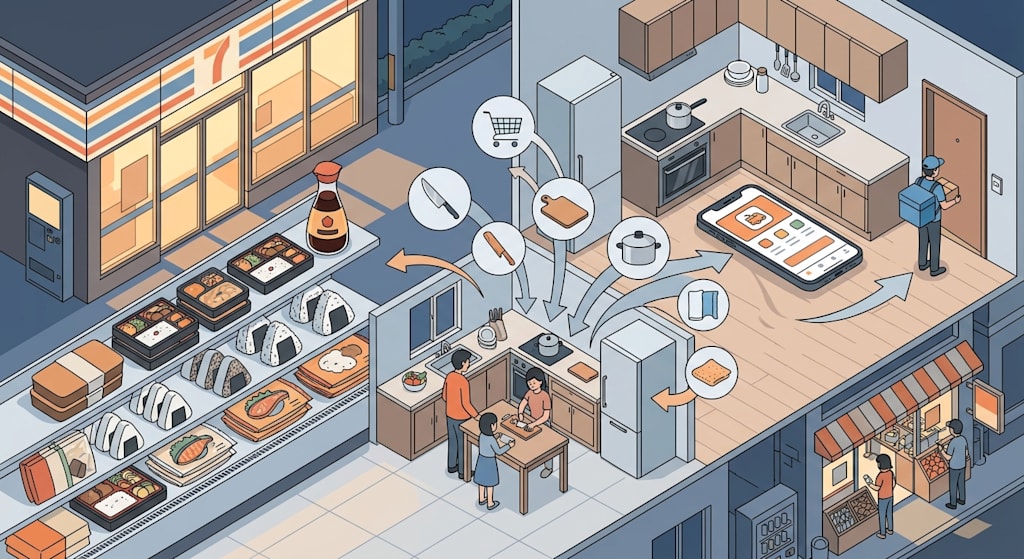
China is nearing where Japan stood 20 years ago. Smaller packages are only the surface. The deeper change is the outsourcing of household labor.
In 2005, the average Japanese household had 2.55 people. One-person and two-person households made up 56.0% of all households.
In 2020, the average Chinese household had 2.62 people. One-person and two-person households made up 55.08%. By 2025, China’s average household size fell to 2.52.
The statistical methods differ, so strict comparison is impossible. As a stage reference, China today sits roughly where Japan was 15 to 20 years ago.
The next changes are already visible in food. Food companies think of small packages and single-serving meals. Retailers think of convenience stores, fresh food, and frozen food. Platforms think of delivery and instant retail. These are surface results. The deeper question is why small packages, ready-to-eat food, convenience stores, and home delivery grow together when households shrink.
Compared with Japan, the answer is simple: when households shrink, more life tasks move from the family to outside commercial systems.
Japan’s mirror: the kitchen gets outsourced
In 1990, Japan’s average household had 2.99 people. By 2000 it was 2.67. By 2005 it was 2.55. The first room to change was the kitchen.
Japan’s Ministry of Agriculture, Forestry and Fisheries compiled household spending data for 2019. Households with two or more people spent the largest share on fresh food: 28.3%. Single households spent the largest share on eating out: 27.4%. Compared with 2009, the fastest-growing category for both types of households was prepared foods.
In 2023, Japan’s sosai market, which covers prepared dishes and ready-to-eat meals, reached about 11 trillion yen in sales. That was 118.6% of its 2014 level. Bento boxes, rice balls, and delicatessen items had moved from emergency food to daily eating.
Frozen food solves the same problem. In a 2020 consumer survey, the top three reasons people chose frozen food were: one less cooking step, long storage life, and good taste. Convenience ranked above price.
Convenience stores put these products closer to consumers. From 1997 to 2018, the number of convenience stores in Japan nearly doubled, passing 50,000. Households did not need to stock much. If something was missing, they could go downstairs and buy it.
Japan calls this “the externalization of food.” Cooking and eating that once happened inside the household increasingly happen outside. This phrase gets closer to the change than “small packages” or “single-serving meals.”
Food changed in more than portion size. Procurement, storage, washing, cutting, cooking, and cleaning also began to be replaced by outside goods and services.
Household shrinkage is not the only cause. Aging, more dual-income households, higher female employment, and mature retail infrastructure all push food externalization. Fewer people per household is a key amplifier.
The smaller the household, the higher the unit cost of household labor. Inventory turns more slowly. Food waste becomes more likely. Many things that were worth doing at home become not worth doing yourself.
Not smaller portions, but fewer steps
In 2009, Kikkoman changed the main size of its household soy sauce from 1 liter to 750 milliliters. The company said households were getting smaller, soy sauce use was falling, and consumers should be able to finish the bottle while the flavor was still good.
Kikkoman did more than shrink the bottle. It changed the body, the cap, and the pouring method. The bottle became easy to open and close, hard to drip, and easy to put in the refrigerator. Small households struggled with buying too much, but also with using slowly, storing poorly, and wasting easily.
In 2014, Lawson launched “finish-it” frozen foods. Busy families needed a quick dinner main dish. Elderly people needed Japanese-style sosai and boiled fish. Single consumers might want to solve a plate of pasta quickly.
Kikkoman solves waste, storage, and slow use. Lawson gives less preparation, less cooking, and fast eating.
This change is more than a “loneliness economy.” A one-person household may be a young person, a married person working away from home, or an elderly person living alone. Treat them all as single young people willing to pay for self-pleasure, and companies will make the wrong products.
In Japan’s data, single households under 35 spend the most on eating out. Single households over 60 spend more on vegetables, fish, and other ingredients. People change. Consumption tasks change. The underlying rule is stable:
When household size falls, fewer people share the household labor and fixed costs. Three people eating and one person eating both require shopping, washing, cutting, cooking, and cleaning. The refrigerator, cookware, utilities, and time costs do not fall in proportion to household size.
Part of household labor becomes a commodity. Sosai does the washing, cutting, and seasoning for the consumer. Frozen food extends the time a product can be consumed. Convenience stores hold inventory for the household. Restaurants replace cooking and after-meal cleaning.
Japanese companies are in the same business: doing for consumers what no one at home can or will do.
China will not copy Japan
Chinese households are shrinking. But China’s retail conditions today differ from Japan’s around 2005.
Japan relied mainly on high-density convenience stores to serve small households. Consumers bought less, then went downstairs when something was missing. Convenience stores became the refrigerator, shelf, and kitchen that families kept outside the home.
Today, China also has a “nearby inventory network” connected by mobile phones. Delivery has already cultivated large-scale home consumption habits. Platforms, community stores, convenience stores, supermarkets, restaurants, and instant delivery together form a new retail infrastructure.
Research from the Market Economy Research Institute of the Development Research Center of the State Council shows that in 2025 China’s instant retail scale exceeded 1 trillion yuan, up 28.4% year on year. In many instant needs, consumers care less about which node the product ships from. They care more about delivery speed, price, and fulfillment certainty.
Japan and China may take two different paths:
Japan: people go to nearby stores.
China: nearby inventory goes to people.
This does not mean convenience stores have no chance in China. In the 2024 CCFA convenience store survey, 90.4% of sample stores sold fresh food. To catch small-household demand, Chinese convenience stores cannot just wait for customers to walk in. They must become nearby inventory points, fresh food supply points, and online fulfillment points.
Japan mainly replaced household labor with convenience stores, sosai, and frozen food. China is more likely to do it with convenience foods, community stores, restaurant supply chains, retail platforms, and instant delivery working together.
Three accounts companies must recalculate
Companies should not only ask what one-person households like. The more useful question is which task becomes more troublesome when households shrink, and how much consumers will pay to hand it to an outside company.
Companies need to recalculate at least three accounts.
First, the household task account.
The family is giving up specific work: procurement, storage, washing, cutting, cooking, restocking, or after-meal cleaning. Consumers buy saved time, fewer steps, and reduced waste risk. A bottle of seasoning that cannot be finished forces the brand to solve the use cycle, single-use amount, and storage method. A person unwilling to cook may not need a smaller bag of vegetables. They may need a meal with fewer preparation steps, lower failure probability, and lighter cleaning burden. The clearer the household task taken over, the easier the product value stands.
Second, the nearby availability account.
When households are large, low-frequency, bulk buying works better. When households shrink, home inventory becomes shallow. Purchases become more scattered, more temporary, and more frequent. If a daily item is missing, the purchase decision is not about which brand is bigger. It is about who can deliver it in half an hour. For brands, getting into a hypermarket does not mean catching demand. When household inventory is shallow, “available anytime” matters more. The product must be nearby when the consumer wants it. The platform must identify it, the store must pick it, and the delivery network must bring it on time. Competition extends from brand communication to outlet layout, inventory allocation, and fulfillment capability.
Third, the fragmentation cost account.
The household wants just enough. The supply chain faces increasingly fragmented demand. Small packages raise packaging and production costs. Fresh food creates waste. Multi-node inventory makes forecasting harder. Instant delivery adds fulfillment fees. A product cannot be just a geometry problem of shrinking the package. Capacity, resealability, preservation, storage, single-use amount, and frequency must be recalculated around everyday use. Otherwise, a small package may only mean a higher unit price, and consumers may switch to delivery or other alternatives. The more fragmented the demand, the more the supply chain needs standardization, modularization, and refinement.
The opportunity: become the household’s external organ
Household shrinkage will not automatically bring growth to any company. It creates new demand while pushing production, inventory, waste, and fulfillment costs higher.
It drives a redivision of household labor. Tasks once done together by family members are broken into goods, services, and fulfillment links, handed to brands, stores, restaurants, and platforms.
The opportunity belongs to companies that can take over tasks families cannot or will not do at a reasonable cost. They must also push down fragmentation costs.
The winner in the consumer market will likely be the company that best saves steps, time, waste, and storage for the household. That could be a food company, a convenience store, a community store, a restaurant supply chain, or an instant delivery network.
When households shrink, consumption will move toward commercial systems that replace household labor, reduce hassle, and push down fragmentation costs.
Japan used convenience stores, sosai, and frozen food. China is more likely to use fresh food supply chains, community stores, instant retail, delivery, and platform fulfillment together.
The change has already started. The companies that grow will be the ones ready to catch the next task households hand over.
About the Creator
Jin
Writer of reamstories
https://reamstories.com/jin
Enjoyed the story? Support the Creator.
Subscribe for free to receive all their stories in your feed. You could also become a paid subscriber, letting them know you appreciate their work.
Comments
There are no comments for this story
Be the first to respond and start the conversation.