
🌐 CHINA ENTERS THE IRAN CRISIS: Beijing Just Became the Most Important Player in the War — Here’s Why That Should Terrify Everyone
Iran’s foreign minister flew to Beijing. Trump is heading to Xi’s door next week. And the country that buys 90% of Iran’s oil now holds the key to whether the world’s biggest energy crisis ends — or explodes.
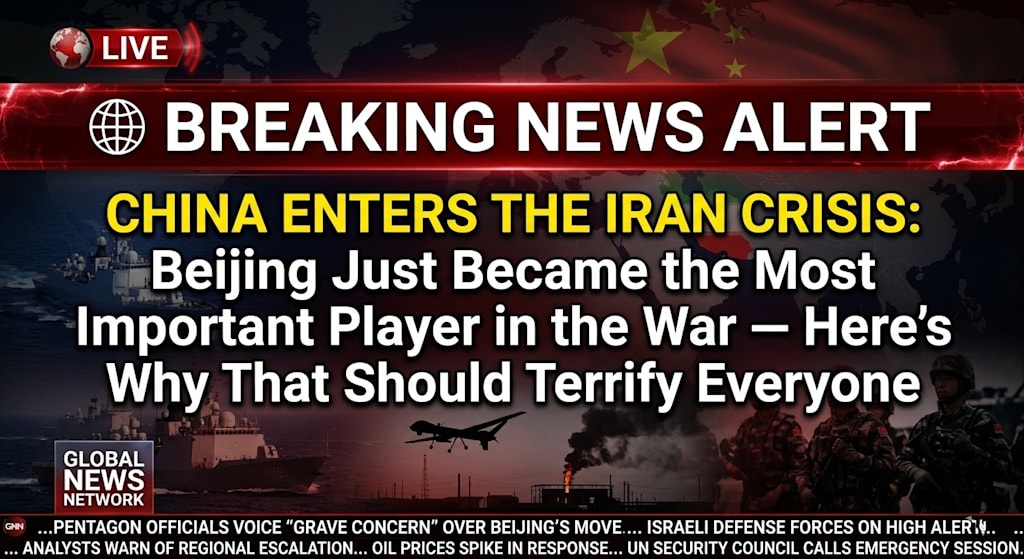
Iran’s foreign minister flew to Beijing. Trump is heading to Xi’s door next week. And the country that buys 90% of Iran’s oil now holds the key to whether the world’s biggest energy crisis ends — or explodes.
For weeks, the U.S.-Iran war has been understood primarily as a bilateral conflict — Washington and Tel Aviv versus Tehran, playing out across the Strait of Hormuz, the skies of the UAE, and the negotiating back-channels of Pakistan. But on Wednesday, that frame shattered. Iran’s Foreign Minister Abbas Araghchi flew to Beijing and met with Chinese Foreign Minister Wang Yi — the first time since the war began that a senior Iranian official has made such a trip. China, the sleeping giant of this conflict, has stepped into the arena.
Iran’s Foreign Minister Abbas Araghchi met with his Chinese counterpart Wang Yi in Beijing on Wednesday morning, the official Xinhua news agency reported. It was the first time since the start of the war that Araghchi had traveled to China, whose close economic and political ties to Tehran give it a unique position of influence.
The timing is not coincidental. Trump is scheduled to travel to Beijing next week to meet with President Xi Jinping — a trip that looms as one of the most consequential diplomatic encounters of 2026. Before that meeting, both sides are maneuvering to shape the narrative and the leverage dynamics. China wants to enter the Trump-Xi summit as a peacemaker, not merely as an economic adversary. Iran wants to ensure that Beijing’s influence is deployed in Tehran’s favor, not against it. And Washington wants Beijing to use its considerable leverage over Iran — as its largest oil customer and diplomatic shield at the UN Security Council — to push Tehran toward a deal.
China’s foreign minister told Iran’s foreign minister that the U.S. and Iran need to agree to a comprehensive ceasefire. He also reaffirmed China’s position that Tehran has the right to pursue nuclear energy. That second statement is significant: it draws a line that China will not cross, signaling to Washington that Beijing will not support any deal that requires Iran to completely abandon its nuclear program. This is the fundamental tension at the heart of any potential peace agreement.
A Middle East expert from the International Institute for Strategic Studies noted that China could play an important role through the leverage it holds over Iran — not only as Iran’s principal customer of oil, but as one of the two nations that shield Iran at the UN Security Council. However, the expert also noted China may have an interest in seeing the U.S. “sink deeper” into the conflict. That ambiguity — China as potential peacemaker versus China as strategic beneficiary of American overextension — is what makes Beijing’s role so deeply uncertain and so consequential.
The economic stakes are enormous. Iran’s closure of the Strait of Hormuz has driven global oil prices to levels that are damaging economies worldwide, including China’s. Beijing has been absorbing discounted Iranian crude throughout the war through its “teapot refineries” — small, independent processors that operate outside mainstream Western trading systems. The U.S. has been targeting these refineries economically as another form of pressure on both Iran and China. The question is whether economic self-interest will ultimately push Beijing to use its leverage constructively — or whether strategic rivalry with the United States will trump everything else.
Araghchi told Wang Yi that “Iran trusts China and expects China to continue playing a positive role in promoting peace and ending conflict.” Whether Beijing chooses to honor that trust — and what price it extracts in return — may be the single most consequential diplomatic question of the next two weeks.
About the Creator
Enjoyed the story? Support the Creator.
Subscribe for free to receive all their stories in your feed.
Comments
There are no comments for this story
Be the first to respond and start the conversation.