
Chemical Warehousing Market Reshaping Global Supply Chains
Chemical Warehousing trends transforming industrial storage and logistics operations worldwide
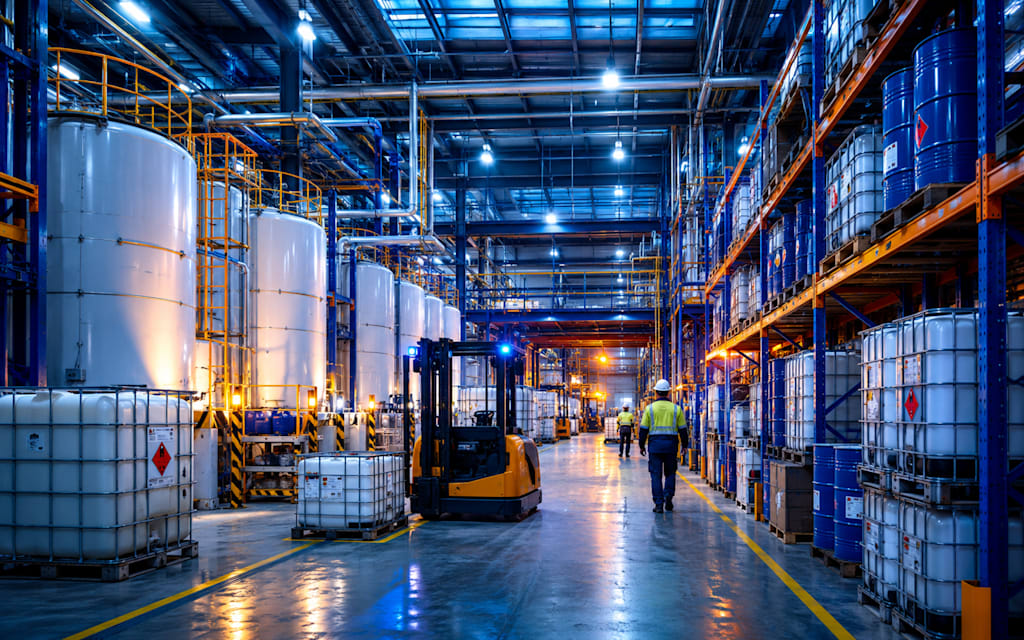
A sharp chemical odor drifted across the loading dock as workers in reflective suits moved barrels through temperature-controlled storage lanes. Inside modern chemical warehouses, every movement is timed, monitored, and tracked because one mistake can halt an entire supply chain. Across manufacturing, agriculture, pharmaceuticals, and energy sectors, the demand for safer and faster chemical storage is quietly becoming one of the biggest industrial priorities worldwide.
The pace of industrial production is pushing logistics operators to rethink storage infrastructure. Companies handling hazardous and specialty chemicals are investing in automated inventory systems, fire-resistant storage designs, and smart compliance technologies to reduce risk while improving operational efficiency. This shift is rapidly turning chemical warehousing into a strategic backbone for industrial growth rather than a simple storage function.
Chemical Warehousing Expanding with Industrial Demand
Industrial supply chains are becoming increasingly dependent on specialized storage facilities capable of handling hazardous, liquid, and temperature-sensitive chemicals. Warehouses are no longer passive storage points. They now function as intelligent distribution hubs designed for safety, regulatory compliance, and rapid transportation management.
The growing complexity of industrial operations is directly influencing the Chemical Warehousing Industry across multiple regions. Manufacturing facilities require faster movement of raw materials, while exporters need strategically located storage centers near ports, highways, and industrial corridors. As industrial production expands in Asia-Pacific, North America, and Europe, warehouse operators are adapting to rising safety and handling standards.
According to Mordor Intelligence, the market is experiencing notable expansion as industrial activity increases worldwide. The Chemical Warehousing Market Size is expected to increase from USD 91.20 billion in 2025 to USD 97.32 billion in 2026 and reach USD 122.29 billion by 2031, growing at a CAGR of 4.67% over 2026-2031.
This growth reflects rising investments in specialized infrastructure, including climate-controlled facilities, spill containment systems, and automated monitoring technologies. Warehousing companies are also integrating digital tracking tools that help businesses monitor inventory movement in real time while improving operational transparency.
Mobile-friendly content sections, visual dashboards, and warehouse automation videos are increasingly being used online to explain these industrial transformations to wider audiences. Modern logistics content is attracting strong search interest from businesses researching safe chemical storage solutions and future industrial supply chain trends.
Chemical Warehousing Operations Becoming Technology Driven
Inside advanced storage facilities, sensors continuously track temperature, humidity, and pressure conditions. Artificial intelligence systems are helping warehouse managers predict inventory movement and detect safety risks before incidents occur. These technologies are reshaping global logistics operations and reducing the margin for human error.
The increasing use of automation is contributing significantly to Chemical Warehousing Market Growth as businesses prioritize efficiency and regulatory compliance. Automated guided vehicles, robotic pallet systems, and AI-powered warehouse management software are helping companies reduce downtime while improving safety standards.
Sustainability is also becoming a major discussion point across industrial logistics. Chemical warehouses are introducing energy-efficient cooling systems, solar-powered infrastructure, and environmentally compliant waste management practices. Governments and industrial regulators are encouraging operators to modernize aging facilities to meet stricter environmental standards.
The rise of e-commerce in industrial procurement is creating additional pressure on logistics providers to deliver chemicals faster and with greater inventory accuracy. Warehouses capable of offering integrated transportation, customs handling, and digital documentation services are gaining stronger competitive positioning in the global market.
Industry analysts are also observing increased partnerships between chemical manufacturers and third-party logistics providers. Outsourcing warehousing operations allows manufacturers to focus on production while logistics specialists handle compliance, transportation coordination, and inventory security. This transition is creating long-term opportunities for technologically advanced warehouse operators worldwide.
Chemical Warehousing Becoming A Strategic Industrial Asset
Chemical storage facilities were once viewed as background infrastructure hidden behind factories and shipping ports. Today, they are becoming central decision-making hubs within global supply chains. Businesses are prioritizing warehouses capable of balancing safety, speed, sustainability, and digital efficiency under one integrated system.
The growing demand for specialized logistics services is influencing the Chemical Warehousing Market Share among regional and international operators. Companies investing aggressively in automation, regulatory compliance, and strategic warehouse locations are strengthening their competitive positions across industrial sectors.
Rapid industrialization, increasing global trade activity, and stricter chemical handling regulations are expected to sustain long-term demand for advanced warehousing infrastructure. Facilities equipped with smart monitoring systems and integrated transportation capabilities are likely to become essential for modern manufacturing ecosystems.
At the same time, labor shortages and rising operational costs are forcing warehouse operators to accelerate digital transformation strategies. Businesses that fail to modernize may struggle to meet evolving customer expectations surrounding speed, traceability, and environmental compliance.
As industrial supply chains continue evolving, chemical warehousing is emerging as one of the most important support systems behind global production and trade. The facilities quietly operating behind factory gates today may ultimately shape the future reliability of worldwide industrial commerce.
Which warehouse innovation do you think will transform industrial logistics the most over the next decade—automation, sustainability, or AI-driven safety systems?
About the Creator
Enjoyed the story? Support the Creator.
Subscribe for free to receive all their stories in your feed.
Comments
There are no comments for this story
Be the first to respond and start the conversation.