
Chandler Parsons Blamed a 2017 Knee Injury on a 2015 Shoe. The Timeline Says No.
Anta paid him more than the Rockets did. He repaid the brand with a story that falls apart at the dates.
The dates first
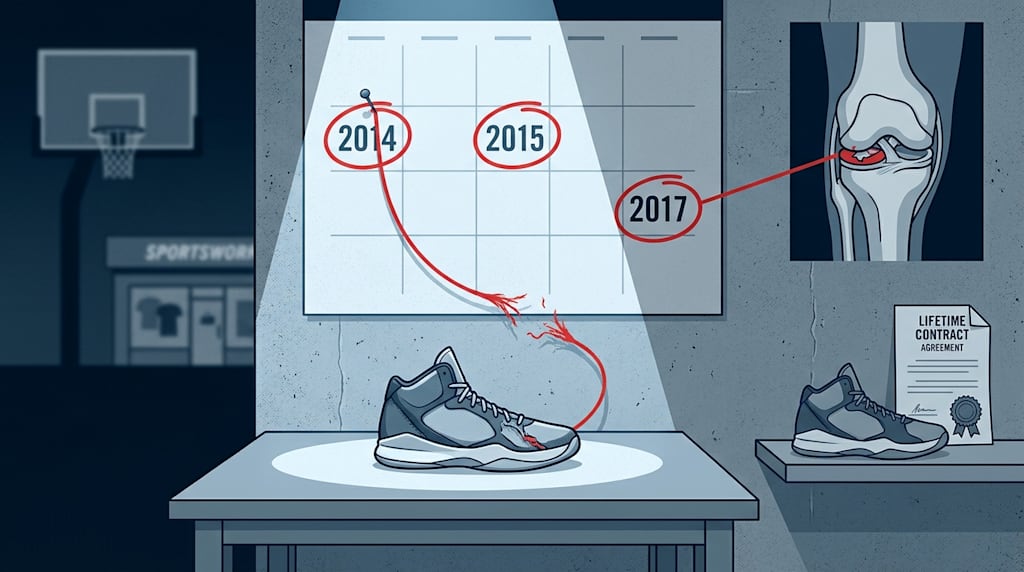
In February 2014, Anta announced the signing of Chandler Parsons. Multiple reports put the deal at five years and $5 million, about $1 million a year.
That same year, Parsons was on a four-year, $3.7 million rookie contract with the Rockets, about $925,000 a year. Anta paid him more in endorsement money than he made as a player. The premium came from the Chinese market dividend left by the Yao Ming era with the Rockets. Anta recognized that value. Parsons benefited from it.
In March 2015, after missing seven games with a left ankle sprain and bone bruise, Parsons returned in Air Jordan 10s. Reports at the time said Anta knew and agreed. Anta was also adjusting his signature shoe, the CP1, based on his feedback. Parsons said he wanted the shoe to be “a little stiffer” to protect his ankle.
The partnership continued. The shoe was still being adjusted. He was wearing another brand on court.
In March 2017, Parsons was diagnosed with a partial tear of the left meniscus. He had surgery and missed the rest of the season. That was two years after he switched to AJ and three years after he signed with Anta. By then he had long stopped wearing Anta shoes in games.
In April 2024, Parsons said on a podcast that Anta’s shoes “were terrible” and were one of the reasons for his knee injury.
A two-year gap in the story
A 2017 meniscus tear cannot be pinned on shoes he stopped wearing in games in 2015 without explaining the two years in between. For those two years, he wore AJ. What happened to his knees during that stretch, how much load they carried, whether he had other injury history: the podcast did not say.
Attribution needs a chain: a product defect, exposure time, medical causation, and exclusion of other variables. Parsons offered a conclusion. He did not offer the chain. He said “one of the reasons.” That phrase leaves room to retreat. Room to retreat is not evidence.
Two people date for a year and break up. Three years later, one of them holds a newborn and insists it is the ex’s child. The timeline does not fit. A sincere story still does not stand.
Klay Thompson is the counterexample
Klay Thompson signed with Anta in 2014, a few months after Parsons. He has kept the partnership for more than a decade and signed a lifetime endorsement deal in February 2026.
A lifetime contract proves only that one player and one brand found a durable fit. If Anta shoes had widespread and serious defects, that durable fit would be hard to explain.
Individual differences exist. Parsons had personal preferences about shoe shape and stiffness. That is normal. The brand allowed him to switch to another brand at the time and adjusted his shoes based on his needs. He did fail to adapt, and that is normal. The problem starts when he reclassified a fitting problem as an injury cause.
Those two claims sit far apart. One is about comfort. The other needs an entire evidentiary system.
Anta paid him well. That is a fact, not a guilt trip.
An average annual endorsement fee of $1 million was higher than his rookie salary with the Rockets. The contract relied on the Rockets’ popularity in China and the dividend left by the Yao Ming era. Other brands might not have offered that money. They might not have been able to.
Commercial partnerships benefit both sides. When a partnership ends, each side goes its own way. That is normal. Public figures still have post-contract brand-protection obligations. They do not have to praise the brand forever. They cannot fabricate or spread false information to disparage a former partner.
Lawyers’ analyses point the same way. Even if the main contract has expired, Anta can still assert rights under post-contract obligations if the remarks are false and disparaging. It can also claim damage to reputation directly. Whether to sue is Anta’s choice. “The contract expired” does not mean “you can say whatever you want.”
The damage goes beyond Anta
Parsons may no longer get big deals. Small ones still exist. Any commercial partner who sees how he treats a former paymaster will think one step further. If he can do this to Anta today, he can do it to them tomorrow.
The business world can survive declining ability. It cannot survive unpredictable betrayal. When a public figure packages his injuries, career decline, and shrinking commercial value into a narrative of “the brand ruined me,” few partners will hand him another contract.
Anta was a tolerant partner for years. It knew and agreed when he switched to AJ. It adjusted his signature shoes based on his needs. It did not tear off the mask during the contract. Years later, he tore it off anyway. Set aside whether the gap was as he described. The attribution itself, a 2017 injury blamed on a 2015 shoe, has moved from professional conduct into malicious smearing.
Criticism is fine. Fabrication is not.
Parsons can criticize shoes that did not fit him. His injuries were real. His career decline was real. Those facts deserve sympathy.
Sympathy cannot replace facts. Pain cannot become a license to fabricate.
Signed in 2014. Knowingly switched to AJ in 2015. Meniscus tear in 2017. The timeline sits in plain view. Any narrative that blames Anta for his knee injury must answer one question first: how could a shoe he stopped wearing in games in 2015 cause an injury in 2017?
If that question has no answer, the claim turns product criticism into malicious attribution. It stops being a complaint about fit and becomes a false charge against a former partner.
Whether Anta pursues accountability is a legal and commercial choice. Observers can still see the factual problem. The story of ingratitude raises a moral question. It also raises a factual one. The facts sit on the other side of this timeline.
About the Creator
Jin
Writer of reamstories
https://reamstories.com/jin
Enjoyed the story? Support the Creator.
Subscribe for free to receive all their stories in your feed. You could also become a paid subscriber, letting them know you appreciate their work.
Comments
There are no comments for this story
Be the first to respond and start the conversation.