
Ceuta Migration Crisis Fuels Online Disinformation Campaign Targeting Spain, Al Jazeera Investigation Finds
An Al Jazeera open-source investigation says the humanitarian emergency in Ceuta rapidly evolved into an online influence campaign, with Israeli-linked accounts amplifying political narratives, AI-generated content, and inflammatory messaging aimed at Spain.

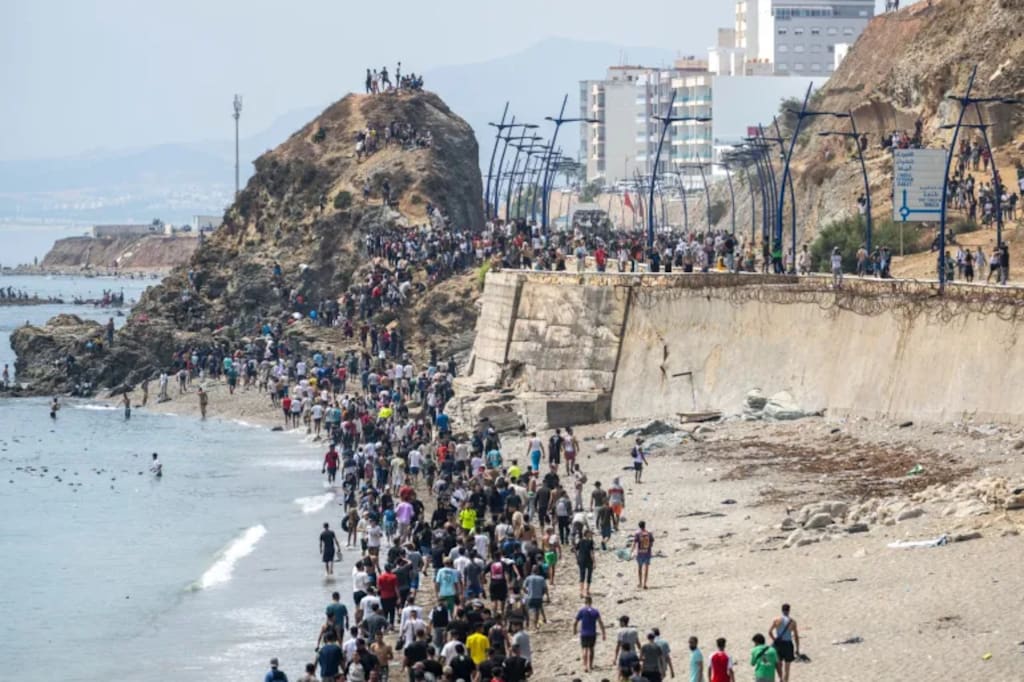
Only hours after Spanish authorities declared a state of emergency in the North African enclave of Ceuta following a sudden influx of migrants, Madrid blamed the crisis on misleading rumors spread by human trafficking networks. According to Spanish officials, those networks exploited a recent ruling by Spain's Supreme Court to falsely convince migrants that they could enter Ceuta and remain legally on Spanish territory.
However, an investigation by Al Jazeera's Open Source Unit argues that the online information environment surrounding the crisis quickly expanded beyond migration-related misinformation. As the situation at the border intensified, the humanitarian emergency also became the focus of a broader digital influence campaign in which Israeli-affiliated accounts allegedly sought to reshape public debate around immigration, European security, and Spain's foreign policy.
According to the investigation, these accounts did not merely report developments from Ceuta. Instead, they amplified selected videos, reframed events through political narratives, and circulated provocative messaging designed to fuel polarization inside Spain while taking advantage of the rapid spread of content across social media platforms.
The report suggests that the online campaign extended beyond the migration crisis itself, portraying the unfolding events as political retribution against Spain because of its positions on the Palestinian issue in recent years, which have often differed from those of several other European governments.
Coordinated Online Activity
Al Jazeera's Open Source Unit documented what it described as unusually intense activity from both well-known Israeli social media personalities and anonymous accounts. According to the report, these accounts promoted images, videos, and AI-generated content portraying Ceuta as descending into complete chaos, with the apparent objective of influencing European public opinion and reinforcing anti-immigration narratives.
The investigation raises a central question: were these online activities simply opportunistic attempts to capitalize on a fast-moving news event, or do they reflect an informal effort to pressure Madrid over its foreign policy choices, particularly regarding the Israeli-Palestinian conflict?
Diplomatic Remarks Spark Debate
The report identifies Israeli Ambassador to the United Nations Danny Danon as one of the first prominent figures to enter the debate. In a post on X, Danon criticized Spain, arguing that a country which "never misses an opportunity to lecture Israel" should first explain why it still maintains what he described as colonial enclaves in Africa before criticizing others.
According to Al Jazeera, Danon's post accumulated more than 10 million views within a short period, making it a major catalyst for the online discussion.
Soon afterward, Dana Erlich, representing the Israeli Embassy in Madrid, issued a statement in both Spanish and English emphasizing that the embassy was closely monitoring developments in Ceuta while stressing that Danon's remarks did not represent the official position of the State of Israel.
Spain's initial official response remained brief. Transport Minister Óscar Puente commented that "things are becoming quite clear," a statement widely interpreted as an indirect reference to Israeli involvement in the growing online controversy.
Meanwhile, Israeli National Security Minister Itamar Ben-Gvir posted a provocative message congratulating Spanish Prime Minister Pedro Sánchez for his commitment to what he called "human diversity," suggesting that Spain should demonstrate that commitment by welcoming residents of Gaza wishing to migrate.
"Free Ceuta" Campaign Gains Momentum
As online discussions intensified, Al Jazeera documented widespread promotion of the hashtag #FreeCeuta, which appeared across dozens of accounts displaying Israeli flags or pro-Israel imagery.
One account operating under the name "Lions of Zion" called for what it described as ending Spain's "occupation" of Ceuta. Other users sarcastically proposed applying a "two-state solution" to Spain itself, borrowing terminology normally associated with the Israeli-Palestinian conflict and repurposing it for political satire.
The messaging went beyond slogans. Some accounts warned of an alleged "massacre" or "genocide" against Moroccan migrants, while others urged the international community not to remain silent if Spanish security forces expanded operations in Ceuta.
At the same time, the repeated use of the word "invasion" echoed rhetoric frequently employed by anti-immigration movements across Europe.
Notably, the "two-state solution" narrative was also promoted by Hananya Naftali, the former digital media adviser to Israeli Prime Minister Benjamin Netanyahu. In one post, Naftali declared his support for "a two-state solution in Spain," proposing one sovereign state for Spain and another for what he described as "peaceful migrants."
He also sarcastically called for an immediate ceasefire between Spanish security forces and migrants, mimicking language commonly used during armed conflicts.
Because of Naftali's prominence among pro-Israel online audiences, Al Jazeera argues that his participation elevated the campaign beyond anonymous social media accounts and connected it to figures with close ties to Israeli political circles.
Shared Visual Narratives
The investigation also identified recurring visual material distributed across multiple accounts. Among the most widely shared was a common map accompanied by calls to "liberate Andalusia" and return what posters described as "occupied lands" to Arab Muslims, effectively reversing the language typically associated with discussions of territorial occupation.
Other posts drew comparisons with Egypt's fortified border around Gaza, suggesting that Spain should adopt similar border control measures.
Claims of Political Retribution
One of the most widely circulated posts came from Israeli researcher and commentator Eddie Cohen. He directly linked the Ceuta migration crisis to an earlier incident during Spain's San Fermín festival in Pamplona, where demonstrators displayed a banner calling for the destruction of Israel.
According to Al Jazeera, Cohen portrayed the developments in Ceuta as a form of punishment for Spain's support of the Palestinian cause. He also referenced Spain's historical expulsion of Jews during the Spanish Inquisition, suggesting that the country's current demographic challenges represented the consequences of its political choices rather than an isolated humanitarian crisis.
The post gained additional traction after being reshared by the unofficial account "Mossad International," which accompanied the message with comments implying that Israel had been watching events unfold and that "the time has come for Spain to pay the price."
Other accounts echoed similar themes, accusing Spain's socialist government of betraying Europe, undermining the West, and turning against the United States. Many repeated the same central message: that Spain's migration crisis should be viewed as the political cost of its international positions.
AI-Generated Videos Amplify the Narrative
The campaign extended beyond text posts and static images. According to the investigation, Israeli-affiliated accounts widely shared AI-generated videos that collectively attracted more than 15 million views.
Many of these videos originated from an account known as "Dr. Clown, PhD," a satirical political profile focused on criticizing mass immigration and progressive policies.
The AI-generated clips depicted exaggerated scenes suggesting that Spanish authorities had abandoned control of Ceuta, portraying police officers as passive while migrants entered the city unchecked. Other videos mocked Prime Minister Pedro Sánchez personally.
The material was subsequently reposted by numerous Israeli accounts, accompanied by reactions ranging from sarcastic Hebrew-language comments to multilingual posts linking Spain's situation to broader debates over migration across Europe.
Evidence of Coordination
Al Jazeera concludes that the campaign involved two distinct categories of participants. The first consisted of identifiable public figures, media personalities, and openly pro-Israel accounts carrying recognizable ideological branding.
The second group included smaller, less prominent accounts displaying remarkably similar posting patterns, identical hashtags, and nearly identical wording. According to the report, these similarities strongly suggest some degree of coordination or centralized message synchronization.
The investigation identifies three recurring themes throughout the campaign. First, the appropriation of terms such as "occupation," "liberation," and "two-state solution" from the Israeli-Palestinian conflict and their ironic application to Spain. Second, the framing of the migration emergency as symbolic punishment for Madrid's diplomatic positions. Third, repeated references to historical events such as the Spanish Inquisition and the expulsion of Jews, adding emotional historical symbolism intended to increase engagement.
Between official diplomatic statements, coordinated multilingual messaging, and AI-generated visual content, Al Jazeera concludes that the humanitarian crisis in Ceuta rapidly evolved into a testing ground for digital disinformation and political influence operations, demonstrating how real-world emergencies can be repurposed online to advance broader geopolitical narratives.
About the Creator
Sahby Mehalla
Marketing Consultant | Independent Journalist | Writing on Medium
Pure intention transforms sound into a message. 🇩🇿
Enjoyed the story? Support the Creator.
Subscribe for free to receive all their stories in your feed.
Comments
There are no comments for this story
Be the first to respond and start the conversation.